From the free course AP United States History on Lykke
4.13 The Society of the South in the Early Republic · 4.14 Causation in Period 4
Key concepts: Society of the South in the Early Republic · Causation in Period 4 · Continuity and change over time · Indigenous enslavement and colonial violence · Haudenosaunee women and gender roles · Abolitionism and antislavery activism · Women’s reform movements · Temperance organizations · Reconstruction and its effects on race relations · Historical argumentation and evidence sorting
The early republic’s South was not simply a region where plantations existed; it was a society organized around agriculture, racial hierarchy, and coercive labor. At the same time, Americans contested slavery, Indigenous enslavement, gender expectations, and social reform—revealing how regional societies could…
4.13 The Society of the South in the Early Republic · 4.14 Causation in Period 4
The early republic’s South was not simply a region where plantations existed; it was a society organized around agriculture, racial hierarchy, and coercive labor. At the same time, Americans contested slavery, Indigenous enslavement, gender expectations, and social reform—revealing how regional societies could preserve older structures while developing new identities.
CED traceability: Topic 4.13, The Society of the South in the Early Republic; Topic 4.14, Causation in Period 4. Related AP themes include SOC (Social Structures), GEO (Geography and the Environment), POL (Politics and Power), and CUL (Culture).
A southern society built on hierarchy
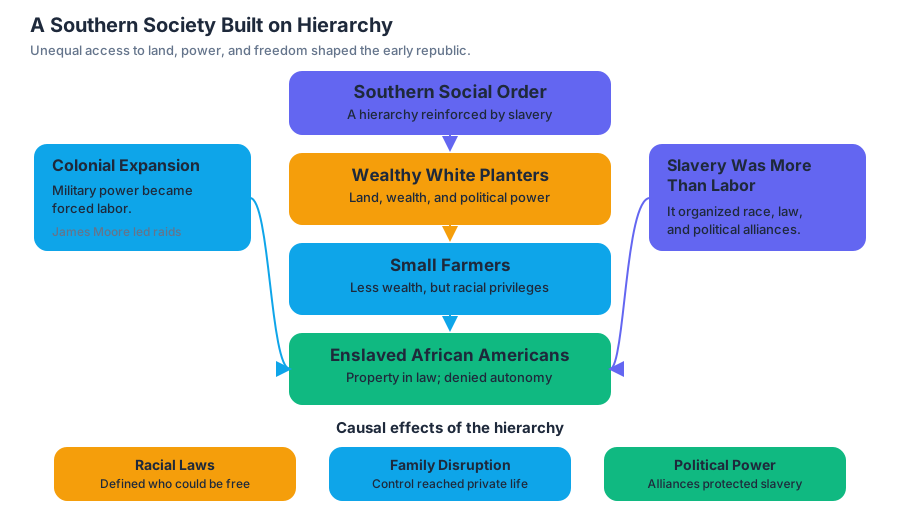
The South’s social order rested on unequal access to land, political power, and personal freedom. Wealthy white planters occupied the highest position; small farmers and landless white people held less economic power but were still granted racial privileges; enslaved African Americans were legally treated as property and denied autonomy. This hierarchy made slavery more than a labor system: it shaped law, family life, politics, and ideas about race.
Colonial violence also included the enslavement of Indigenous people. In South Carolina, Colonel James Moore led raids to capture and enslave Indigenous people, demonstrating that European and colonial expansion repeatedly converted military power into forced labor. This evidence complicates the misconception that slavery in early North America began only with the large-scale nineteenth-century cotton economy or affected only Africans.
Misconception check — “Slavery was only an economic institution.” Economic profit was central, but slavery also produced racial laws, political alliances, violence, and social definitions of freedom. A causation answer that identifies only plantation profits is incomplete; a stronger answer explains how labor exploitation reinforced an entire social order.
Gender, community, and competing worldviews
Recent scholarship on women in Haudenosaunee society challenges older portrayals that treated Indigenous communities as automatically organized according to European gender expectations. Haudenosaunee women exercised important authority within households, agriculture, and community decision-making. The larger historical point is not that every Indigenous society had identical gender roles, but that gender operated differently across cultures.
This comparison is useful because historical evidence may reveal both continuity and change over time. European colonists often attempted to impose patriarchal assumptions, while Indigenous communities maintained institutions that gave women forms of authority unfamiliar to European observers. Avoid the misconception that “women had power” means all gender inequality disappeared; historians must identify which powers women held, in which settings, and how colonial pressure altered them.
Antislavery activism and reform associations
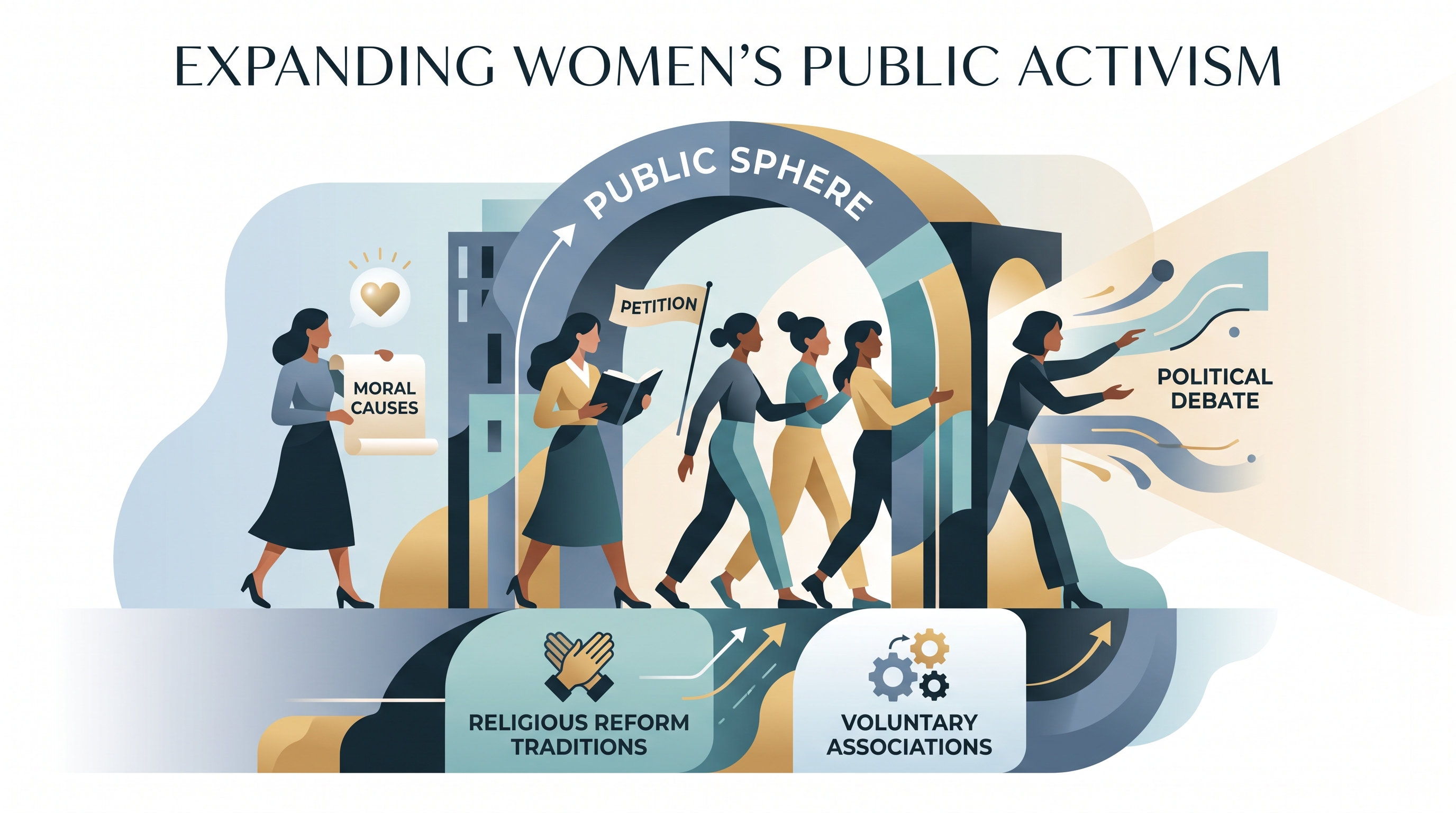
Northern opposition to slavery became increasingly organized in the early nineteenth century. The 1834 Constitution of the Boston Female Anti-Slavery Society presents an abolitionist message from northern women opposed to slavery. Its existence shows that women participated in political reform even when formal voting and officeholding were largely closed to them. They used petitions, meetings, publications, fundraising, and moral persuasion to influence public debate.
Reform organizations also developed around temperance. Martha Washington Salem Union No. 4, Daughters of Temperance, operated through a constitution and bylaws. Such documents reveal how reformers created rules, membership expectations, leadership structures, and collective discipline. The organization’s name also shows how women used respectable domestic and civic identities to claim a public role.
4.14 Causation in Period 4
Causation is the historical reasoning process of explaining why a development occurred and what consequences followed. Instead of listing events, historians identify relationships among causes, developments, and effects—while distinguishing long-term conditions from immediate triggers and intended effects from unintended ones.
A useful model is Reconstruction, although Reconstruction belongs primarily to Period 5. Its short-term successes changed race relations in the defeated South through emancipation’s enforcement, expanded African American political participation, and constitutional protections. Reconstruction also shifted the balance of power between Congress and the presidency, especially during conflicts over the treatment of the former Confederate states.
To build a causal explanation, sort effects under relevant themes and explain the sorting choice:
| Historical effect | Theme | Why the classification fits |
|---|---|---|
| Expanded African American citizenship and political participation | SOC | It changed relationships among racial groups and the meaning of membership in society. |
| Congressional direction of Reconstruction policy | POL | It altered the distribution of authority between Congress and the president. |
| Federal enforcement in the South | POL / SOC | Government power directly affected social relations and civil rights. |
The same method applies to Period 4. For example, reform activism grew from religious revivalism, voluntary associations, print culture, and dissatisfaction with social problems. Those causes produced abolitionist and temperance campaigns, but the campaigns also exposed limits: reformers challenged slavery while sometimes relying on gendered ideas about moral authority.
Worked causal example
Question: Why did women’s antislavery organizations become influential despite women’s limited formal political rights?
Reasoning: First, identify the condition: women generally lacked voting rights and officeholding. Next, connect causes: religious reform traditions and voluntary associations gave women organizational networks; abolitionism supplied a moral issue that could be discussed through petitions and public statements. Finally, explain the effect: groups such as the Boston Female Anti-Slavery Society entered political debate indirectly, helping expand the boundaries of women’s public activism.
This example develops AP Historical Thinking Skill 1: Developments and Processes, especially identifying patterns of continuity and change; Skill 3: Claims and Evidence in Sources, by using the 1834 constitution as evidence; Skill 4: Contextualization, by linking reform organizations to the early republic; Skill 5: Making Connections, by explaining relationships among religion, gender, and activism; and Skill 6: Argumentation, by making a defensible causal claim.
Retrieval check: How do James Moore’s raids, Haudenosaunee women’s authority, the Boston Female Anti-Slavery Society, and the Daughters of Temperance help historians see both continuity and change? A strong answer should identify one continuing pattern—organized power and social hierarchy—and one change: the expansion of collective activism and the public roles available to women and reformers.
Source Materials
- AP U.S. History Course and Exam Description
- AP U.S. History Course and Exam Description Clarifications and Corrections
- AP U.S. History Course Overview
- AP U.S. History Course at a Glance
- AP United States History Course at a Glance Poster
- AP United States History
- AP United States History
- AP United States History Sample Syllabus 1