From the free course AP United States History on Lykke
5.5 Sectional Conflict: Regional Differences · 5.6 Failure of Compromise
Key concepts: Sectional conflict between the North and South · The Compromise of 1850 · The Missouri Compromise · Popular sovereignty · Free-soil ideology · Federal versus state authority over slavery · Attempts by courts and national leaders to resolve slavery in the territories · The Kansas–Nebraska Act · The admission of Texas and its effect on sectional tensions · Industrialization and regional differences
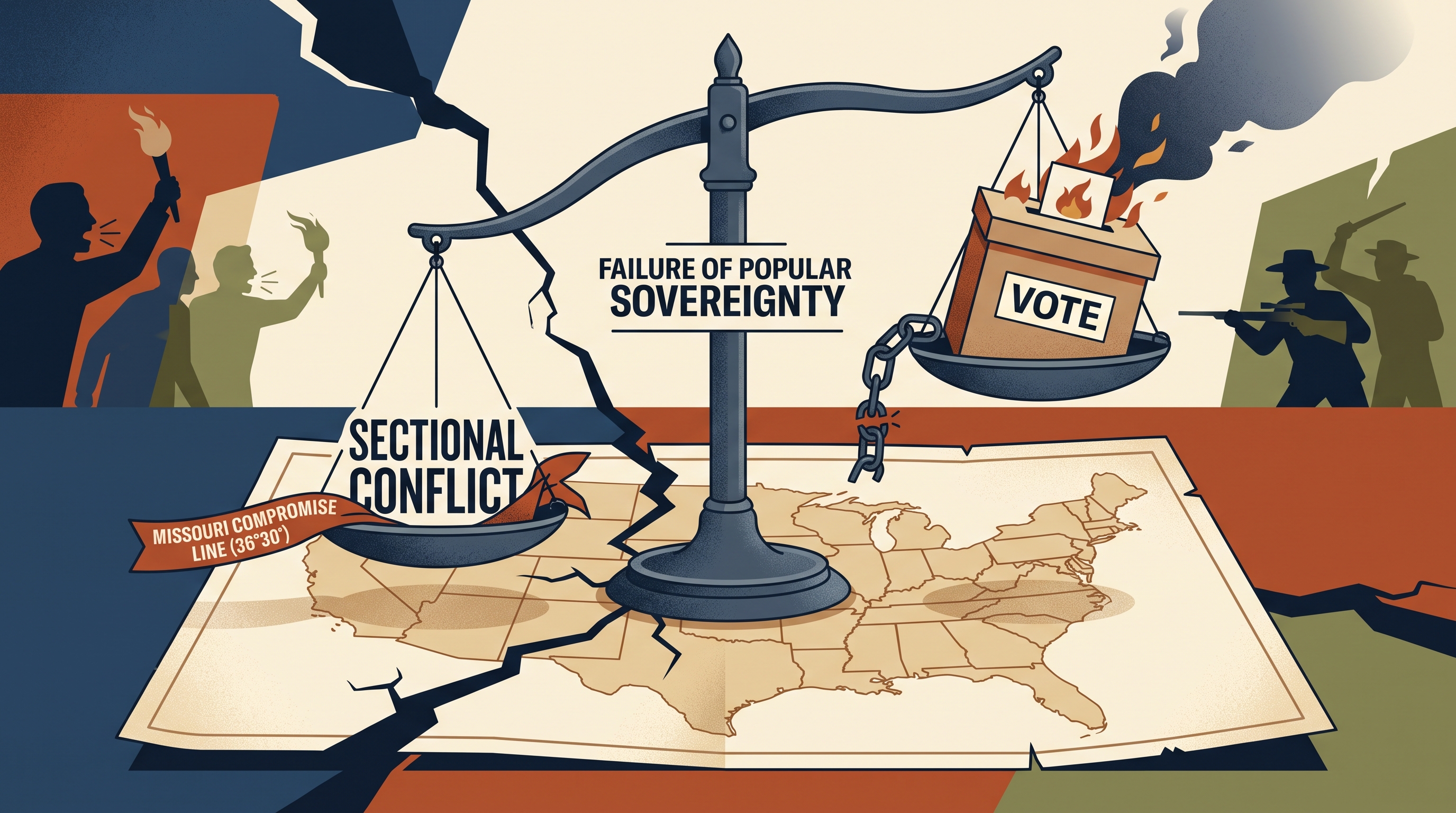
By the 1850s, the United States was arguing over a question that no compromise could permanently contain: who had the authority to decide whether slavery could expand into western territories—the federal government, territorial settlers, or the states themselves?
5.5 Sectional Conflict: Regional Differences · 5.6 Failure of Compromise
By the 1850s, the United States was arguing over a question that no compromise could permanently contain: who had the authority to decide whether slavery could expand into western territories—the federal government, territorial settlers, or the states themselves? The dispute was not only moral. It also involved political power, economic systems, constitutional interpretation, and the future balance between free and slave states.
Sectional conflict was the growing political, economic, and cultural rivalry between regions—especially the industrializing North and the plantation-based South.
Two regions, increasingly different interests
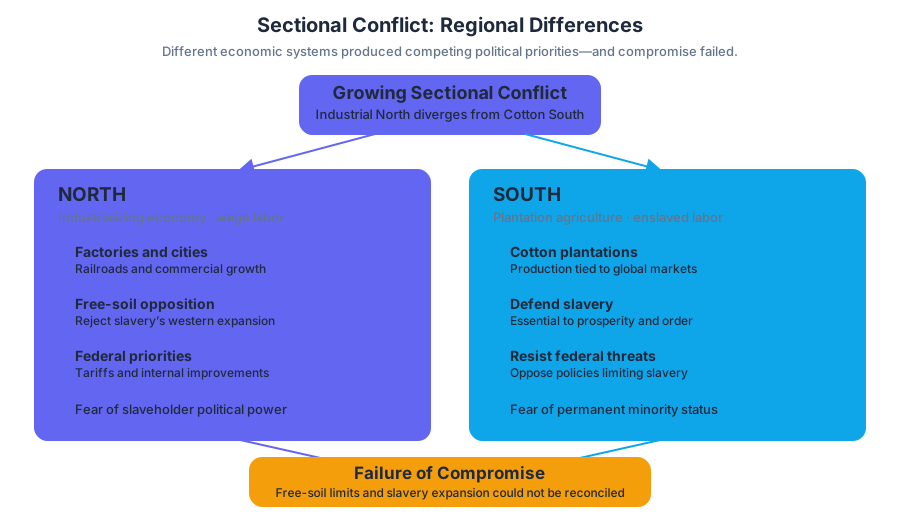
Industrialization helped widen the economic distance between the North and South. Northern states developed factories, wage labor, commercial agriculture, railroads, and expanding cities. The Southern economy remained heavily tied to cotton cultivation, plantation agriculture, and enslaved labor. These systems created different priorities: many Northern politicians favored tariffs, internal improvements, and restrictions on slavery’s expansion, while Southern leaders defended slavery and opposed federal policies they believed threatened it.
| North | South |
|---|---|
| Industrializing economy and wage labor | Plantation agriculture and enslaved labor |
| Growing cities, factories, and rail networks | Cotton production linked to international markets |
| Free-soil opposition to slavery’s expansion | Defense of slavery as essential to prosperity and social order |
| Concern about the political power of slaveholders | Concern about becoming a permanent minority in national politics |
Free-soil ideology opposed the expansion of slavery into western territories, even when its supporters did not demand immediate emancipation in the South. Many Free-Soil advocates argued that slavery threatened opportunities for white farmers and wage workers by allowing wealthy planters to dominate western land and labor. This position differed from abolitionism, which sought to end slavery, but both movements challenged Southern efforts to expand the institution.
Why the Missouri Compromise mattered later
The Missouri Compromise of 1820 admitted Missouri as a slave state and Maine as a free state while prohibiting slavery in much of the Louisiana Purchase north of latitude $36^\circ 30'$. It temporarily preserved the balance between free and slave states, but it did not settle the underlying constitutional or moral conflict.
Its deeper importance was political: the compromise treated slavery’s expansion as a problem that could be managed geographically. That solution postponed rather than resolved the issue. As the nation acquired new territory, politicians repeatedly returned to the same unresolved question, and each new settlement carried greater stakes.
Misconception check: The Missouri Compromise did not “end” the slavery debate. It created a temporary boundary and postponed the conflict until later territorial expansion made the boundary inadequate.
Texas, western territory, and the balance of power
The admission of Texas into the Union intensified sectional disagreement. Texas entered as a large slaveholding state in 1845, and its annexation raised questions about the future admission of additional slave states, the expansion of slavery toward the Southwest, and the political balance in Congress. Northern critics saw annexation as evidence that slaveholders were using national power to enlarge their influence; Southern supporters viewed it as protection for economic interests and regional security.
The Mexican–American War and the resulting Mexican Cession made the problem even more urgent. The question was no longer merely whether existing states would remain free or slave. It was whether slavery would enter territories stretching across the continent.
Compromise as a repeated strategy—and a repeated failure
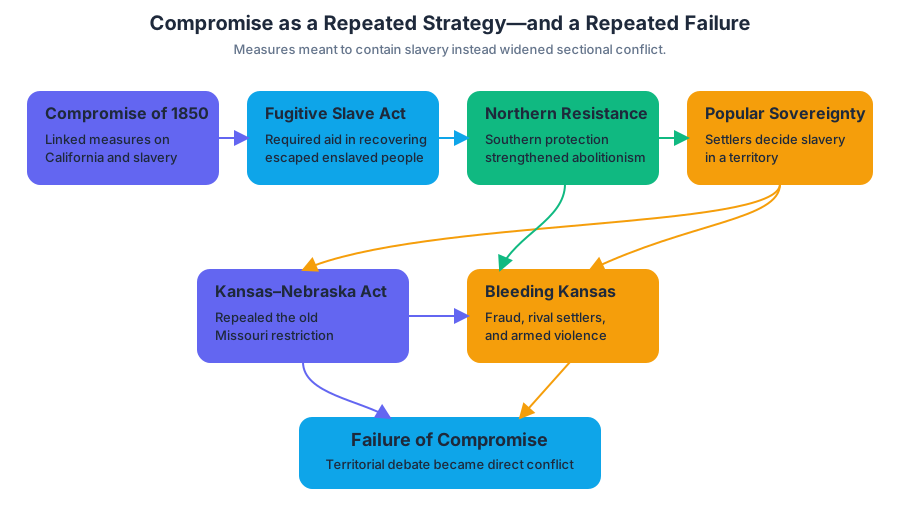
The Compromise of 1850 attempted to lower tensions through several linked measures concerning California, territorial status, slavery, and enforcement of federal law. It reduced immediate political pressure, but the Fugitive Slave Act intensified Northern opposition by requiring assistance in the recovery of escaped enslaved people. A policy designed to protect Southern interests therefore strengthened abolitionist resistance in the North.
Debates over slavery also became debates over popular sovereignty, the principle that settlers in a territory should decide whether to permit slavery. Supporters presented popular sovereignty as democratic self-government. Opponents argued that it could allow slavery to spread before a territory became a state and that enslaved people could not meaningfully participate in the decision.
The Kansas–Nebraska Act of 1854 applied popular sovereignty to territories where the Missouri Compromise had previously restricted slavery. It therefore reopened land that many Northerners believed had been reserved for free settlement. Proslavery and antislavery settlers rushed into Kansas, where fraudulent elections and armed violence produced Bleeding Kansas. Rather than settling the issue democratically, popular sovereignty transformed the territorial question into direct sectional conflict.
Federal power, state authority, and the collapse of compromise
The conflict involved competing claims about federal versus state authority. Southern leaders often argued that the federal government had a duty to protect slaveholders’ property in the territories. Northern antislavery politicians increasingly argued that Congress could restrict slavery’s expansion. Some defenders of states’ rights claimed that states could resist federal actions they considered unconstitutional, while national leaders warned that such resistance threatened the Union.
Courts and national leaders repeatedly attempted to resolve the territorial slavery issue, including through the Missouri Compromise, the Compromise of 1850, the Kansas–Nebraska Act, and the Dred Scott decision. These measures failed because each settlement addressed a procedure without resolving the central conflict: whether slavery was a legitimate national institution that could expand, or a sectional institution whose growth had to be restricted.
The key causal chain:
Economic and regional differences → disagreement over slavery’s expansion → conflict over federal authority and popular sovereignty → failed compromises → sectional parties and escalating violence.
Worked historical reasoning
Suppose a source from 1856 celebrates popular sovereignty as “the right of settlers to govern themselves.” To interpret it, apply Skill 2: Sourcing and Situation: ask who created it, when, and amid what conflict. The Kansas–Nebraska Act had recently produced violence, so the language may defend territorial self-government while minimizing the fact that competing groups were using migration, elections, and force to control Kansas.
Then apply Skill 5: Making Connections. The source connects to the failure of the Missouri Compromise because popular sovereignty replaced a clear geographic restriction with a process that reopened the controversy. A strong explanation would not merely identify the source’s topic; it would show how the policy increased sectional tension.
AP skill and identifier traceability
This topic aligns with Unit 5: Learning Objective D, “Explain the similarities and differences in how regional attitudes affected federal policy in the period after the Mexican–American War,” and Unit 5: Learning Objective G, “Explain the political causes of the Civil War.”
The required historical developments include KC-5.2.II.A, the controversy over slavery in territories acquired through the Mexican Cession; KC-5.2.II.B.i, attempts including the Compromise of 1850; KC-5.2.II.B.ii, the Kansas–Nebraska Act and Dred Scott decision and their failure to reduce conflict; and KC-5.2.II.C, the weakening of the Second Party System and emergence of sectional parties, especially the Republican Party.
Use Skill 1: Developments and Processes to trace how one compromise produced the conditions for another crisis; Skill 4: Contextualization to place each policy within territorial expansion and regional economic change; Skill 5: Making Connections to link legislation, court decisions, and political realignment; and Skill 6: Argumentation to defend the claim that compromise postponed conflict more often than it solved it. When analyzing a source, Skill 3: Claims and Evidence in Sources requires explaining how its evidence supports an interpretation rather than simply describing what it says.
Retrieval check
Why did the Kansas–Nebraska Act increase sectional conflict even though it promised democratic self-government? A complete answer should identify popular sovereignty, explain how it reopened the Missouri Compromise’s restriction, and connect the resulting violence in Kansas to broader disagreements over federal authority and slavery’s expansion.
Source Materials
- AP U.S. History Course and Exam Description
- AP U.S. History Course and Exam Description Clarifications and Corrections
- AP U.S. History Course Overview
- AP U.S. History Course at a Glance
- AP United States History Course at a Glance Poster
- AP United States History
- AP United States History
- AP United States History Sample Syllabus 1