From the free course AP United States History on Lykke
8.1 Contextualizing Period 8 · 8.2 The Cold War from 1945 to 1980
Key concepts: Period 8 of U.S. history, covering 1945–1980 · The Cold War from 1945 to 1980 · AP U.S. History periodization and exam weighting · Primary-source analysis · Formative multiple-choice and free-response questions · Economic effects of wheat production, milling, barreling, and trade · Dutch colonization and land transactions with Indigenous peoples at Fort Orange · Secession and the Civil War · American imperialism in the Philippines · Filipino self-determination
By 1945, the United States had emerged from World War II with enormous economic and military power—but victory created a new problem: how should the nation use that power in a world divided between American-led capitalism and Soviet-led communism?
8.1 Contextualizing Period 8 · 8.2 The Cold War from 1945 to 1980
By 1945, the United States had emerged from World War II with enormous economic and military power—but victory created a new problem: how should the nation use that power in a world divided between American-led capitalism and Soviet-led communism? Period 8, defined as 1945–1980, begins with that question and follows the expansion of American global leadership, the Cold War, and the domestic arguments those policies produced.
Period 8 = 1945–1980
The period begins after World War II and ends amid the political, economic, and international crises of the 1970s. It follows Period 7: 1890–1945, which includes U.S. imperialism, World War I, the Great Depression, the New Deal, and World War II.
The period as a historical problem
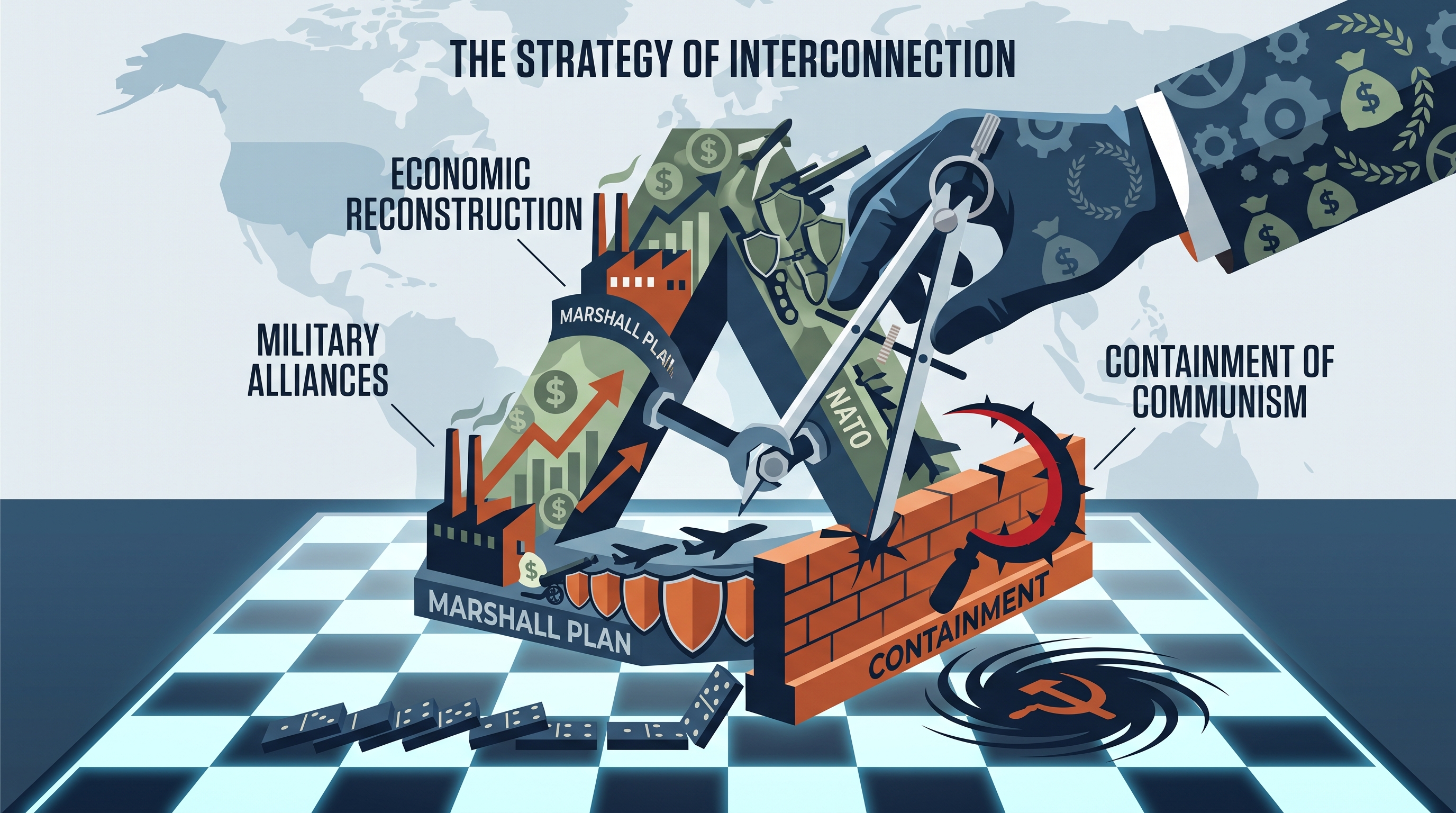
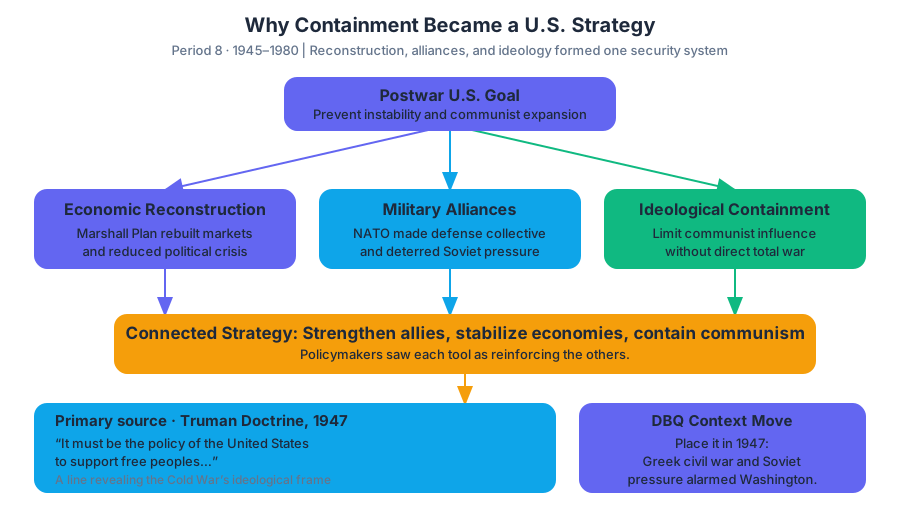
The end of World War II did not restore the older international order. Instead, the United States became a global superpower while the authoritarian Soviet Union expanded its influence across Eastern Europe and supported communist movements elsewhere. American policymakers therefore pursued three connected goals: limiting communist military and ideological influence, creating a free-market global economy, and constructing an international security system.
A useful causal map is:
World War II ends
        ↓
Power vacuum and Soviet-American rivalry
        ↓
U.S. containment policies
        ├── Economic aid and trade
        ├── Military alliances
        ├── Nuclear deterrence
        └── Political and covert intervention
        ↓
Global Cold War + domestic debates over federal power and civil liberties
CED traceability
8.1 Contextualizing Period 8 is assessed through Learning Objective 8.1, which asks students to explain the context in which the United States became a global superpower after World War II. Its essential knowledge includes KC-8.1.I, which identifies the goals of limiting Soviet power, promoting a free-market global economy, and building international security, and KC-8.1.II, which emphasizes debates over federal authority, international policy, and civil liberties.
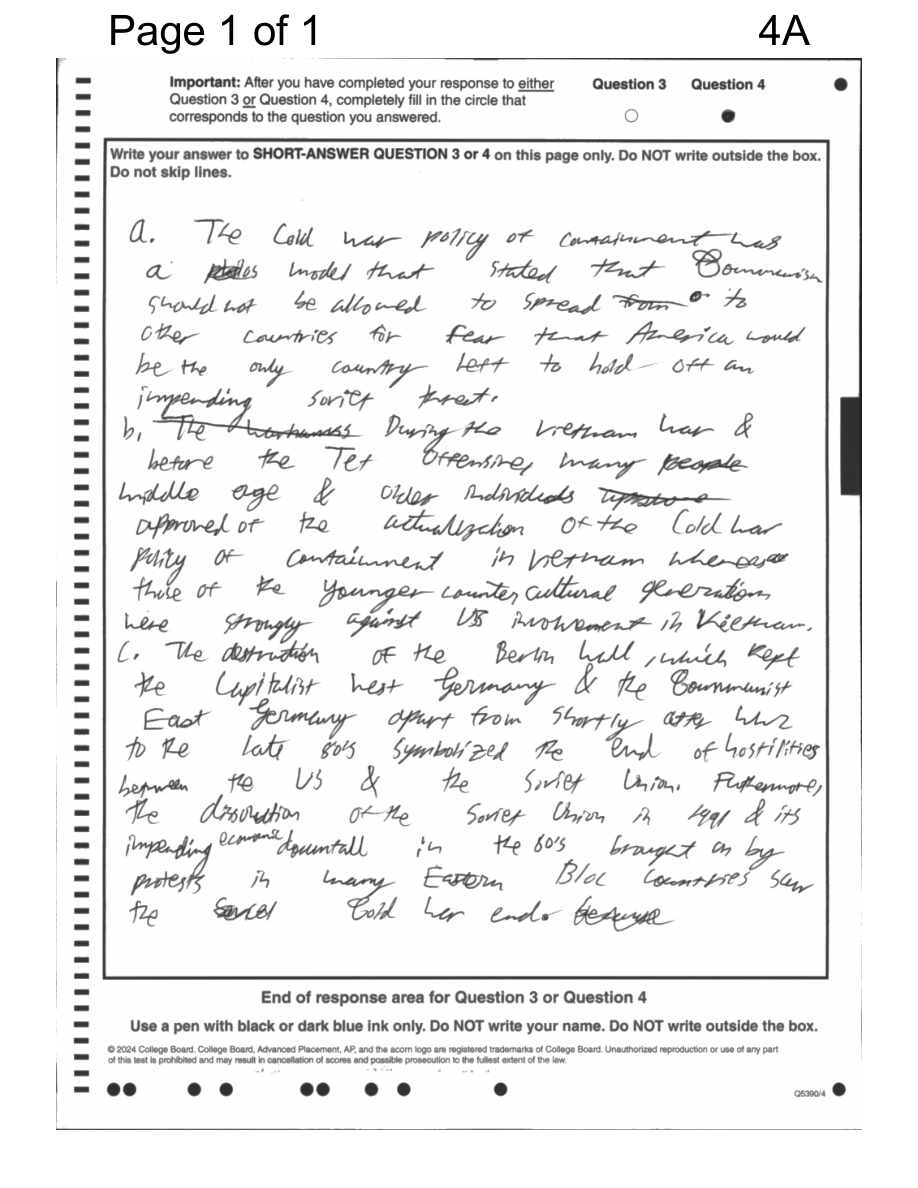
8.2 The Cold War from 1945 to 1980 develops Learning Objective 8.2, explaining the causes and effects of U.S. involvement in the Cold War. The central concept is containment—the policy of limiting the expansion of communism rather than attempting to eliminate every communist government already in existence.
From wartime alliance to Cold War rivalry
The United States and the Soviet Union had cooperated against Nazi Germany, but their partnership concealed major disagreements. The United States favored political pluralism, private enterprise, and open international markets; the Soviet Union established communist governments in Eastern Europe and sought security through a sphere of influence near its borders. The destruction caused by World War II made European reconstruction urgent, while the development of atomic weapons made rivalry potentially catastrophic.
The United States responded with a combination of economic, diplomatic, and military measures. The Truman Doctrine promised support for governments resisting communist pressure; the Marshall Plan used economic assistance to rebuild Western Europe; the Berlin airlift demonstrated American opposition to Soviet pressure on West Berlin; and the North Atlantic Treaty Organization created a collective-security alliance. The Korean War transformed containment from a largely European policy into a global military commitment.
A worked contextualization example
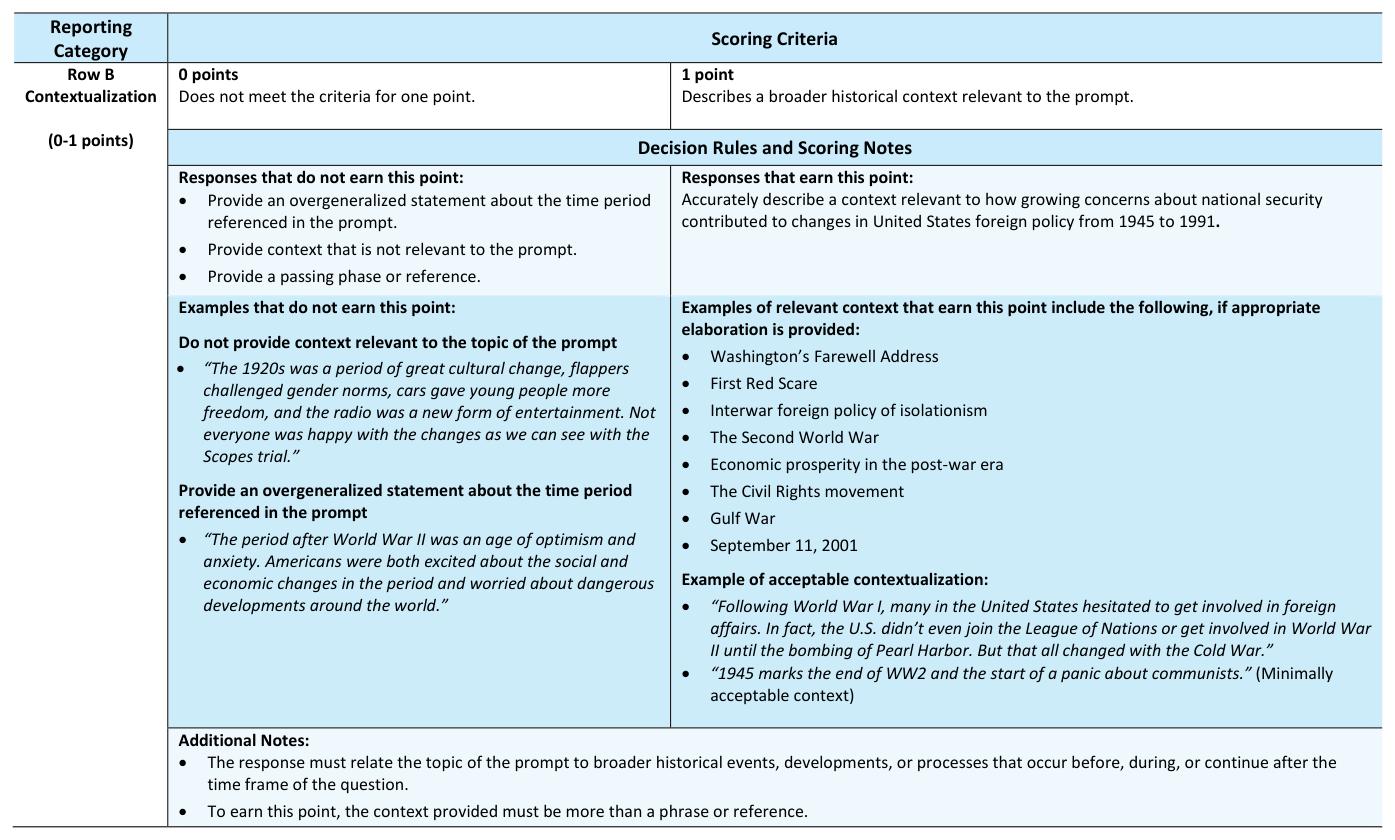
Imagine a document dated 1948 that calls for American aid to European nations threatened by communist movements. To contextualize it, do not merely write “the Cold War was happening.” Build a chain of specific background developments: World War II had devastated Europe; Soviet influence had expanded in Eastern Europe; American leaders feared both political instability and the loss of markets; and the Truman administration was adopting containment.
Strong contextualization:
“The document reflects the post–World War II rivalry between the United States and the Soviet Union. Because European economies and governments were weakened by the war while Soviet influence expanded in Eastern Europe, U.S. officials used economic reconstruction as part of a broader strategy to contain communism and organize a U.S.-led international order.”
The explanation earns its force because it identifies developments that occurred before or around the document and shows why they mattered. A list of unrelated facts is not contextualization; a connected historical setting is.
Primary-source analysis: sourcing before argument
AP historical reasoning begins with Skill 2: Sourcing and Situation. When reading a primary source, identify the author, date, audience, purpose, and historical situation—but then connect one of those features to the source’s argument. For example, Andrew Carnegie’s opposition to American imperialism in the Philippines becomes more meaningful when read alongside an open letter arguing that the United States had violated Filipinos’ right to self-determination: both sources reveal that American expansion generated arguments about whether national power was consistent with democratic principles.
Those earlier debates provide useful context for Period 8 because Cold War policy revived the same tension: could the United States defend freedom abroad while limiting choices—or civil liberties—at home? A document’s date, therefore, is not decoration. It can show whether an argument arose during imperial expansion, wartime mobilization, or postwar superpower rivalry.
Historical connections and common traps
Skill 4: Contextualization connects Period 8 to earlier developments. The Dutch agent at Fort Orange, instructed to purchase land from Indigenous people and manage Dutch colonists, illustrates an earlier pattern in which overseas expansion combined economic goals with colonial administration. The secession of Southern states, which precipitated the Civil War, illustrates a different pattern: political conflict over sectional power can escalate into military conflict. These examples help students recognize recurring relationships without pretending that the Cold War was identical to colonialism or the Civil War.
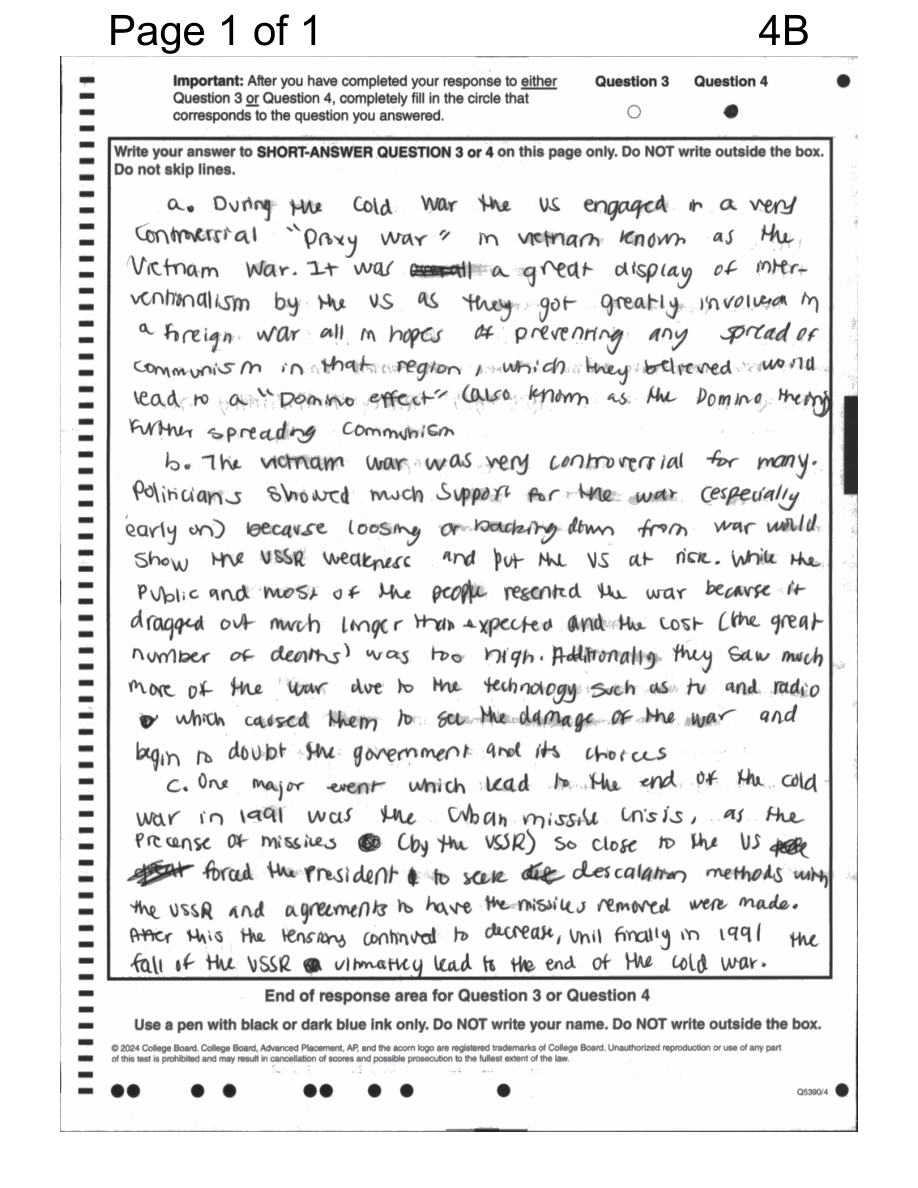
Misconception check — “The Cold War was not a real war.” It was “cold” because the United States and Soviet Union generally avoided direct full-scale war against each other, especially because nuclear weapons made such a conflict extraordinarily dangerous. Yet the rivalry produced military alliances, arms competition, espionage, covert operations, and “hot” conflicts such as Korea.
Skill 1: Developments and Processes asks students to trace how containment expanded from European recovery and diplomacy into a worldwide security strategy. Skill 3: Claims and Evidence in Sources requires using a source to support a claim rather than merely summarizing it. Skill 5: Making Connections links foreign policy to domestic debates over federal power and civil liberties, while Skill 6: Argumentation turns those connections into a defensible historical claim.
Retrieval and interpretation check
Answer without looking back: Why did American policymakers connect economic reconstruction, military alliances, and the containment of communism after 1945? Then identify one line in a primary source that supplies contextual information and explain how that line would help establish the source’s historical situation for a DBQ.
Source Materials
- AP U.S. History Course and Exam Description
- AP U.S. History Course and Exam Description Clarifications and Corrections
- AP U.S. History Course Overview
- AP U.S. History Course at a Glance
- AP United States History Course at a Glance Poster
- AP United States History
- AP United States History
- AP United States History Sample Syllabus 1
- Figure — Sample Responses - LEQ 4 - Set 1 (p. 4)
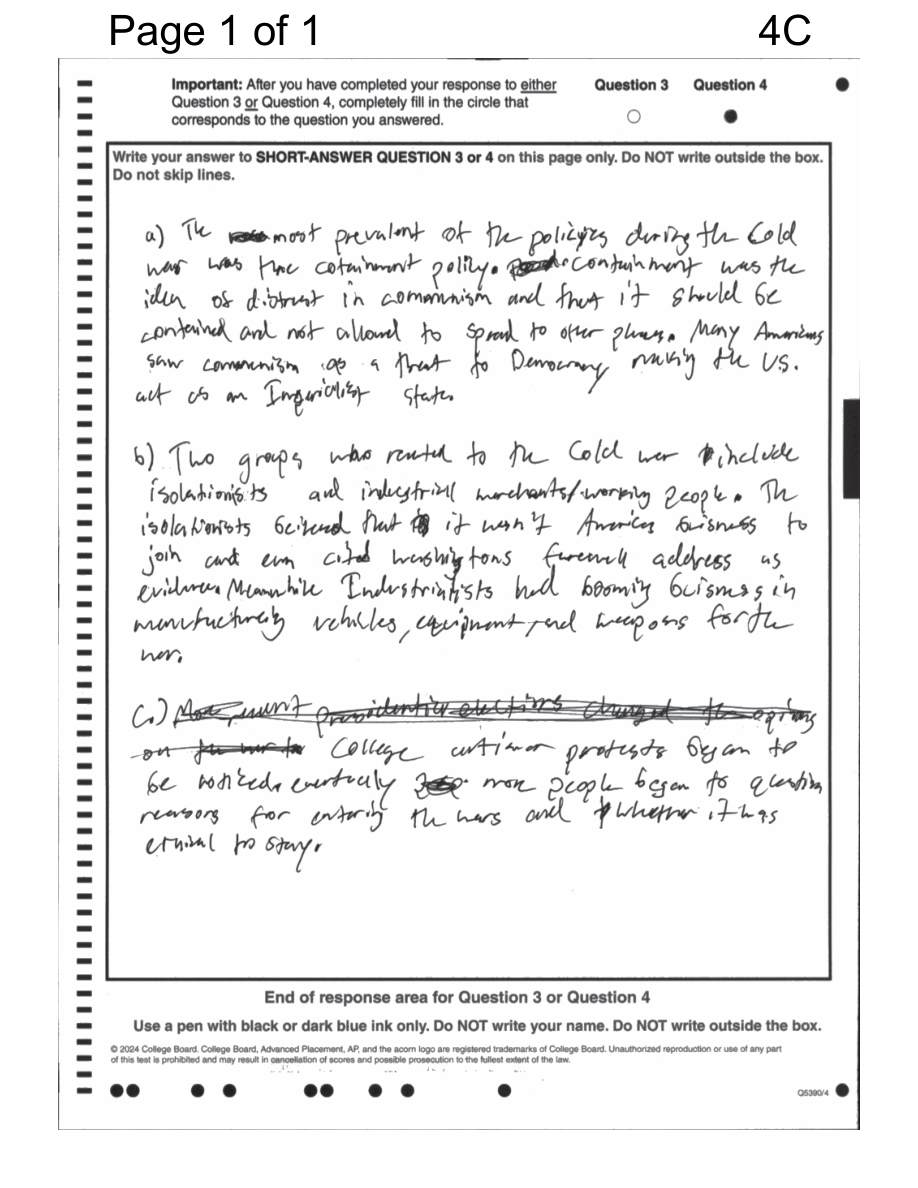
- Figure — Sample Responses - SAQ 4 - Set 1 (p. 4)
- Figure — Sample Responses - SAQ 4 - Set 1 (p. 5)
- Figure — Sample Responses - SAQ 4 - Set 1 (p. 6)