From the free course AP United States History on Lykke
3.7 The Articles of Confederation · 3.8 The Constitutional Convention and Debates over Ratification
Key concepts: Articles of Confederation · Legislative supremacy under the Articles · Property qualifications for voting and citizenship · Northwest Ordinance · Constitutional Convention · Federalism · Separation of powers · Constitutional compromises over slavery and the slave trade · Federalists and Anti-Federalists · Bill of Rights and ratification
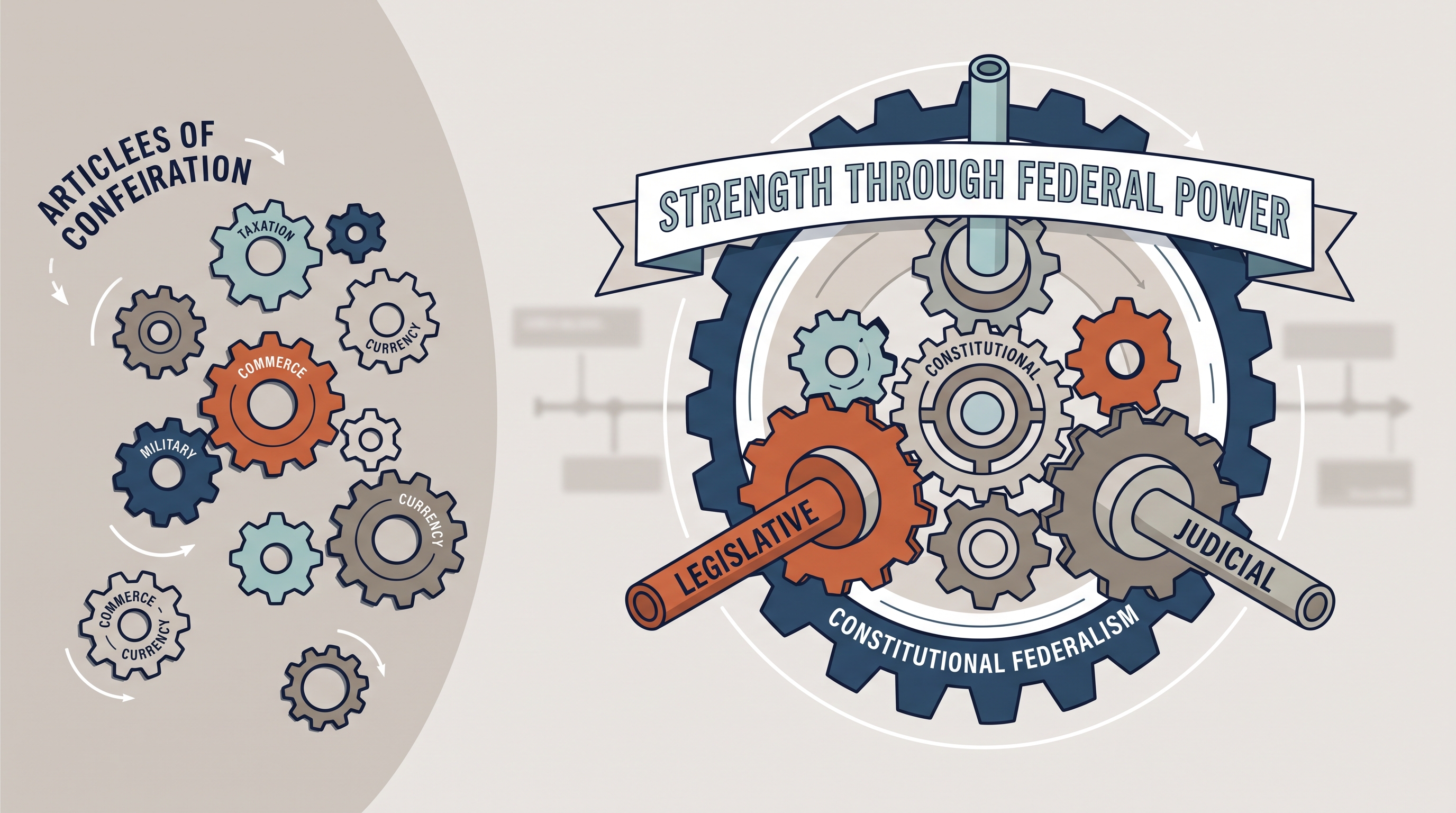
The Articles of Confederation unified the newly independent states, but they placed most government power in a single legislative body and gave the central government limited authority.
3.7 The Articles of Confederation · 3.8 The Constitutional Convention and Debates over Ratification
The Articles of Confederation unified the newly independent states, but they placed most government power in a single legislative body and gave the central government limited authority. The central problem was not whether Americans wanted government; it was where governmental power should reside and how much power the national government could safely exercise.
Investigative question: How did Americans move from a government dominated by state legislatures to a federal system with separate branches, while still fearing concentrated national power?
The Articles: unity without strong central authority
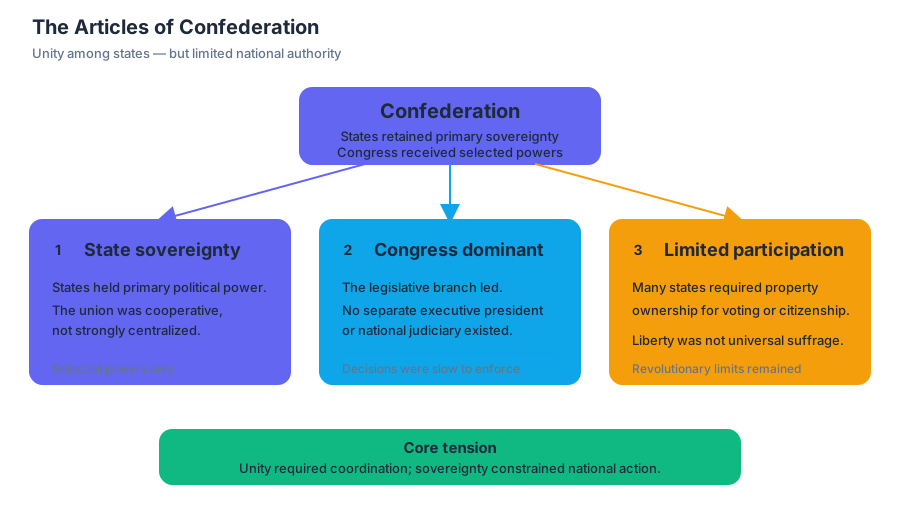
The Articles created a confederation, meaning a union in which the states retained primary sovereignty and delegated only selected powers to a central government. Under this arrangement, the Confederation Congress handled national concerns, but it lacked the full institutional tools needed to govern effectively.
Power under the Articles was concentrated in the legislative branch: there was no separate executive president to enforce national decisions and no national judiciary to interpret federal law. This reflected Revolutionary suspicion of executive authority, but it also made the government slow and difficult to coordinate.
Many new state constitutions likewise placed power in legislative bodies and maintained property qualifications—requirements that voters or citizens own property. These rules limited political participation and show that Revolutionary language about liberty did not immediately produce universal suffrage or equal citizenship.
| Problem under the Articles | Why it mattered |
|---|---|
| Limited central authority | Congress struggled to respond to national problems |
| Difficulties with finances | The government had trouble meeting expenses and obligations |
| Interstate commerce disputes | States could pursue conflicting trade policies |
| Foreign-relations weakness | Other nations could doubt the Confederation’s ability to enforce agreements |
| Internal unrest | Events such as Shays’s Rebellion encouraged calls for stronger government |
Misconception check — “The Articles created no national government.” They did create a central government and unified the states, but that government had limited power. The more accurate contrast is weak central authority under the Articles versus stronger, constitutionally divided authority under the Constitution.
The Northwest Ordinance: governing expansion
The Northwest Ordinance demonstrated that the Confederation Congress could create durable national policy. It established a process for territories in the Northwest Territory to become states, rather than treating western settlement as an unplanned scramble among existing states.
The ordinance also promoted public education, protected private property, and banned slavery in the Northwest Territory. Its state-admission process became a model for orderly expansion: territories could develop institutions and eventually enter the Union as states.
Worked contextual example: Suppose a historian argues that the Articles were entirely ineffective. The Northwest Ordinance complicates that claim. The Articles-era government struggled with finance and interstate coordination, but it successfully established rules for territorial governance, education, property, and slavery. A strong historical argument therefore distinguishes institutional weakness from complete failure.
The Constitutional Convention: redesign through compromise
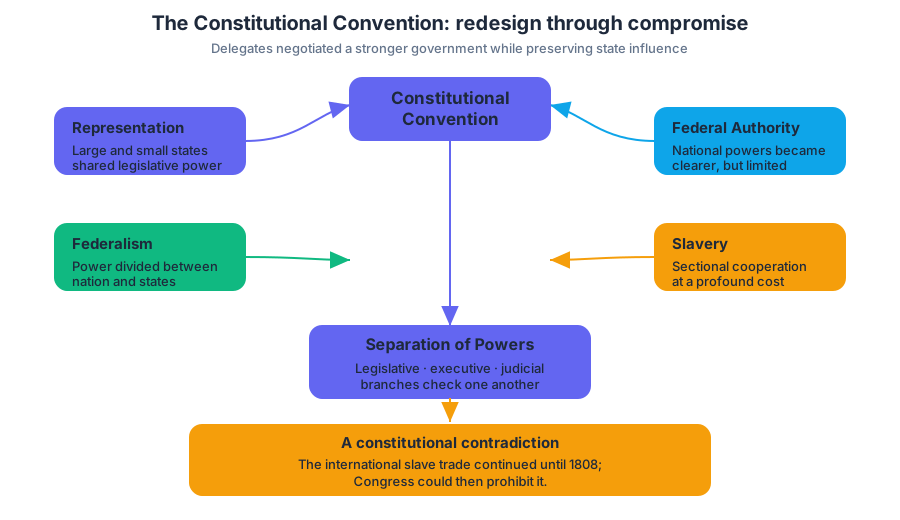
Delegates from the states met at the Constitutional Convention to negotiate the structure and functions of a new government. They did not simply replace one document with another; they bargained over representation, federal authority, slavery, and the relationship between state and national governments.
The Constitution created federalism, a system that divides power between a national government and state governments. It also established separation of powers, assigning legislative, executive, and judicial responsibilities to distinct branches. This produced a central government that was limited by constitutional boundaries but dynamic because it possessed clearer authority to act.
Convention compromises revealed the Constitution’s contradictions. The agreement over slavery permitted the international slave trade to continue until 1808, after which Congress could prohibit it. The compromise protected sectional cooperation in the short term while embedding slavery into the new national political order.
Ratification: Federalists, Anti-Federalists, and the Bill of Rights
Federalists supported ratification because they believed the nation needed a stronger government capable of managing finance, commerce, defense, and foreign relations. Anti-Federalists feared that the proposed government would endanger state authority and individual liberty. Federalists, including Alexander Hamilton and James Madison, defended the Constitution through the Federalist Papers.
Federalists secured ratification in part by promising to add a Bill of Rights, a written list of protected individual liberties. George Washington endorsed the Constitution in his September 17, 1787, letter transmitting it to Congress, helping give the document legitimacy during the ratification debate.
AP historical reasoning in action
This topic most directly develops Unit 3: Learning Objective H, “Explain how different forms of government developed and changed as a result of the Revolutionary Period,” and Unit 3: Learning Objective I, “Explain the differing ideological positions on the structure and function of the federal government.”
Use HISTORICAL THINKING SKILL 1.A: Identify and describe a development or process to trace the movement from legislative supremacy under the Articles to federalism and separation of powers. Use HISTORICAL THINKING SKILL 3.A: Identify and describe a claim and/or argument in a non-primary source and 3.B: Identify and describe a claim and/or argument in a primary source when comparing Federalist and Anti-Federalist arguments. Use HISTORICAL THINKING SKILL 4.B: Explain how a historical context affects a specific historical development to connect Revolutionary distrust of centralized power to the Articles, and postwar difficulties to the Constitutional Convention.
Retrieval check: Why is the Northwest Ordinance evidence both for the Articles government’s limitations and for its achievements? Then explain why the Bill of Rights was a ratification compromise rather than part of the original Constitution.
Source Materials
- AP U.S. History Course and Exam Description
- AP U.S. History Course and Exam Description Clarifications and Corrections
- AP U.S. History Course Overview
- AP U.S. History Course at a Glance
- AP United States History Course at a Glance Poster
- AP United States History
- AP United States History
- AP United States History Sample Syllabus 1