From the free course AP United States History on Lykke
7.15 Comparison in Period 7
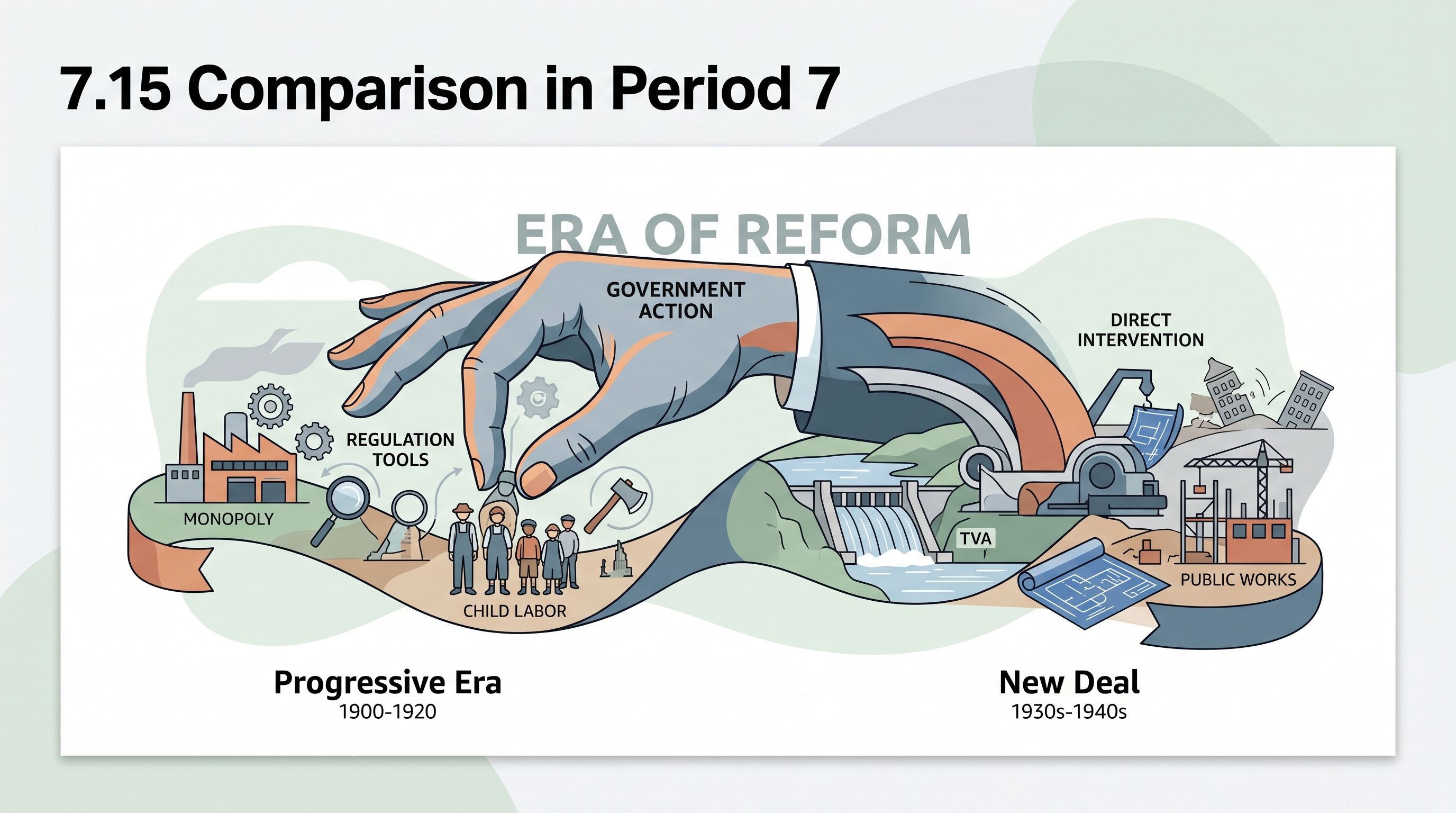
The Progressive Era and the New Deal both expanded the federal government’s response to social and economic problems, but they arose from different crises and produced different kinds of reform.
7.15 Comparison in Period 7
The Progressive Era and the New Deal both expanded the federal government’s response to social and economic problems, but they arose from different crises and produced different kinds of reform. The Progressive Era confronted the disorder of industrial capitalism; the New Deal confronted the collapse of the national economy during the Great Depression.
Learning Objective 7.15: Compare the effects of the Progressive Era and the New Deal.
Essential Knowledge 7.15.A: Reform movements in Period 7 expanded government responsibility for regulating the economy, protecting citizens, and addressing social problems, although reformers disagreed about the proper scope and methods of federal power.
The comparison at a glance
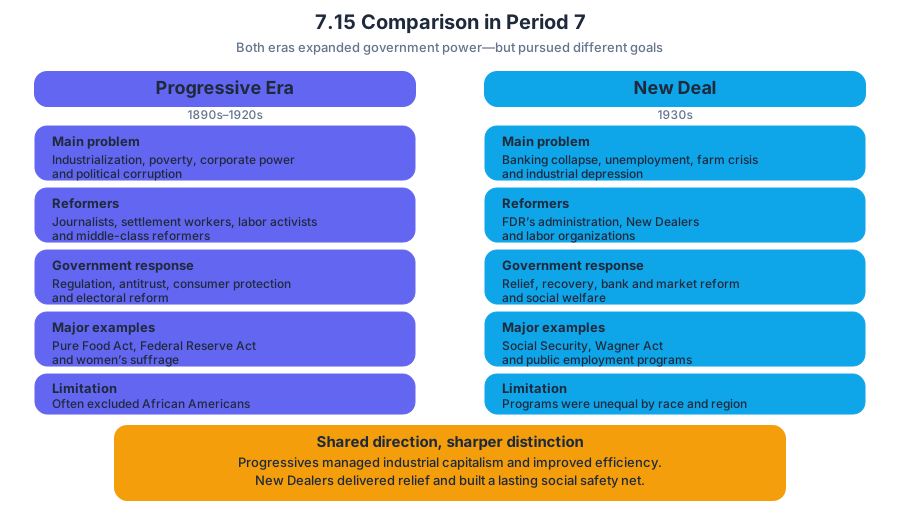
| Feature | Progressive Era | New Deal |
|---|---|---|
| Approximate period | 1890s–1920s | 1930s |
| Main problem | Industrialization, urban poverty, corporate power, political corruption | Banking collapse, mass unemployment, farm crisis, industrial depression |
| Reformers | Journalists, settlement workers, labor activists, middle-class reformers, some politicians | Franklin D. Roosevelt’s administration, New Dealers, labor organizations, reform economists |
| Government response | Regulation, antitrust action, consumer protection, electoral reform | Relief, recovery, reform of banks and markets, social welfare |
| Major examples | Pure Food and Drug Act, Federal Reserve Act, direct primaries, women’s suffrage | Social Security Act, Wagner Act, bank regulation, public employment programs |
| Main limitation | Often excluded African Americans and preserved racial segregation | Created broader protections but often administered programs unequally by race and region |
The comparison is not simply “small government versus big government.” Both eras increased government intervention. The more precise distinction is that Progressives usually tried to manage industrial capitalism and make government more efficient, while New Dealers used federal power to provide immediate economic relief and create a longer-lasting social safety net.
Progressive reform: correcting industrial capitalism
Progressive reformers believed that rapid industrialization had produced problems that individual charity could not solve: unsafe factories, polluted food supplies, political machines, corporate monopolies, and overcrowded cities. Investigative journalists such as Ida Tarbell exposed corporate practices, while settlement-house workers such as Jane Addams documented urban poverty and immigrant working conditions.
Their solution was not generally to abolish capitalism. Instead, reformers sought expert regulation and a more responsive democracy. Theodore Roosevelt’s “trust-busting,” the creation of the Federal Reserve under Woodrow Wilson, consumer-protection laws, conservation policies, and reforms such as initiative, referendum, and recall all reflected the belief that government could discipline concentrated power.
Key distinction: Progressive reform often targeted specific abuses of industrial society—monopoly, unsafe products, corruption, and poor working conditions—rather than promising universal economic security.
The New Deal: responding to systemic collapse
The Great Depression created a wider emergency. After the stock-market crash and banking failures, millions of Americans lost jobs, homes, savings, and farms. Franklin D. Roosevelt’s New Deal responded through three overlapping goals: relief for people suffering immediately, recovery for the economy, and reform to prevent another depression.
The Federal Deposit Insurance Corporation stabilized bank deposits; public employment programs put people to work; the Agricultural Adjustment Administration attempted to address farm prices; the Wagner Act strengthened collective bargaining; and the Social Security Act established old-age pensions and assistance programs. These policies permanently increased expectations that the federal government should protect economic security.
The New Deal did not end every Depression-era problem. Unemployment remained high until wartime production accelerated, and many programs excluded or disadvantaged agricultural and domestic workers—occupations held disproportionately by African Americans. Nevertheless, the New Deal reshaped the relationship between citizens and the federal government more broadly than most Progressive reforms had.
Worked comparison: building an argument
Prompt: Evaluate the extent to which the New Deal continued Progressive Era reform between 1933 and 1939.
Step 1 — Establish a shared context. Both periods responded to problems created or intensified by modern industrial capitalism. Progressives confronted corporate concentration and urban social problems; New Dealers confronted the economic collapse that exposed weaknesses in banks, farms, and labor markets.
Step 2 — Identify a continuity. Both movements expanded federal regulation. Progressive legislation regulated food, drugs, railroads, banks, and corporations; New Deal legislation regulated banking, securities markets, labor relations, and social welfare.
Step 3 — Identify a difference. The New Deal went beyond Progressive regulation by creating direct federal relief and a national social-insurance system. Social Security did not merely correct a corrupt institution; it established an ongoing federal responsibility for economic security.
Step 4 — Explain significance. The New Deal therefore continued the Progressive belief in active government but extended it from supervision of capitalism toward protection against capitalism’s failures.
Model thesis: The New Deal substantially continued Progressive reform by expanding federal regulation and using expert administration, but it also marked a major change because the federal government assumed direct responsibility for relief, employment, labor rights, and long-term economic security.
Misconception check
Misconception: “The Progressive Era helped everyone equally.” Progressive reform frequently excluded African Americans, tolerated segregation, and sometimes promoted racial control through supposedly scientific policies. Correction: evaluate reform by both its stated goals and its distribution of power and benefits.
Misconception: “The New Deal ended the Great Depression.” It reduced suffering, stabilized institutions, and reformed the economy, but full employment came only with the massive mobilization of World War II.
Retrieval and interpretation check
In two sentences, explain one continuity and one difference between the Progressive Era and the New Deal. A strong response should name a specific policy from each era and explain why the similarity or difference mattered—not merely list reforms.
Skill 6.C — Comparison: explain the significance of a similarity or difference. Skill 1.B — Developments and Processes: explain how reform developed in response to changing historical conditions.
Source Materials
- AP U.S. History Course and Exam Description
- AP U.S. History Course and Exam Description Clarifications and Corrections
- AP U.S. History Course Overview
- AP U.S. History Course at a Glance
- AP United States History Course at a Glance Poster
- AP United States History
- AP United States History
- AP United States History Sample Syllabus 1