From the free course AP United States History on Lykke
8.13 The Environment and Natural Resources, 1968–1980 · 8.14 Society in Transition
Key concepts: Environmental problems and public policy, 1968–1980 · Geography and the Environment (GEO) · Competition over natural resources · The 1970s energy crisis · Creation and scope of the Federal Energy Administration · The Cuyahoga River fires · The Love Canal toxic-waste controversy · The Three Mile Island nuclear accident · Earth Day and environmental activism · Making connections by identifying patterns among environmental incidents and subsequent policies
Environmental accidents in the late 1960s and 1970s transformed pollution and energy use from local concerns into national political problems. The central question was no longer simply who caused the damage?
8.13 The Environment and Natural Resources, 1968–1980 · 8.14 Society in Transition
Environmental accidents in the late 1960s and 1970s transformed pollution and energy use from local concerns into national political problems. The central question was no longer simply who caused the damage? but also what authority should government use to prevent, investigate, and repair it?
Geography and the Environment (GEO): Geographic conditions and competition over natural resources shaped American development while producing conflicts over pollution, energy supplies, public health, and the proper scope of government action.
From environmental concern to public policy
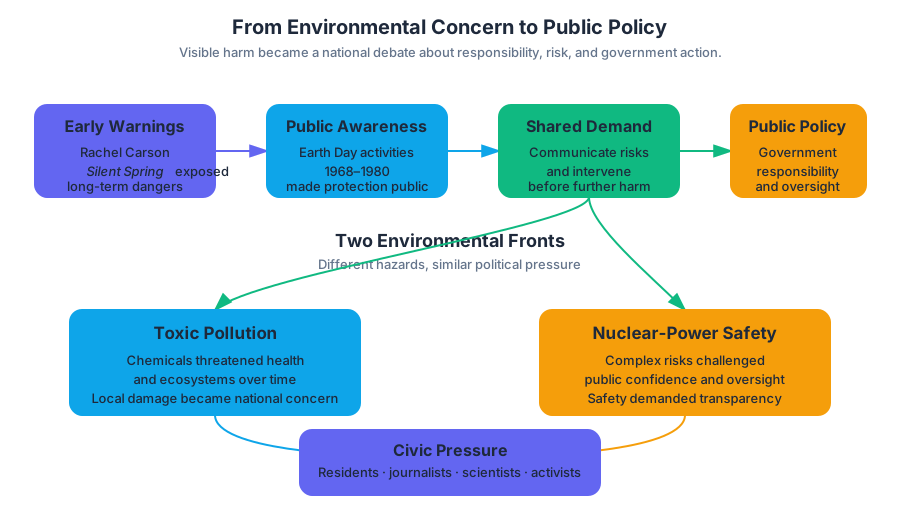
The environmental movement connected visible local damage to national debates about responsibility. Earth Day activities—including the first and second Earth Days—made environmental protection a public issue, while Rachel Carson’s earlier warnings in Silent Spring helped Americans recognize that industrial chemicals could create long-term ecological and health dangers.
The period’s environmental concerns included toxic pollution and nuclear-power safety. These problems differed in appearance and scale, but they shared an important political pattern: residents, journalists, scientists, and activists demanded that government communicate risks and intervene before private or public institutions caused further harm.
The energy crisis and the Federal Energy Administration
The energy crisis of the 1970s contributed to the creation of the Federal Energy Administration (FEA). Its importance lay in its national coordinating role: energy production, transportation, prices, and fuel distribution affected every region, so a fragmented response could leave communities competing for scarce supplies.
The FEA’s scope included collecting and organizing energy information, coordinating national energy policy, administering fuel-allocation and pricing measures, and promoting conservation. In practice, this meant that the federal government could monitor shortages, help determine where fuel should go, manage emergency rules, and encourage reduced consumption rather than treating energy as only a private-market issue.
Roger Anders’s 1980 report, “The Federal Energy Administration,” provides historical context for the agency’s implementation and scope. The key historical development is the expansion of federal administrative capacity: an energy shortage encouraged the government to build an institution capable of managing a national resource problem.
Misconception check: The FEA was not simply an agency that “found more oil.” Its central function was coordination and regulation—gathering information, allocating fuel, addressing prices, and supporting conservation during a national crisis.
Three environmental accidents, three kinds of harm
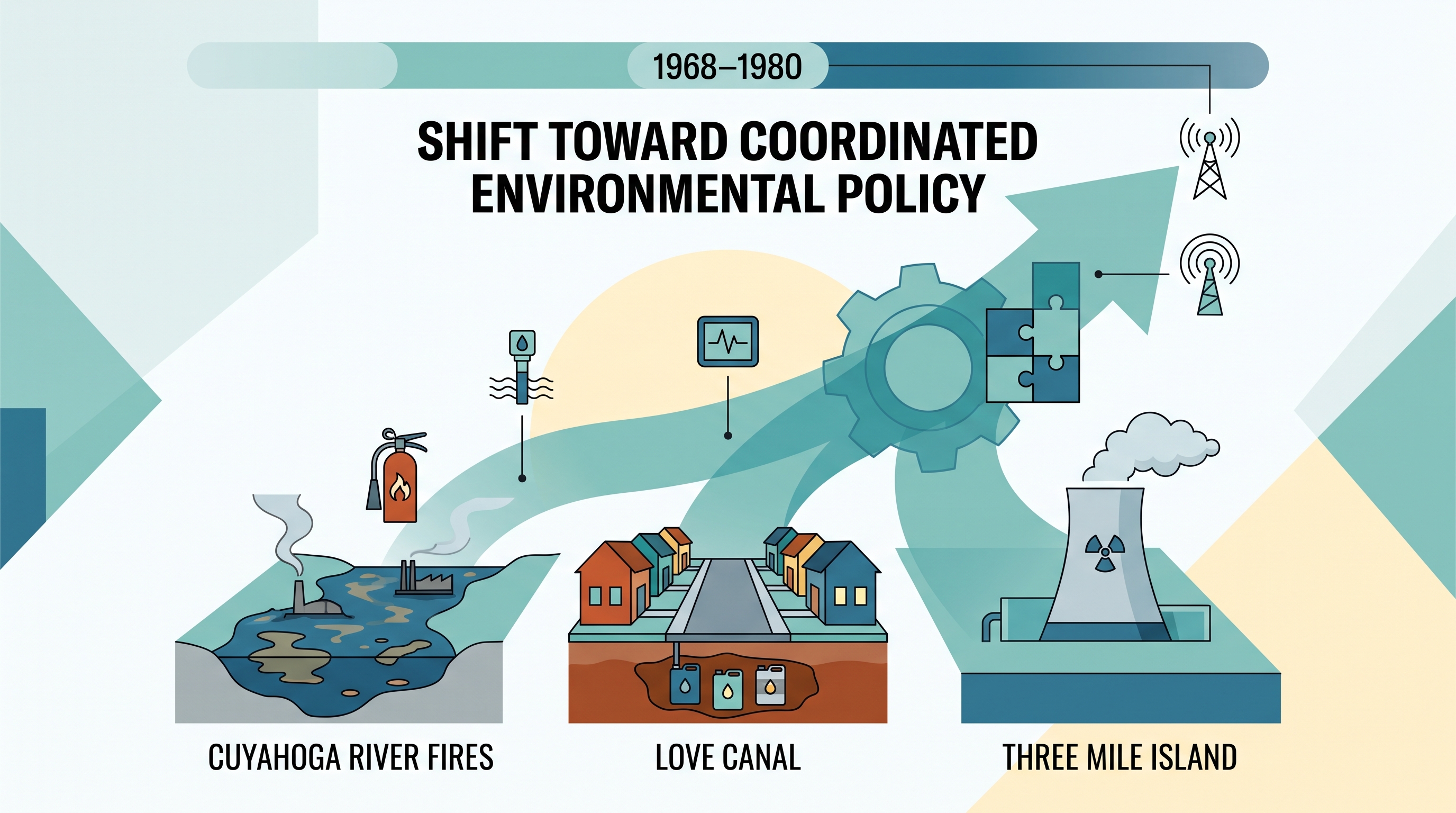
The Cuyahoga River fires, Love Canal, and Three Mile Island illustrate different environmental threats and different demands for policy response.
| Incident | Main danger | What made it politically powerful | Likely policy response |
|---|---|---|---|
| Cuyahoga River fires | Industrial pollution in a river | A river visibly catching fire made water contamination impossible to ignore | Cleanup efforts and stronger water-pollution controls |
| Love Canal | Buried chemical waste contaminating a residential area | Residents reported health concerns and demanded relocation and government action | Investigation, public communication, intervention, and relocation demands |
| Three Mile Island | Nuclear-power safety failure | The accident raised fears about invisible radiation exposure and the safety of nuclear energy | Greater scrutiny of reactor safety, emergency planning, and regulation |
Love Canal: contamination and failed communication
Love Canal was a toxic-waste contamination controversy, not a controversy about “toxic radiation.” Buried chemical waste beneath a residential community produced fears about contamination and suspected health effects. Residents sought government intervention and, for some families, relocation from the affected area.
Loretta Gambino’s April 5, 1979 testimony described inadequate government intervention and communication. Her testimony matters because it shows that an environmental crisis involves more than physical contamination: residents also need reliable information, a clear authority responsible for action, and meaningful participation in decisions affecting their safety.
Three Mile Island and public trust
The Three Mile Island nuclear-power-plant accident occurred on March 28, 1979. Unlike the Cuyahoga fires, which produced highly visible flames, Three Mile Island generated fear about a technological system whose dangers were difficult for ordinary residents to observe or evaluate.
The comparison reveals a broader pattern. Each incident exposed a gap between modern economic activity and public safeguards; each prompted demands for investigation or policy action; and each made government credibility part of the crisis. Yet the effects differed because river pollution, buried chemical waste, and nuclear-power failure involved different pathways of harm, evidence, and public fear.
AP historical reasoning: Skill 5.A
5.A: Making Connections means identifying patterns among or connections between historical developments and processes. A strong connection does not merely say that three events were “similar.” It explains the shared mechanism and preserves the differences.
Worked example: The Cuyahoga fires made industrial water pollution visible; Love Canal made buried chemical contamination a residential and public-health issue; Three Mile Island made nuclear safety and government communication central concerns. Together, these events show how environmental problems between 1968 and 1980 expanded the expected responsibilities of government from reacting to damage toward monitoring risk, communicating danger, and coordinating national policy.
Retrieval check: Which incident involved buried chemical waste? What responsibility did the FEA exercise that was broader than local cleanup? Finally, state one similarity and one difference among the Cuyahoga River fires, Love Canal, and Three Mile Island. A complete answer should identify Love Canal, explain national energy coordination, and connect the accidents to policy responses while distinguishing their forms of harm.
Source Materials
- AP U.S. History Course and Exam Description
- AP U.S. History Course and Exam Description Clarifications and Corrections
- AP U.S. History Course Overview
- AP U.S. History Course at a Glance
- AP United States History Course at a Glance Poster
- AP United States History
- AP United States History
- AP United States History Sample Syllabus 1