From the free course AP United States History on Lykke
AP Practice 6
A strong Long Essay Question (LEQ) answer does more than remember events: it makes a defensible historical claim, places that claim in context, uses precise evidence, and explains relationships through historical reasoning.
AP Practice 6
A strong Long Essay Question (LEQ) answer does more than remember events: it makes a defensible historical claim, places that claim in context, uses precise evidence, and explains relationships through historical reasoning. The practice below is original and unofficial; it uses the Unit 8 conflict over economic policy, social change, and political conservatism as its historical setting.
The task
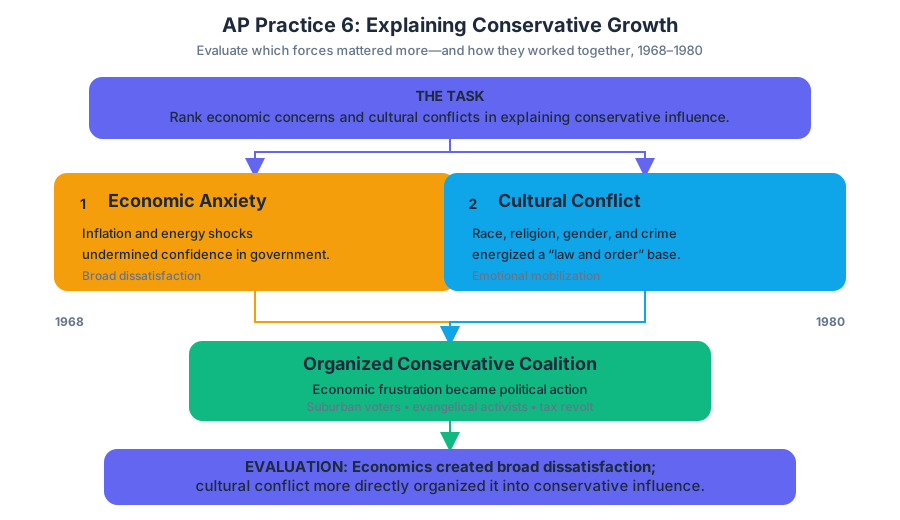
Prompt: Evaluate the relative importance of economic concerns and cultural conflicts in explaining the growth of conservative political influence in the United States from 1968 to 1980.
This is an evaluate-the-relative-importance prompt. It does not ask whether economics or culture mattered. It asks you to rank their importance and explain how they interacted. A defensible answer might argue that economic concerns created broad dissatisfaction, while cultural conflicts converted that dissatisfaction into an organized conservative political movement.
Timing plan
For an LEQ, reserve approximately 40 minutes: about 5 minutes to identify the task and plan, 30 minutes to write, and 5 minutes to check the argument. The goal is not to mention every event from the period; the goal is to select evidence that directly proves the thesis.
| Stage | Action | Time |
|---|---|---|
| Decode | Identify the period, issue, and required comparison of causes | 2 minutes |
| Plan | Choose a judgment, context, and evidence clusters | 3 minutes |
| Write | Develop an introduction, body paragraphs, and conclusion | 30 minutes |
| Review | Check thesis, evidence, reasoning, and complexity | 5 minutes |
The principal historical thinking skills are 1. Developments and Processes, 3. Claims and Evidence in Sources, 4. Contextualization, and 5. Making Connections. Because an LEQ supplies no documents, Skill 3 is used through the student’s selection and explanation of historical evidence rather than through sourcing a provided source.
Plan the argument before writing
A useful planning chain is:
$$ \text{Economic pressures} \rightarrow \text{public dissatisfaction} $$
$$ \text{Cultural conflicts} \rightarrow \text{political mobilization} $$
$$ \text{Election strategy} \rightarrow \text{conservative influence} $$
Possible economic evidence includes stagflation, the oil crisis, declining confidence in government economic management, criticism of welfare spending, and the appeal of tax reduction. Possible cultural evidence includes conflicts over racial equality, school desegregation, abortion, gender roles, religion, and the expansion of federal authority. Political evidence might include Barry Goldwater’s 1964 campaign as an earlier ideological foundation, Richard Nixon’s “silent majority,” and Ronald Reagan’s 1980 victory.
A defensible thesis
Economic concerns were important because inflation, energy shortages, and distrust of federal economic policy weakened support for liberal governance; however, cultural conflicts were more significant in transforming dissatisfaction into conservative political power, because they organized voters around emotionally charged questions of race, religion, family, and national identity. By 1980, conservative influence rested on the combination of economic discontent and cultural mobilization rather than on either cause alone.
This thesis earns the thesis or claim point because it answers the entire prompt, establishes a relative judgment, and previews a line of reasoning. It does not merely state that “both economics and culture mattered.”
Model evidence and reasoning
Contextualization: The conservative rise developed after the New Deal and Great Society had expanded the federal government’s role in economic security and civil rights. The civil rights movement, antiwar activism, and social movements of the 1960s also challenged older assumptions about authority and social order. This context explains why later disputes over government policy became connected to larger arguments about identity and national direction.
Economic paragraph: Inflation and unemployment during the 1970s damaged confidence in government. Stagflation appeared to contradict the expectation that federal economic management could reliably produce prosperity, while the oil crisis made economic insecurity visible in everyday life. Conservatives used these problems to argue for lower taxes, reduced regulation, and a smaller federal role. The evidence matters because it shows how material hardship created an opening for criticism of liberal policy.
Cultural paragraph: Cultural conflicts gave conservative politics a powerful organizing language. Resistance to school desegregation, opposition to abortion rights, concern about changing gender roles, and the growth of evangelical political activism connected federal policy to questions of community authority and moral order. These issues could mobilize voters even when they did not directly address inflation or unemployment, making cultural conflict more politically durable than economic frustration alone.
Synthesis: The two forces reinforced one another. A voter could oppose federal welfare programs as inefficient, view civil-rights enforcement as excessive federal intervention, and support a candidate promising both economic retrenchment and restored social order. Reagan’s 1980 coalition therefore reflected a fusion of economic conservatism, religious conservatism, and backlash against perceived cultural change.
What the rubric rewards
A high-scoring response should make its reasoning visible rather than expecting the reader to infer it.
| Rubric target | What to demonstrate in this essay |
|---|---|
| Thesis or claim | Rank economic and cultural causes and establish a defensible line of reasoning |
| Contextualization | Explain the New Deal/Great Society order and the upheavals of the 1960s |
| Evidence | Use at least two specific historical examples and connect them to the argument |
| Analysis and reasoning | Explain causation and relative significance, not just sequence events |
| Complexity | Show interaction, qualification, change over time, or limits to the argument |
For the evidence points, naming an event is not enough. “The oil crisis occurred” is identification; “the oil crisis intensified doubts about federal economic management and strengthened arguments for deregulation and tax reduction” is evidence used in support of an argument.
Named misconception check
Misconception: “Conservatism rose only because of the economy.” Economic problems mattered, but economic explanations alone cannot account for the role of evangelical organizing, racial backlash, debates over abortion, or opposition to perceived cultural liberalism. The strongest historical explanation shows how economic and cultural concerns overlapped and how political leaders combined them.
Final self-check
Before submitting, ask:
- Did I make a judgment about relative importance?
- Did I explain what changed from the 1960s to 1980?
- Did I use at least two precise examples?
- Did I connect every example to the thesis?
- Did I explain interaction or qualification rather than listing causes?
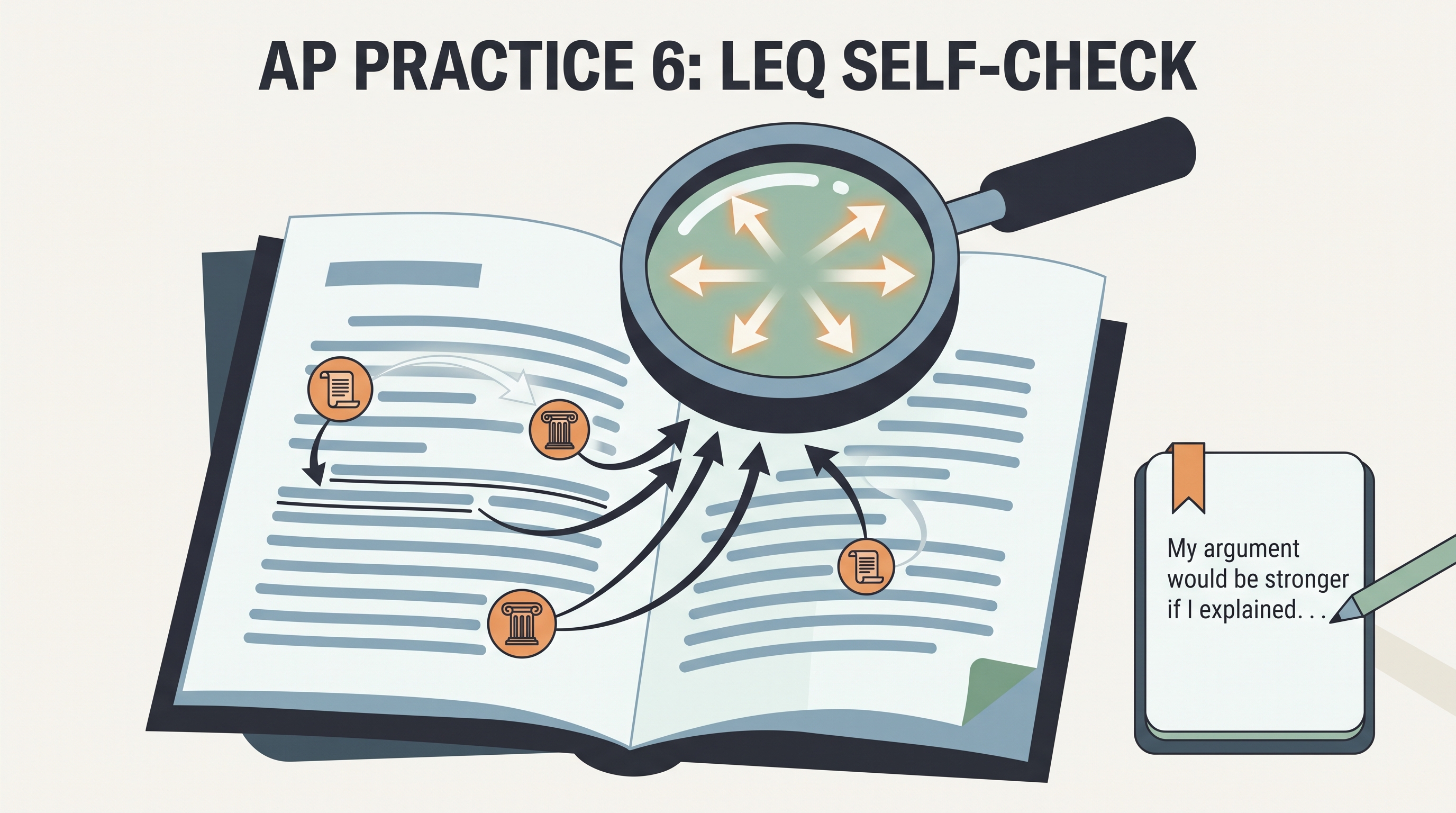
Error-review routine: After writing, underline the thesis, circle each specific piece of evidence, and draw an arrow from each example to the claim it proves. If an example has no arrow, either explain its significance or remove it. Finally, write one sentence beginning, “My argument would be stronger if I explained…” This turns a completed essay into targeted practice for the next LEQ.
Source Materials
- AP U.S. History Course and Exam Description
- AP U.S. History Course and Exam Description Clarifications and Corrections
- AP U.S. History Course Overview
- AP U.S. History Course at a Glance
- AP United States History Course at a Glance Poster
- AP United States History
- AP United States History
- AP United States History Sample Syllabus 1
- AP US History Past Exam Questions — AP Central
- Khan Academy — AP US History
- Gilder Lehrman Institute — AP US History Study Guide
- AP US History Units — Save My Exams