From the free course AP United States History on Lykke
7.11 Interwar Foreign Policy · 7.12 World War II: Mobilization
Key concepts: Interwar foreign policy · World War II mobilization · Unilateral foreign policy · Multilateral foreign policy · Interventionism · Non-interventionism · Internationalism · Isolationism · U.S. foreign-policy traditions and involvement in European affairs · Historical analysis of primary sources and cultural or political values
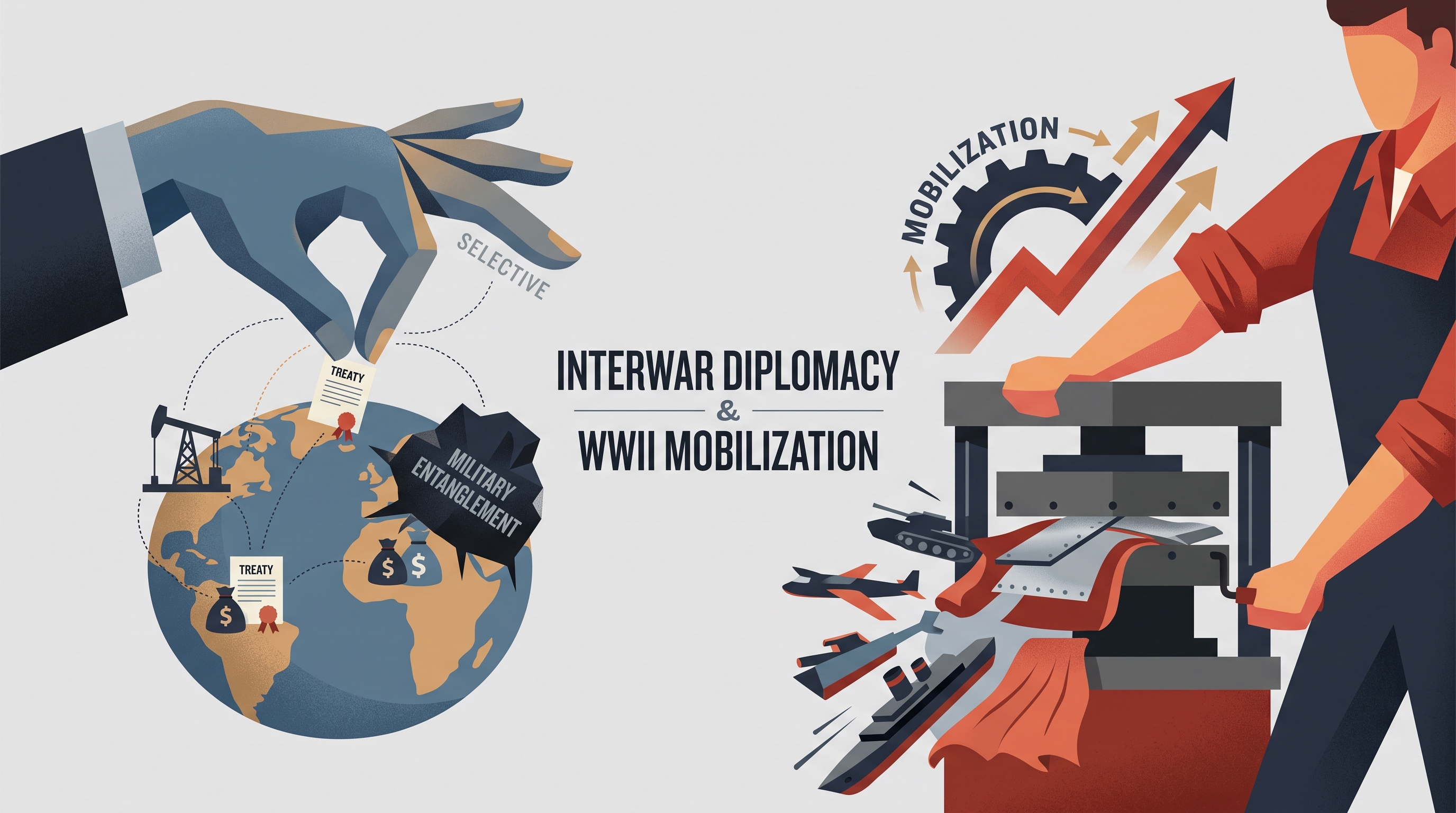
Between World War I and World War II, the United States tried to shape world affairs without fully committing to permanent military involvement overseas. That tension produced a foreign policy that was simultaneously isolationist in public mood and active through finance, treaties, diplomacy, and selective…
7.11 Interwar Foreign Policy · 7.12 World War II: Mobilization
Between World War I and World War II, the United States tried to shape world affairs without fully committing to permanent military involvement overseas. That tension produced a foreign policy that was simultaneously isolationist in public mood and active through finance, treaties, diplomacy, and selective intervention.
Investigative question: How could the United States claim to avoid foreign entanglements while still attempting to organize international order—and how did World War II make that balance impossible?
From neutrality to intervention—and back again
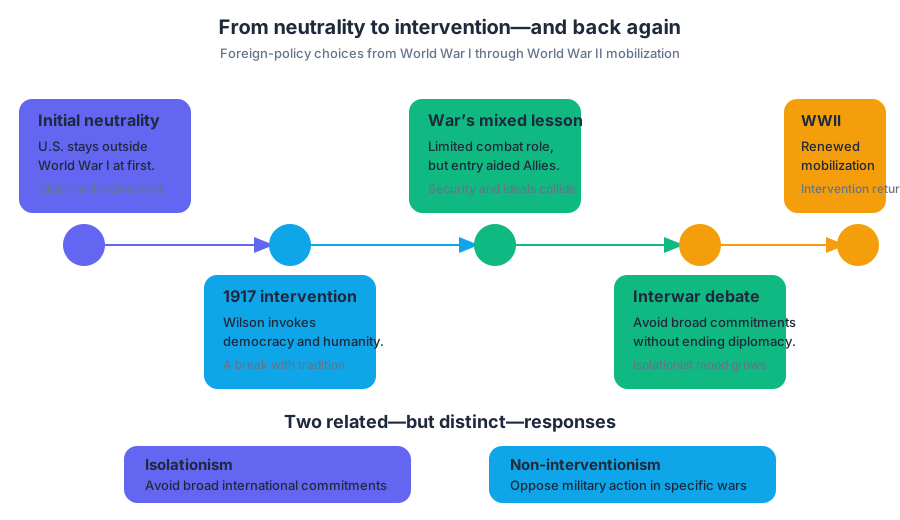
The United States initially remained neutral in World War I. When it entered the conflict, it departed from the older tradition of noninvolvement in European affairs. President Woodrow Wilson presented intervention not simply as a strategy for national security but as a defense of humanitarian and democratic principles. Although the American Expeditionary Forces played a relatively limited role in combat, U.S. entry helped tip the balance toward the Allies.
KC-7.3.II.A: After initial neutrality in World War I, the nation entered the conflict, departing from the tradition of noninvolvement in European affairs in response to Wilson’s call to defend humanitarian and democratic principles.
The experience created a political problem: Americans could believe that democratic ideals mattered internationally while also fearing that military involvement would draw the nation into endless European conflicts. Isolationism favored keeping the United States outside broad international commitments. Non-interventionism more specifically opposed military intervention in particular foreign conflicts. The approaches overlapped, but they were not identical: a country could avoid war while still using diplomacy or economic power abroad.
The interwar policy grid
Foreign-policy actions can be classified along three separate dimensions. These categories should not be collapsed into one another.
| Dimension | Central question | Possible U.S. position |
|---|---|---|
| Unilateral vs. multilateral | Does the United States act alone or through coordinated international institutions? | The interwar United States often acted unilaterally. |
| Interventionist vs. non-interventionist | Does the United States actively intervene in another country’s affairs, especially militarily? | It could reject war while still using economic pressure or diplomacy. |
| Internationalist vs. isolationist | Does the United States accept sustained responsibility for global affairs or emphasize withdrawal? | Public opinion often leaned isolationist, even as policy remained internationally engaged. |
Unilateral foreign policy means acting primarily through national decisions rather than binding collective institutions. Multilateral foreign policy means coordinating with several nations through shared agreements or organizations. The interwar United States pursued a unilateral foreign policy that used international investment, peace treaties, and selective military intervention to promote an American vision of international order, even while maintaining isolationism.
KC-7.3.II.D: In the years following World War I, the United States pursued a unilateral foreign policy using international investment, peace treaties, and select military intervention to promote a vision of international order while maintaining U.S. isolationism.
Worked example: the Dawes Plan
In 1924, U.S. banker Charles Dawes led negotiations for the Dawes Plan, an arrangement designed to help Germany pay World War I reparations and revive its economy. The United States did not enter a permanent European political alliance, yet American financial leadership influenced European reconstruction and stability.
Classify the action step by step:
- It was unilateral in leadership because U.S. officials and bankers drove the arrangement.
- It was internationalist in effect because it addressed a European economic crisis.
- It was largely non-interventionist militarily because it relied on finance rather than deploying an army.
- It coexisted with isolationism because Americans could oppose political entanglement while accepting limited economic engagement.
Retrieval check: Why would calling the Dawes Plan simply “isolationist” be incomplete? A strong answer identifies its isolationist limits but also its international economic purpose.
The road to World War II
During the 1930s, many Americans were alarmed by the rise of fascism and totalitarianism. Nevertheless, most opposed military action against the aggression of Nazi Germany and Japan. Neutrality reflected the memory of World War I, the desire to avoid another overseas war, and the belief that domestic problems required attention.
KC-7.3.II.E: In the 1930s, many Americans recognized the danger posed by fascism and totalitarianism, but most opposed military action against German and Japanese aggression until the Japanese attack on Pearl Harbor brought the United States into World War II.
The Japanese attack on Pearl Harbor transformed the debate. The United States moved from non-interventionism to direct intervention, and mobilization reorganized the nation’s economy, labor force, technology, and social life for total war. This transition connects foreign policy to the domestic consequences of wartime production.
Mobilization: war as a national system
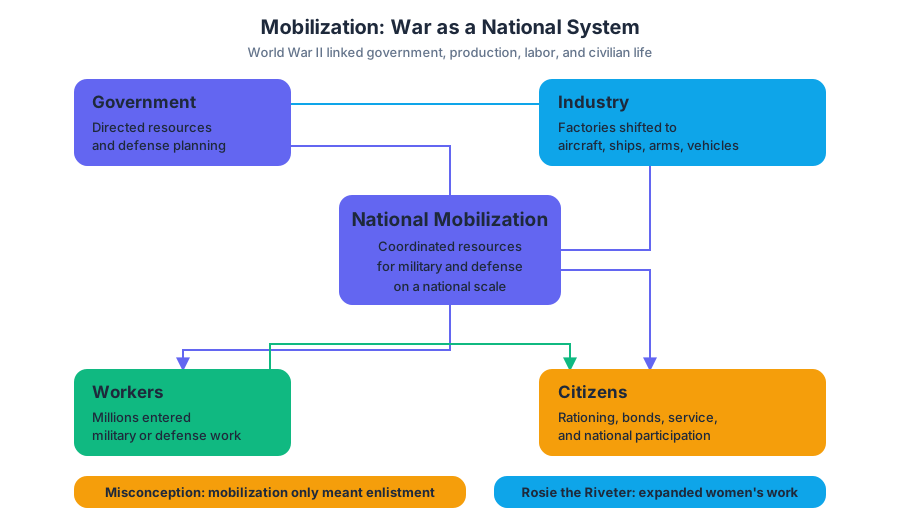
World War II mobilization was the rapid coordination of government, industry, workers, and citizens for military production and national defense. Factories shifted toward airplanes, ships, weapons, and vehicles; the federal government directed resources; and millions of Americans entered military or defense-related work.
The image of Rosie the Riveter captures one visible result. Women entered industrial jobs traditionally associated with men, demonstrating that wartime necessity could temporarily alter workplace expectations. The change was significant, but it did not automatically eliminate gender inequality or guarantee that women would permanently keep those jobs after the war.
Named misconception — “Mobilization only meant enlistment.” Mobilization included military service, but it also involved industrial production, labor changes, government planning, and civilian participation.
Historical thinking in action
This topic most directly develops Skill 1: Developments and Processes, especially 1.B: Explain a historical development. To explain interwar policy, connect the development to both sides of the tension: Americans resisted military entanglement, yet U.S. leaders used investment, treaties, and selective intervention to shape international affairs.
It also uses Skill 2: Sourcing and Situation, Skill 3: Claims and Evidence in Sources, Skill 4: Contextualization, Skill 5: Making Connections, and Skill 6: Argumentation. When analyzing a source about isolationism, fascism, or mobilization, do not adopt or reject its cultural or political values; identify what its authors’ words reveal about the period, then use that evidence to construct a historically defensible claim.
Interpretation check: A source praising “peace through withdrawal” may reveal strong interwar fear of military entanglement even if the reader disagrees with its politics. Historical analysis asks what the source shows, who produced it, and why—not whether its values should be endorsed.
Source Materials
- AP U.S. History Course and Exam Description
- AP U.S. History Course and Exam Description Clarifications and Corrections
- AP U.S. History Course Overview
- AP U.S. History Course at a Glance
- AP United States History Course at a Glance Poster
- AP United States History
- AP United States History
- AP United States History Sample Syllabus 1