From the free course AP United States History on Lykke
9.7 Causation in Period 9
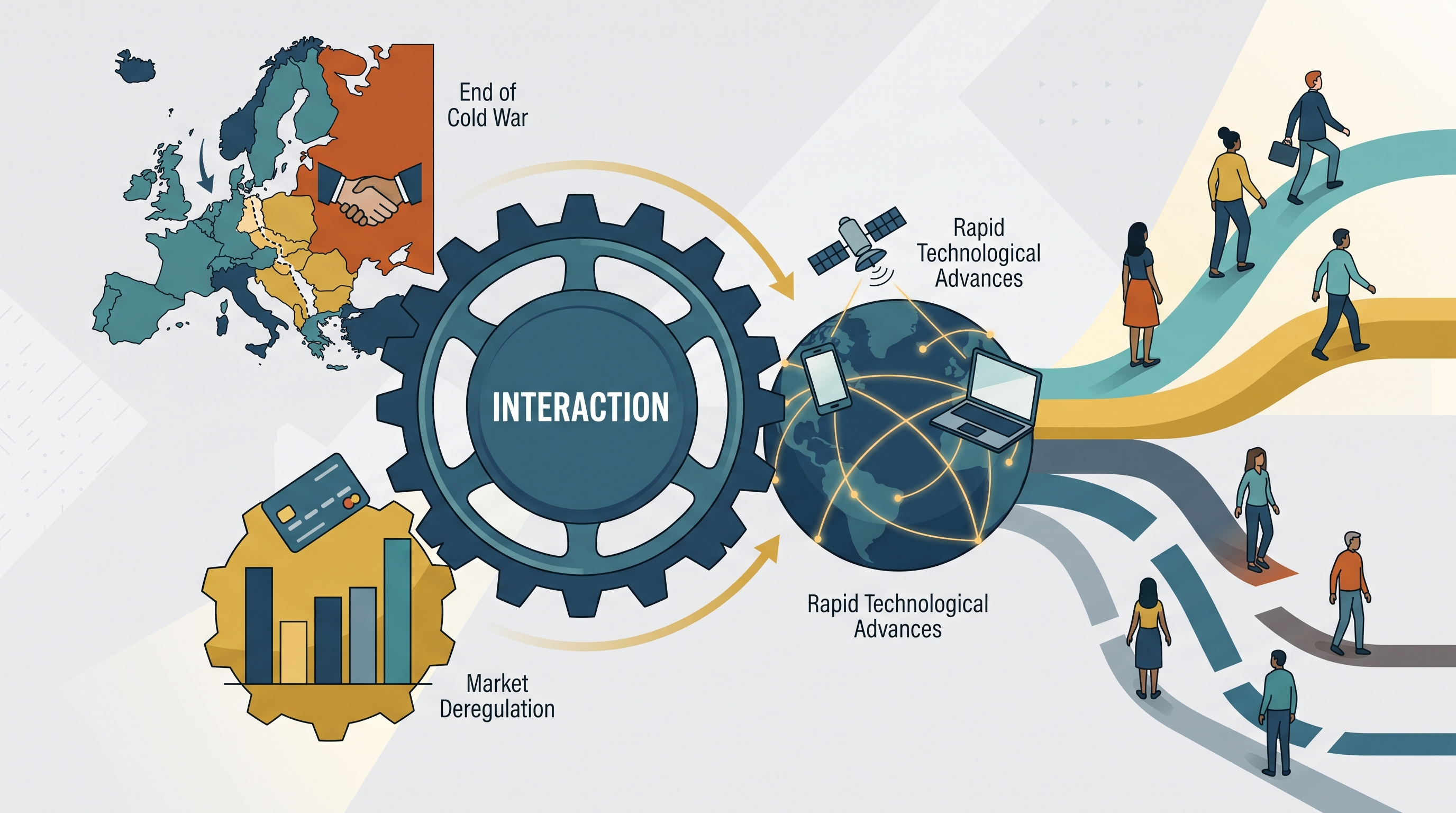
The major changes after 1980 did not come from one event or one president. They resulted from interacting causes: conservative political mobilization, economic restructuring, the end of the Cold War, immigration, technological change, and new social movements.
9.7 Causation in Period 9
The major changes after 1980 did not come from one event or one president. They resulted from interacting causes: conservative political mobilization, economic restructuring, the end of the Cold War, immigration, technological change, and new social movements. The central historical question is therefore: How did these developments produce both change and continuity in the United States from 1980 to the present?
Learning Objective 9.7.A: Explain the causes and effects of economic and social changes in the period from 1980 to the present.
The official historical reasoning process here is causation: identifying the factors that produced a development, distinguishing short-term triggers from long-term conditions, and explaining the consequences that followed. A strong causal explanation does not merely place events in chronological order. It shows how one development increased, limited, or redirected the effects of another.
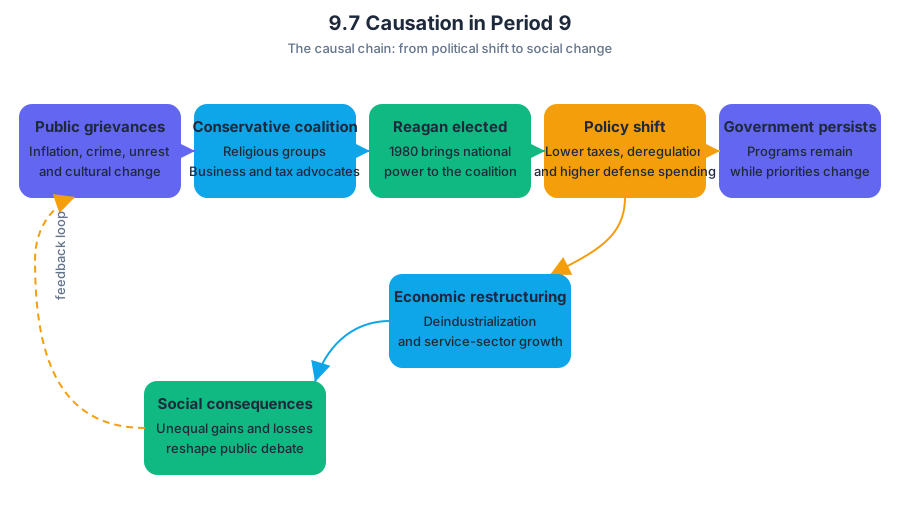
The causal chain: from political shift to social change
A useful way to organize Period 9 is as a chain with feedback loops:
The conservative movement gained strength partly because many Americans reacted against perceived failures of liberal government, inflation, crime, social unrest, and cultural changes associated with the 1960s and 1970s. Religious conservatives, business groups, and advocates of lower taxes formed an influential political coalition. Ronald Reagan’s election in 1980 gave this coalition national power, although the federal government did not simply disappear: military spending increased, and many existing programs remained.
At the same time, the economy shifted away from the manufacturing-heavy pattern of the mid-twentieth century. Deindustrialization, automation, globalization, and the growth of service and information industries changed where Americans worked and how securely they were employed. These developments produced economic growth for some Americans while widening inequality and weakening many unionized industrial communities.
Causal distinction: A policy can be a cause without being the only cause. Deregulation and tax changes affected economic inequality, but technological change, international competition, corporate decisions, and the decline of unions also mattered.
Connecting foreign policy and domestic change
The end of the Cold War transformed the international setting in which the United States operated. The collapse of the Soviet Union removed the chief rival that had shaped American foreign policy since 1945. The United States emerged as the world’s dominant military and economic power, but the post–Cold War period also brought new challenges, including terrorism, regional conflicts, and debates over the proper use of American military force.
This change had domestic consequences. Government spending and national security priorities remained important, while debates over globalization, trade, immigration, and America’s responsibilities abroad became connected to arguments about national identity at home. Period 9 therefore demonstrates that foreign affairs and domestic politics are not separate tracks: international changes can reshape elections, economic policy, public fears, and ideas about citizenship.
Migration, technology, and contested identity
Immigration from Latin America and Asia increased the nation’s cultural and demographic diversity, especially in the South and West. Immigrants contributed labor, entrepreneurship, and cultural influence, while immigration also generated political disputes over border enforcement, legal status, language, and national belonging. The result was both continuity—recurring arguments over immigration—and change in the composition of American society.
Technological developments intensified these transformations. Computers, the internet, digital communications, and global networks accelerated the movement of information, money, and culture. They expanded access and productivity, but they also created new forms of inequality: people with reliable access, specialized education, and adaptable skills often benefited more than communities and workers left behind by economic restructuring.
Worked causal example: explaining rising inequality
Question: Explain one major cause of increasing economic inequality after 1980 and one effect of that inequality.
Step 1 — Identify a defensible cause: The decline of manufacturing employment and labor unions reduced the bargaining power and wages of many working-class Americans.
Step 2 — Explain the mechanism: As factories closed, automated, or moved production abroad, workers increasingly entered lower-paid service jobs. Because unions had historically negotiated wages and benefits, their decline made it harder for workers to secure a large share of economic growth.
Step 3 — Identify an effect: Regional inequality widened. Many older industrial communities experienced population loss and declining tax bases, while technology-centered metropolitan areas attracted investment and highly educated workers.
Step 4 — Add complexity: Economic restructuring was not caused by union decline alone. Automation, globalization, changing consumer demand, and policy choices operated together.
AP skills in action
This topic most directly develops 1. Developments and Processes, because students must identify major Period 9 developments and explain how they unfolded; 4. Contextualization, because causes must be placed within the political, economic, and international conditions of the late twentieth century; and 5. Making Connections, specifically causation, because students must connect developments across politics, economics, foreign affairs, migration, and society. A source-based question may also require 2. Sourcing and Situation and 3. Claims and Evidence in Sources.
Misconception check
Misconception: “The 1980s marked a complete break from the past.”
The period contained important changes, but also strong continuities. Political debates still revolved around the role of government; immigration remained contested; racial and economic inequalities persisted; and the federal government continued to regulate, spend, and intervene. The best answer explains both transformation and persistence rather than labeling the entire period simply “conservative” or “liberal.”
Retrieval and interpretation check
In two or three sentences, explain how one political development, one economic development, and one demographic or technological development interacted after 1980. Your response should use a causal verb—such as enabled, accelerated, limited, or provoked—and should identify at least one effect that was unequal across different groups or regions.
Source Materials
- AP U.S. History Course and Exam Description
- AP U.S. History Course and Exam Description Clarifications and Corrections
- AP U.S. History Course Overview
- AP U.S. History Course at a Glance
- AP United States History Course at a Glance Poster
- AP United States History
- AP United States History
- AP United States History Sample Syllabus 1