From the free course AP United States History on Lykke
6.5 Technological Innovation · 6.6 The Rise of Industrial Capitalism
Key concepts: Technological innovation · Large-scale production · Industrial capitalism · Business consolidation · Government economic policies · Rapid economic development · Concentrated wealth · Growth and control of markets and natural resources · Farmers’ responses to agricultural instability · Labor changes during industrialization
Between 1865 and 1898, a new economic system made production faster, markets larger, and wealth more concentrated: industrial capitalism, an economy in which private businesses invest capital in machinery, factories, transportation, and natural resources to produce goods for profit.
6.5 Technological Innovation · 6.6 The Rise of Industrial Capitalism
Between 1865 and 1898, a new economic system made production faster, markets larger, and wealth more concentrated: industrial capitalism, an economy in which private businesses invest capital in machinery, factories, transportation, and natural resources to produce goods for profit. The central question is not simply what new machines appeared? It is: How did technology, government policy, and business organization reinforce one another?
Core claim: Technological advances, large-scale production methods, expanding markets, and pro-growth government policies generated rapid economic development and business consolidation.
The industrial growth machine
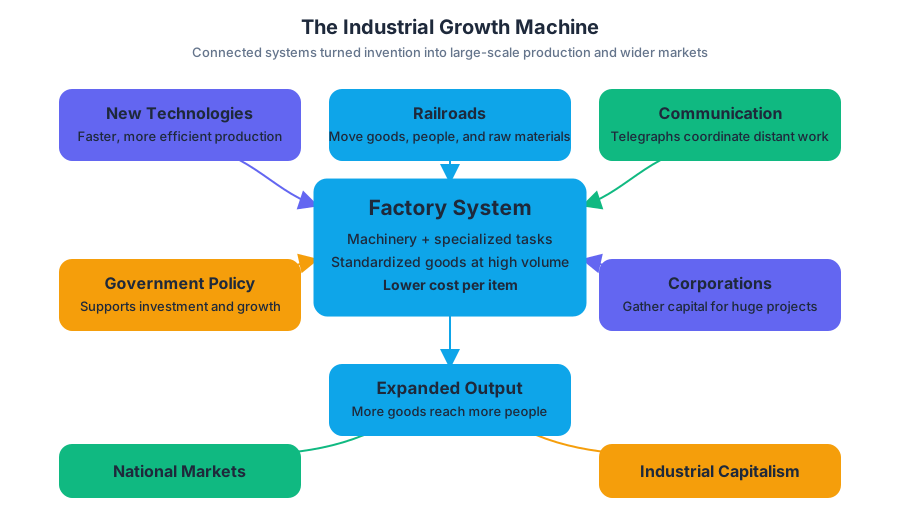
Industrialization worked like a connected system rather than a collection of isolated inventions. Railroads opened markets; telegraphs and expanding communication networks coordinated distant operations; factories used machinery and standardized production; government policies supported economic growth; and corporations gathered the money required for enormous projects.
Large-scale production means producing standardized goods in high volume, often with specialized machinery and divided tasks. This lowered the cost per item and made products available to much larger markets. Industrial companies consequently sought control over not only factories but also transportation routes, raw materials, and distribution networks.
| Industrial force | Immediate effect | Larger consequence |
|---|---|---|
| New technologies | Faster or more efficient production | Lower costs and expanded output |
| Railroads and communication networks | Connected distant producers and consumers | National and international markets |
| Pro-growth government policies | Encouraged investment and infrastructure | Faster economic development |
| Corporate organization | Pooled large amounts of capital | Business consolidation |
| Control of resources and markets | Reduced competition | Concentrated wealth and power |
The result was business consolidation, the combination or coordination of firms into larger, more powerful enterprises. Industrial companies grew by controlling markets and natural resources, contributing to a society in which economic power was increasingly concentrated in the hands of corporate owners and investors.
A worked example: from gelatin to Jell-O
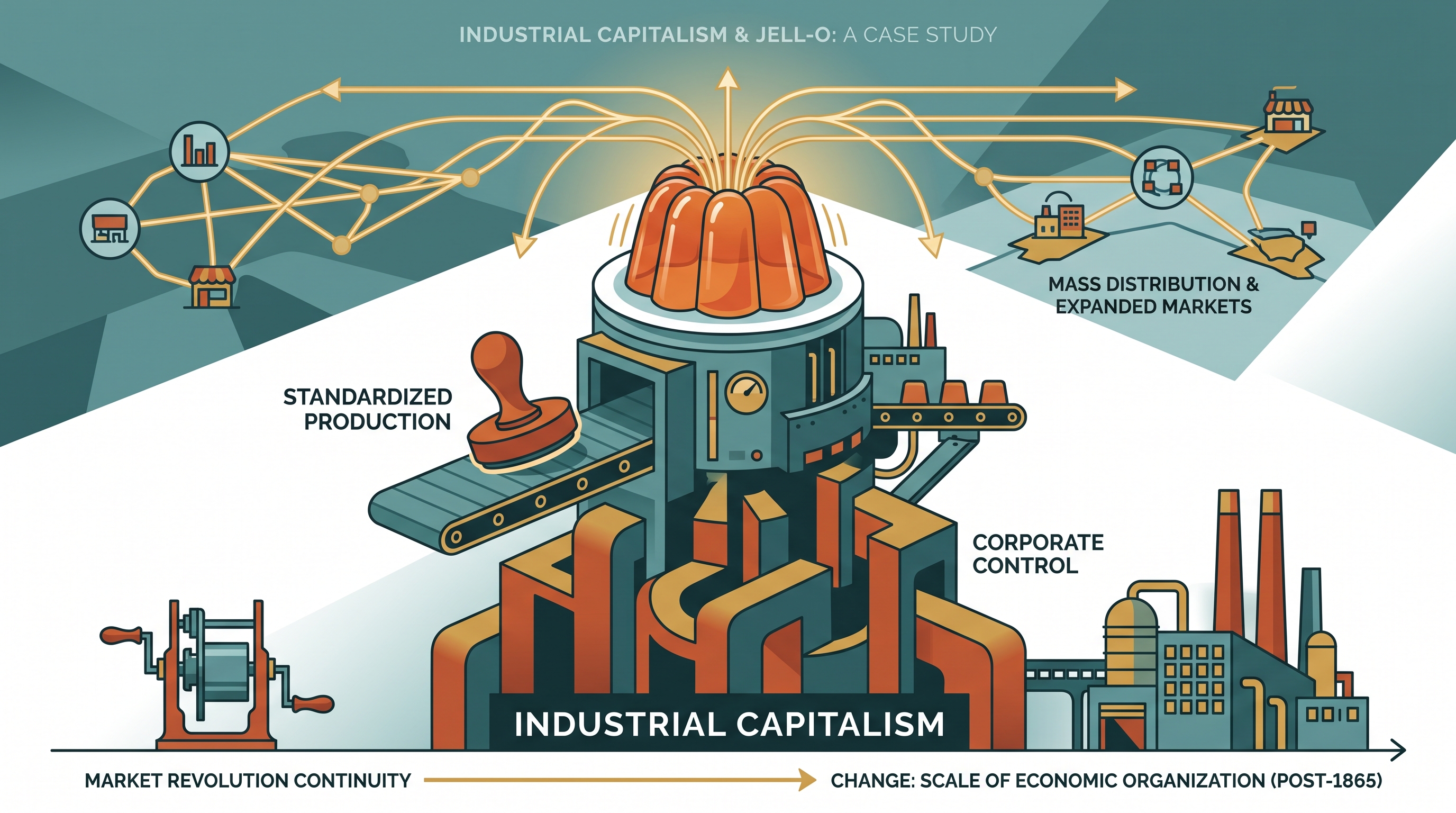
The development and production of Jell-O illustrates how technological and industrial change reached ordinary households. Gelatin had existed before the Gilded Age, but industrial production, standardized packaging, advertising, transportation, and national distribution transformed it into a mass-market product.
The causal chain looks like this:
$$ \text{industrial processing} \rightarrow \text{standardized product} \rightarrow \text{mass production} \rightarrow \text{national distribution} \rightarrow \text{mass consumption} $$
Jell-O therefore mattered historically not because it was uniquely revolutionary, but because it demonstrates how industrial capitalism converted a product into a brand. The same system that expanded consumer choice also rewarded firms able to control production, marketing, transportation, and access to markets.
Technology compared across periods
The technology of the Gilded Age continued developments associated with the Market Revolution, but it operated on a much larger scale.
| Market Revolution | Gilded Age |
|---|---|
| Canals, steamboats, early railroads, and mechanical production | National railroad systems, advanced communication networks, and large factories |
| Expanded regional markets | Integrated national and international markets |
| Increased commercial exchange | Created powerful corporations and concentrated industrial wealth |
| Changed work and transportation | Intensified the scale and organization of industrial capitalism |
The important continuity is that technology continued to reduce distance and connect producers with consumers. The major change was scale: late-nineteenth-century systems required vastly more capital, resources, coordination, and government assistance.
Government and corporate power
Industrial capitalism did not develop independently of government. Businesses sought policies that protected investment, supported infrastructure, opened markets, or removed restrictions they considered obstacles to growth. The Chicago, Burlington, and Quincy Railroad offers a revealing example: its president, C. B. Perkins, contacted future Attorney General Richard Olney and asked for help persuading the Cleveland administration to abolish a government restriction or policy.
The episode shows the reciprocal relationship between business and government. Economic activity shaped government policy, while government decisions helped determine which companies could expand. Government was not merely an outside referee; its choices could accelerate, limit, or redirect industrial development.
Instability beneath rapid growth
Rapid development did not produce equal security. Financial panics and economic downturns exposed the risks of an economy dependent on credit, markets, railroads, and industrial investment. Agricultural instability also prompted varied responses from farmers, who faced falling prices, debt, transportation costs, and powerful corporations.
Misconception check — “Industrial capitalism benefited everyone equally.” Industrialization expanded production and created new consumer opportunities, but it also concentrated wealth, increased dependence on corporations, and produced instability for farmers and other groups. Economic growth and economic inequality could occur simultaneously.
AP reasoning in this topic
For KC-6.1, KC-6.1.I, and KC-6.1.II, the most useful AP skill is Skill 6: Argumentation, especially 6.A — Develop a thesis or claim and 6.B — Support an argument using specific and relevant evidence. A strong argument connects technology to mechanisms: railroads expanded markets, factories enabled large-scale production, government policies encouraged investment, and corporations consolidated control.
This topic also activates Skill 1: Developments and Processes, particularly 1.A — Identify a historical concept, development, or process and 1.B — Explain a historical concept, development, or process. Do not merely list inventions; explain how technological change altered production, markets, corporate organization, and government policy.
Retrieval check
In two or three sentences, explain why Jell-O is evidence of industrial capitalism rather than merely a food innovation. Then identify one continuity with the Market Revolution and one major change in the scale of economic organization after 1865. A complete response should mention standardized production, mass distribution, expanded markets, and corporate control.
Source Materials
- AP U.S. History Course and Exam Description
- AP U.S. History Course and Exam Description Clarifications and Corrections
- AP U.S. History Course Overview
- AP U.S. History Course at a Glance
- AP United States History Course at a Glance Poster
- AP United States History
- AP United States History
- AP United States History Sample Syllabus 1