From the free course AP United States History on Lykke
5.11 Failure of Reconstruction · 5.12 Comparison in Period 5
Key concepts: Failure of Reconstruction · Supreme Court interpretation of the Fourteenth Amendment · Limits of federal protection against racial violence · Colfax Massacre · Individual versus state action under constitutional law · Historical comparison as a method of analysis · Using primary-source legal opinions · Defining the scope of historical study
Reconstruction ultimately failed to secure lasting federal protection for African Americans, even though the constitutional amendments adopted after the Civil War created new national definitions of freedom and citizenship.
5.11 Failure of Reconstruction · 5.12 Comparison in Period 5
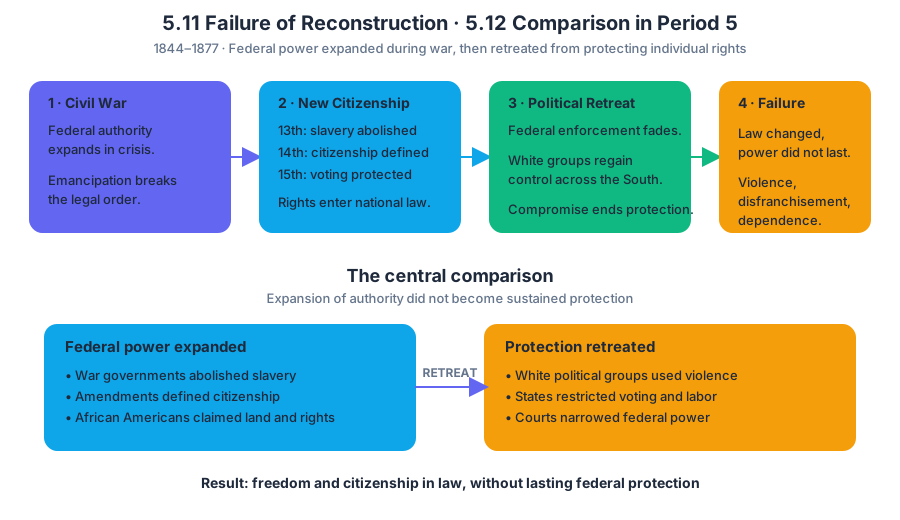
Reconstruction ultimately failed to secure lasting federal protection for African Americans, even though the constitutional amendments adopted after the Civil War created new national definitions of freedom and citizenship. The central contradiction is stark: the federal government could abolish slavery and establish citizenship in law, yet it did not sustain the political and legal power needed to protect Black citizens from racial violence, disenfranchisement, and economic dependence.
Scope of the comparison: Period 5 covers approximately $1844$–$1877, with attention to the United States as a whole and especially the former Confederate South. The comparison connects the Civil War and Reconstruction governments, African Americans seeking citizenship and landownership, southern white political groups, and the Supreme Court’s interpretation of federal power. These boundaries matter because they let us compare the expansion of federal authority during wartime with its later retreat from protecting individual rights.
Why Reconstruction failed
Southern plantation owners continued to control most of the region’s land after Reconstruction. Formerly enslaved people sought landownership, but many could not become economically self-sufficient. Sharecropping—an arrangement in which farmers worked land owned by someone else in exchange for a share of the crop—often trapped Black families and poor white farmers in debt. This economic dependence made political independence difficult: a person who owed money to a landowner could face eviction, job loss, or violence for challenging local authority.
The failure was also political and legal. Segregation, racial violence, local political tactics, and Supreme Court decisions progressively weakened African American rights. The Fourteenth and Fifteenth Amendments remained in the Constitution, but constitutional language alone could not guarantee safety when federal enforcement declined and local authorities tolerated or participated in racial terror.
Misconception check — “Reconstruction failed because the amendments were meaningless.” The amendments were not meaningless. The Fourteenth and Fifteenth Amendments later became foundations for twentieth-century civil-rights decisions. The more precise conclusion is that Reconstruction failed to enforce those promises consistently in the nineteenth century.
The Fourteenth Amendment and federal protection
The Fourteenth Amendment defined national citizenship and required states to respect due process and equal protection. The key constitutional question was whether the amendment allowed the federal government to punish private individuals who violated other people’s rights, or whether it mainly restricted governments themselves.
In United States v. Cruikshank (1876), arising from the Colfax Massacre, the Supreme Court interpreted the Fourteenth Amendment narrowly. The majority held that the amendment did not give the federal government general authority to punish individuals for violence committed against other individuals. Its reasoning treated the amendment primarily as a limit on state action—official conduct by state governments—not as a broad federal guarantee against every private act of racial violence.
This distinction weakened federal protection. If a white mob attacked Black citizens but local and state officials failed to prosecute the attackers, victims could not automatically rely on the Fourteenth Amendment to obtain federal intervention. The ruling therefore stripped victims of racial violence of an important federal legal remedy precisely when local systems were least willing to protect them.
Reading the majority opinion as evidence
When analyzing the assigned portions of the Supreme Court majority opinion, separate the Court’s claim, constitutional reasoning, and historical consequence:
| Analytical question | What to identify |
|---|---|
| Claim | What protection does the Court say the Fourteenth Amendment provides? |
| Reasoning | Does the Court distinguish state action from private action? |
| Consequence | What happens when local authorities do not protect victims? |
| Historical significance | How does the interpretation limit Reconstruction’s promise? |
The opinion’s legal logic may appear formally neutral because it applies a general rule about federalism and state action. Its practical effect, however, was unequal: racial violence in the South was often carried out by private groups with the cooperation or inaction of local officials. A rule that required state responsibility to be clearly demonstrated could leave Black victims without protection when state authorities deliberately refused to act.
The Colfax Massacre as a worked example
In the Colfax Massacre of $1873$, armed white attackers overwhelmed Black Republican defenders in Colfax, Louisiana, after a disputed election. The violence demonstrated that emancipation and citizenship did not automatically produce physical security or political equality. Federal prosecutors brought charges under federal enforcement laws, but the Supreme Court’s later interpretation weakened the legal basis for prosecuting such private violence.
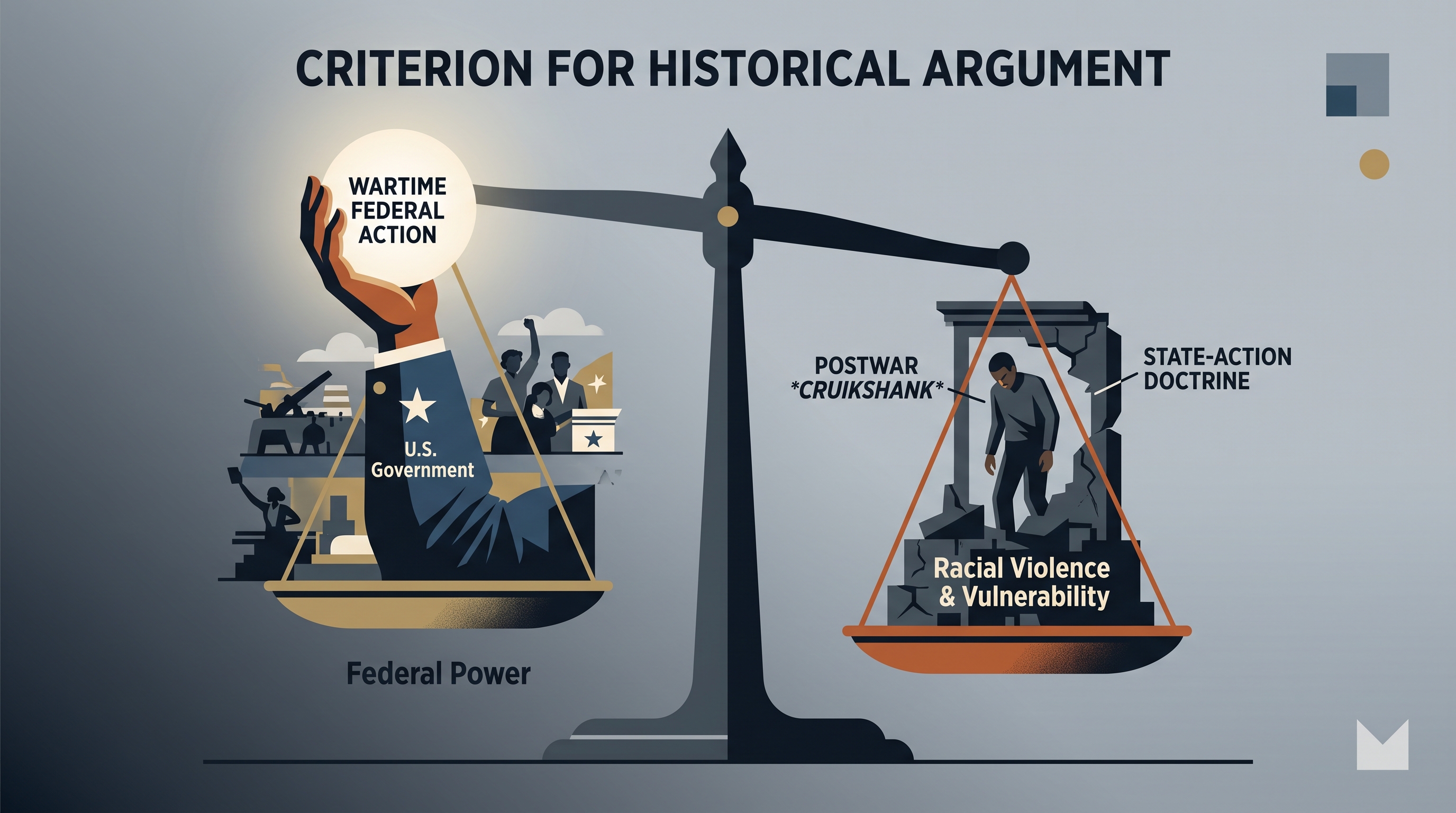
Worked comparison: Use federal protection as the criterion. During the Civil War and early Reconstruction, the national government expanded its role: it defeated the Confederacy, abolished slavery through the Thirteenth Amendment, and supported new constitutional protections. By the mid-$1870$s, however, decisions such as Cruikshank narrowed the federal government’s ability to respond when private mobs attacked African Americans.
The comparison shows both change and continuity. The change was the expansion and then contraction of federal authority. The continuity was the persistence of racial power: land remained concentrated, local white leaders resisted Black political participation, and violence enforced the social order. A strong historical argument must include both sides rather than labeling Reconstruction simply a success or a failure.
Comparison as historical argument
Topic 5.12 emphasizes Skill 3.C: Claims and Evidence in Sources and comparison as a method of argumentation. Comparing sources or developments means more than listing similarities and differences. It requires a criterion—such as citizenship, federal power, landownership, or protection from violence—and an explanation of why the comparison reveals historical change.
Retrieval check: In one sentence, explain why the Colfax Massacre exposed the limits of Reconstruction. Then compare wartime federal action with the postwar interpretation in Cruikshank using the criterion of federal protection. A complete answer should identify the shift from national enforcement to a narrower state-action doctrine and explain why that shift left victims of racial violence vulnerable.
Source Materials
- AP U.S. History Course and Exam Description
- AP U.S. History Course and Exam Description Clarifications and Corrections
- AP U.S. History Course Overview
- AP U.S. History Course at a Glance
- AP United States History Course at a Glance Poster
- AP United States History
- AP United States History
- AP United States History Sample Syllabus 1