From the free course AP United States History on Lykke
7.1 Contextualizing Period 7 · 7.2 Imperialism: Debates
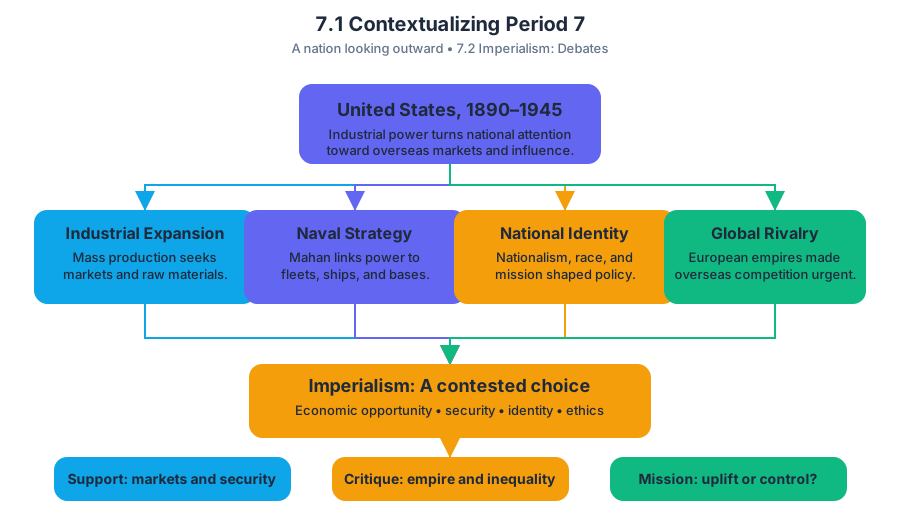
By 1890, the United States had become an industrial power with expanding factories, railroads, cities, financial institutions, and overseas trade—but Americans sharply disagreed about what that power should do beyond the continent.
7.1 Contextualizing Period 7 · 7.2 Imperialism: Debates
By 1890, the United States had become an industrial power with expanding factories, railroads, cities, financial institutions, and overseas trade—but Americans sharply disagreed about what that power should do beyond the continent. Imperialism, the policy of extending a nation’s political, economic, or military influence over other peoples and territories, became one of the defining debates of Period 7, 1890–1945.
7.1 Contextualizing Period 7: A nation looking outward
The period opened after the Civil War and Reconstruction had transformed the United States. Industrial growth increased national wealth and production, while westward expansion, the completion of transcontinental railroads, and the incorporation of western lands strengthened federal authority. At the same time, industrial capitalism created intense competition: American businesses sought new markets, investors sought profitable opportunities, and naval strategists argued that overseas bases were essential to national security.
A useful analogy is a factory that has become too productive for its local customers. Its owners may search for new buyers, cheaper supplies, and protected shipping routes. That analogy captures one part of American expansion after 1890—but it can mislead if it makes imperialism seem purely economic. National identity, racial theories, Christian missionary activity, military strategy, and competition with European empires also shaped policy.
Learning Objective 7.1.A — Explain the context for the development of the United States in the period 1890 to 1945. The context includes several connected developments:
- Industrial and economic expansion: Mass production and corporate growth encouraged Americans to seek foreign markets and access to raw materials.
- Naval and strategic expansion: Alfred Thayer Mahan’s argument that national power depended on a modern navy, a strong merchant fleet, and overseas bases influenced policymakers.
- Nationalism and racial ideology: Some Americans claimed that Anglo-Saxon or “civilized” nations had a duty to govern supposedly less-developed peoples. These ideas supplied an ideological defense for imperial rule.
- Reform and social tension: Urban poverty, labor conflict, immigration, and racial violence produced domestic debates about democracy and citizenship. Those tensions shaped how Americans interpreted expansion abroad.
- Global competition: European powers had already established colonial empires in Africa and Asia. Supporters of expansion feared that the United States would become economically and strategically weaker if it remained outside this competition.
Retrieval check: Why did industrialization encourage overseas expansion, and why is industrialization alone an incomplete explanation? A strong answer connects production and markets to at least one additional factor, such as naval strategy, nationalism, racial ideology, or global rivalry.
7.2 Imperialism: Debates
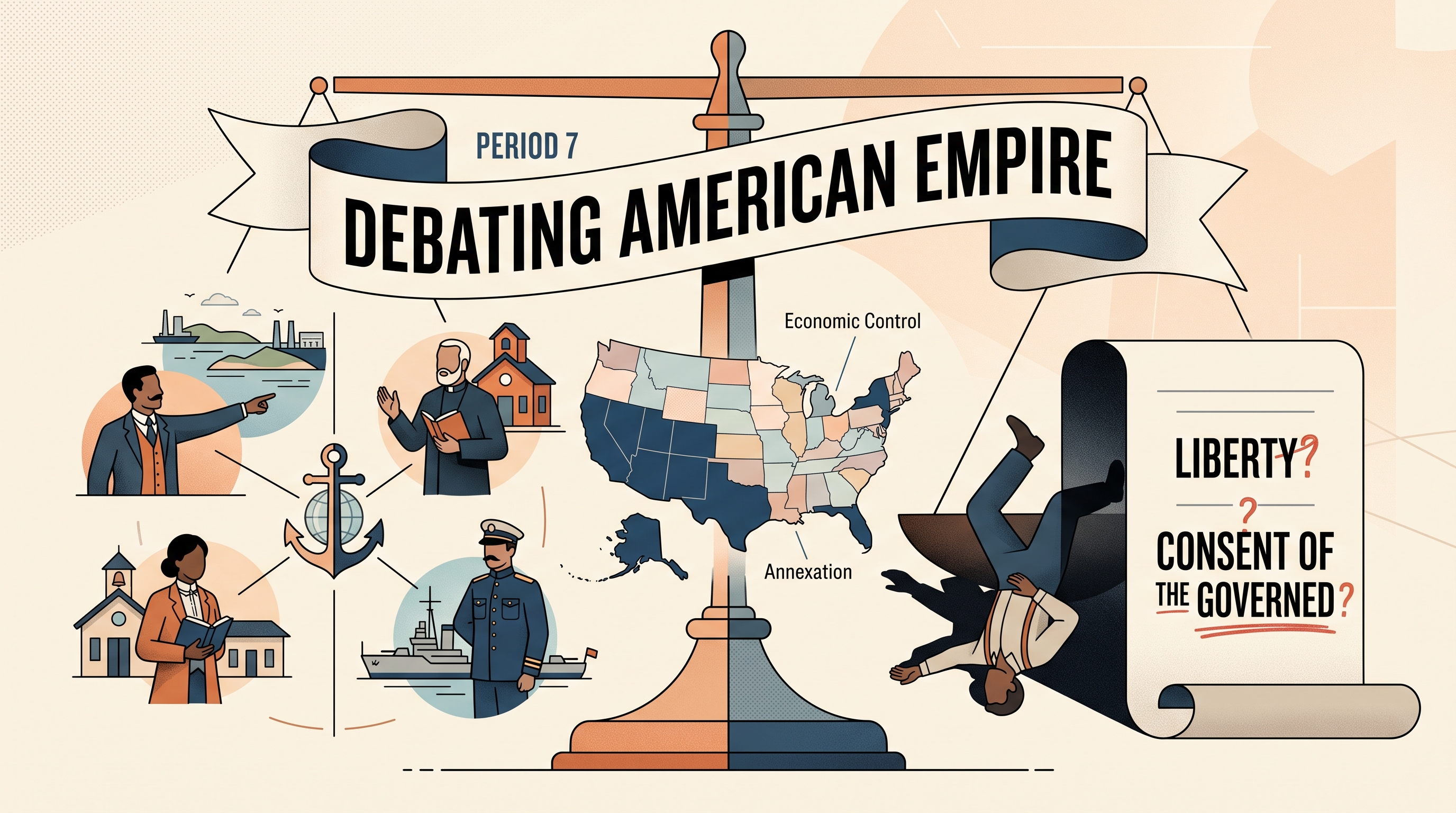
Imperialism created a conflict between power and principle. Supporters argued that overseas expansion would strengthen the economy, protect trade, spread Christianity and “civilization,” and give the United States international influence. Opponents responded that ruling people without their consent contradicted the Declaration of Independence and the republican traditions Americans claimed to defend.
The debate was not simply “expansionists versus isolationists.” Many anti-imperialists supported a powerful United States but rejected colonial rule. The Anti-Imperialist League included people with different motives: some defended self-government, some feared the costs of empire, some opposed racial hierarchy, and some worried that imperial possessions would bring nonwhite populations into the American political system.
Supporters of imperialism also disagreed about methods. Some favored formal annexation and direct political control; others preferred informal influence through trade, investment, military pressure, or unequal diplomatic agreements. This distinction matters because a country can exercise imperial power without formally declaring a colony.
A worked sourcing example
Imagine a newspaper editorial arguing that the United States should govern an overseas island because its inhabitants were “not ready” for self-government. To source it, begin with the author’s likely point of view: the writer may be a nationalist, business advocate, missionary, military strategist, or believer in racial hierarchy. Then identify the purpose: the editorial is trying to persuade readers and justify political control. Finally, connect the argument to its historical situation: the United States was debating overseas expansion while European empires were competing for territory.
The strongest interpretation does more than label the source “biased.” It explains how the author’s assumptions shaped the argument. For example: Because the editorial was written during an era of global imperial competition and reflected racial theories about “civilization,” its claim that foreign rule was benevolent helped transform conquest into a supposed obligation.
Skill 4.B — Explain how a historical development relates to another historical development. Imperialism debates should be connected to industrialization, nationalism, racial ideology, naval expansion, and the earlier American tradition of territorial growth.
Sourcing also activates Skill 2.B — Explain the point of view, purpose, historical situation, or audience of a source. On a DBQ, naming the author’s position earns little by itself; the analysis must show why that position mattered and how it shaped the source’s claims.
Misconception check
Misconception: “All imperialism supporters wanted the same thing.” Correction: expansionists shared a belief that overseas influence could benefit the United States, but they differed over annexation, economic control, military occupation, citizenship, and the meaning of self-government. Likewise, anti-imperialists did not necessarily favor weakness or complete withdrawal from world affairs.
The central contradiction of Period 7 is therefore clear: the United States presented itself as a nation founded on liberty while debating whether it should govern people who had not consented to American rule. That contradiction would become concrete in the Spanish–American War and the arguments over territories acquired afterward.
Final retrieval check: Construct a two-part explanation: first, identify one material cause of American imperialism; second, explain why an anti-imperialist might argue that the resulting policy violated American ideals.
Source Materials
- AP U.S. History Course and Exam Description
- AP U.S. History Course and Exam Description Clarifications and Corrections
- AP U.S. History Course Overview
- AP U.S. History Course at a Glance
- AP United States History Course at a Glance Poster
- AP United States History
- AP United States History
- AP United States History Sample Syllabus 1
- AP US History Past Exam Questions — AP Central
- Khan Academy — AP US History
- Gilder Lehrman Institute — AP US History Study Guide
- AP US History Units — Save My Exams