From the free course AP United States History on Lykke
AP Practice 2
Key concepts: Columbian Exchange · Smallpox and other diseases introduced to the Americas · Horses and other animals introduced to the Americas · Enslavement laws in colonial New York · John Dickinson’s opposition to the Townshend Acts · Boston Massacre Oration by John Hancock · Identifying claims, reasons, and evidence in primary sources · Whiskey Rebellion and federal authority · Antebellum reform movements, including deaf education and mental-health reform · Transportation, immigration, and global trade in the nineteenth century
Task type: Short-Answer Questions (SAQs). On the current AP U.S. History exam, SAQs reward concise historical reasoning rather than extended essays.
AP Practice 2
Task type: Short-Answer Questions (SAQs). On the current AP U.S. History exam, SAQs reward concise historical reasoning rather than extended essays. A strong response usually does three things: identifies a historically accurate development, explains a connection or significance, and uses specific evidence rather than repeating the prompt.
Core skill: Distinguish an author’s claim—the position the author wants the audience to accept—from the reasons supporting that claim and the evidence used to make those reasons convincing.
Timing target: Allow about $13$ minutes for one three-part SAQ. Spend roughly $2$ minutes reading, $8$ minutes writing, and $3$ minutes checking whether each answer directly addresses its lettered task. Each part is scored independently, so a missed part does not erase points earned elsewhere.
SAQ 1 — Exchange, disease, animals, and colonial power
The Columbian Exchange connected the Americas, Europe, and Africa after the voyages of European explorers. Its effects included the introduction of smallpox and other diseases into the Americas, as well as the arrival of horses and other animals previously unfamiliar to many Native American societies.
A. Identify one major demographic consequence of the Columbian Exchange in the Americas.
B. Explain one way the introduction of horses changed interactions among Native American peoples or between Native Americans and Europeans.
C. Explain one reason the Columbian Exchange strengthened European conquest or colonization.
Worked reasoning
A — Earn the point by connecting smallpox to population change. Smallpox caused severe population decline among many Native American communities because they lacked previous exposure and therefore had limited immunity. Avoid saying simply that “disease spread”; identify the demographic effect.
B — Earn the point by explaining a mechanism. Horses increased mobility, hunting capacity, and military effectiveness for some Native American groups. A complete answer explains how horses mattered rather than merely naming them.
C — Earn the point by connecting disease to power. Population loss weakened communities’ ability to resist European invasion, disrupted political structures, and made conquest easier. European advantages therefore involved more than weapons: disease and ecological change also reshaped the balance of power.
Common misconception: The Columbian Exchange was not a balanced or equal exchange of benefits. Crops, animals, people, and diseases moved in multiple directions, but epidemic disease produced especially devastating consequences in the Americas.
SAQ 2 — Law, resistance, and revolutionary argument
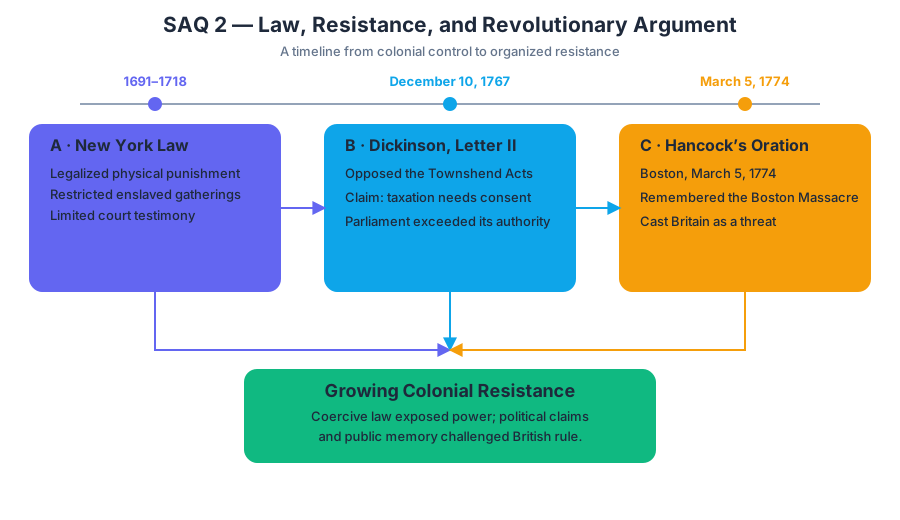
A New York law in force from 1691 to 1718 legalized physical punishment of enslaved people by European New Yorkers, restricted gatherings of enslaved people, and limited their ability to testify in court. Decades later, John Dickinson’s Letters from a Farmer in Pennsylvania, Letter II, dated December 10, 1767, opposed the Townshend Acts. John Hancock delivered the Boston Massacre Oration in Boston on March 5, 1774, reflecting growing anti-British sentiment.
A. Explain one way the New York law illustrates the relationship between law and slavery in the British colonies.
B. Identify Dickinson’s central claim about the Townshend Acts and explain one reason he used to support it.
C. Explain one way Hancock’s oration could intensify colonial resistance to British rule.

Source Materials
- AP U.S. History Course and Exam Description
- AP U.S. History Course and Exam Description Clarifications and Corrections
- AP U.S. History Course Overview
- AP U.S. History Course at a Glance
- AP United States History Course at a Glance Poster
- AP United States History
- AP United States History
- AP United States History Sample Syllabus 1
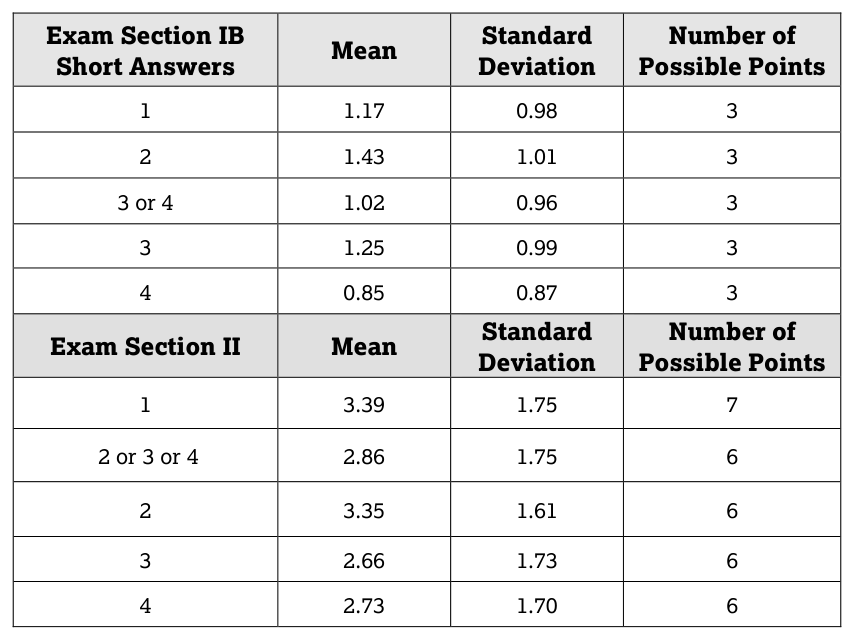
- Figure — Scoring Statistics – Set 2 (p. 1)
- AP US History Past Exam Questions — AP Central
- Khan Academy — AP US History
- Gilder Lehrman Institute — AP US History Study Guide