From the free course AP United States History on Lykke
4.11 An Age of Reform · 4.12 African Americans in the Early Republic
Key concepts: Antebellum reform and abolitionism · African American community institution-building · The African Meeting House in Boston · Free Black communities in the early republic · Proslavery arguments based on poverty and racial inequality · African American resistance to slavery · Congo Square and African American cultural continuity in New Orleans · African American intellectual and political activism · Black religious, educational, and civic organizations
A free Black community in Boston built the African Meeting House in 1806—not merely as a place of worship, but as a school, abolitionist meeting place, and center for collective action.
4.11 An Age of Reform · 4.12 African Americans in the Early Republic
Abolition did not begin with a single speech or law; it grew through institutions that allowed free and enslaved African Americans to worship, teach, organize, publish, and resist. The African Meeting House in Boston captures this transformation: built by Boston’s free Black community in 1806, it functioned simultaneously as a church, school, abolitionist meeting place, and center for community organizations.
Reform and abolitionism
Antebellum reform refers to the wave of organized efforts in the early nineteenth century to correct perceived social and moral problems. Religious revivalism, especially evangelical Protestantism, encouraged many Americans to believe that individuals and communities could deliberately improve society. Reformers attacked issues such as alcohol abuse, inadequate education, harsh prisons, and slavery.
Abolitionism was the movement to end slavery. Abolitionists disagreed about methods—some relied on moral persuasion, others on political action, petitions, newspapers, or direct resistance—but they shared the claim that slavery was incompatible with the nation’s ideals of liberty and human equality.
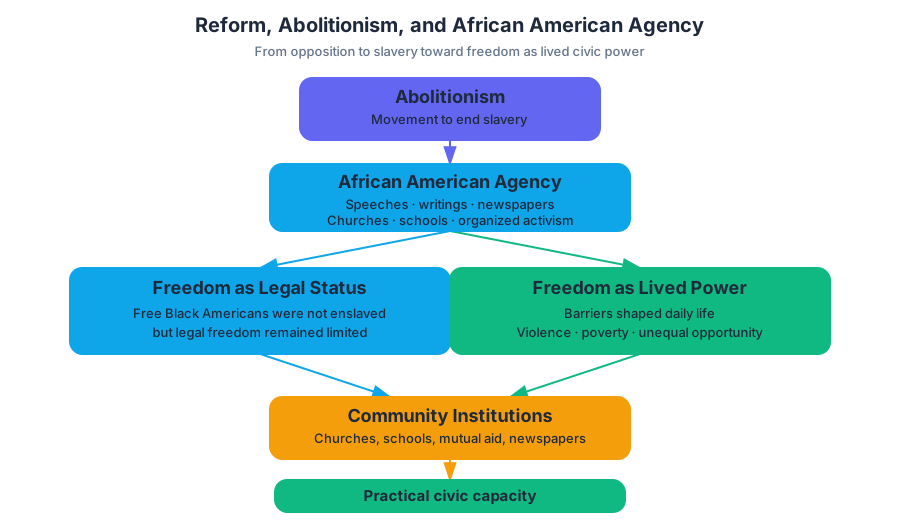
African Americans were not merely subjects of white reform campaigns. They built their own churches, schools, mutual-aid societies, newspapers, and political organizations. These institutions gave Black communities places to preserve family and cultural life, debate strategy, educate children, and challenge slavery and racial discrimination.
African American community institution-building
Free Black communities faced legal restrictions, economic discrimination, violence, and the constant danger that slavery could expand or that free people could be kidnapped. Institution-building therefore served two purposes: it strengthened daily community life and created a platform for collective resistance.
The church was especially important. It was a place of worship, but also a schoolroom, meeting hall, political forum, and source of mutual aid. Community organizations could collect funds, support families in crisis, promote literacy, and coordinate opposition to slavery.
The African Meeting House
The African Meeting House in Boston illustrates how one building could concentrate several forms of power. Constructed by Boston’s free Black community in 1806, it served as a church and school while also hosting abolitionists and community organizations. Its significance lies not only in its architecture but in the authority it represented: African Americans created and controlled a public institution devoted to their community’s needs.
The building also challenges a common misconception: free did not mean equal. Free Black Bostonians could organize institutions, but they still confronted racial inequality and insecure civil rights. Their meeting house was therefore both a place of community independence and a response to exclusion from white-controlled institutions.
Free Black communities and cultural survival
Free Black communities formed in northern cities and in parts of the South, while enslaved people created their own networks under far more dangerous conditions. Family ties, religious practices, oral traditions, music, work skills, and collective gatherings helped African Americans preserve identity despite legal and physical attempts to control them.
Congo Square in New Orleans represents this cultural dimension of community life. Enslaved people gathered there to perform music and dance, sustaining forms of collective expression within a society organized around unfree labor. Such practices were not evidence that slavery was benign; they show how people maintained culture and solidarity under coercion.
Proslavery arguments
As abolitionism gained strength, defenders of slavery developed arguments intended to make racial inequality appear natural, necessary, or beneficial. One argument claimed that African Americans were poor because of racial inferiority and therefore required white control. Another reversed the cause and effect: because slavery had deprived Black people of wealth, education, and legal rights, proslavery writers used their resulting poverty as supposed evidence that they were incapable of independence.
These arguments treated conditions produced by slavery as proof that slavery was justified. The logical flaw is circular: slavery created inequality, and slaveholders then cited that inequality to defend slavery.
| Abolitionist claim | Proslavery response | Historical problem |
|---|---|---|
| Slavery violates liberty and human dignity. | Enslaved people supposedly need white guardianship. | The argument denies freedom in order to claim that freedom is impossible. |
| African Americans deserve education and citizenship. | Poverty and limited education supposedly prove racial inferiority. | Slavery itself restricted education, property, movement, and legal rights. |
| Enslaved people resist because slavery is oppressive. | Resistance supposedly proves Black people are disorderly. | Resistance can instead reveal the coercion of the system. |
African American resistance to slavery
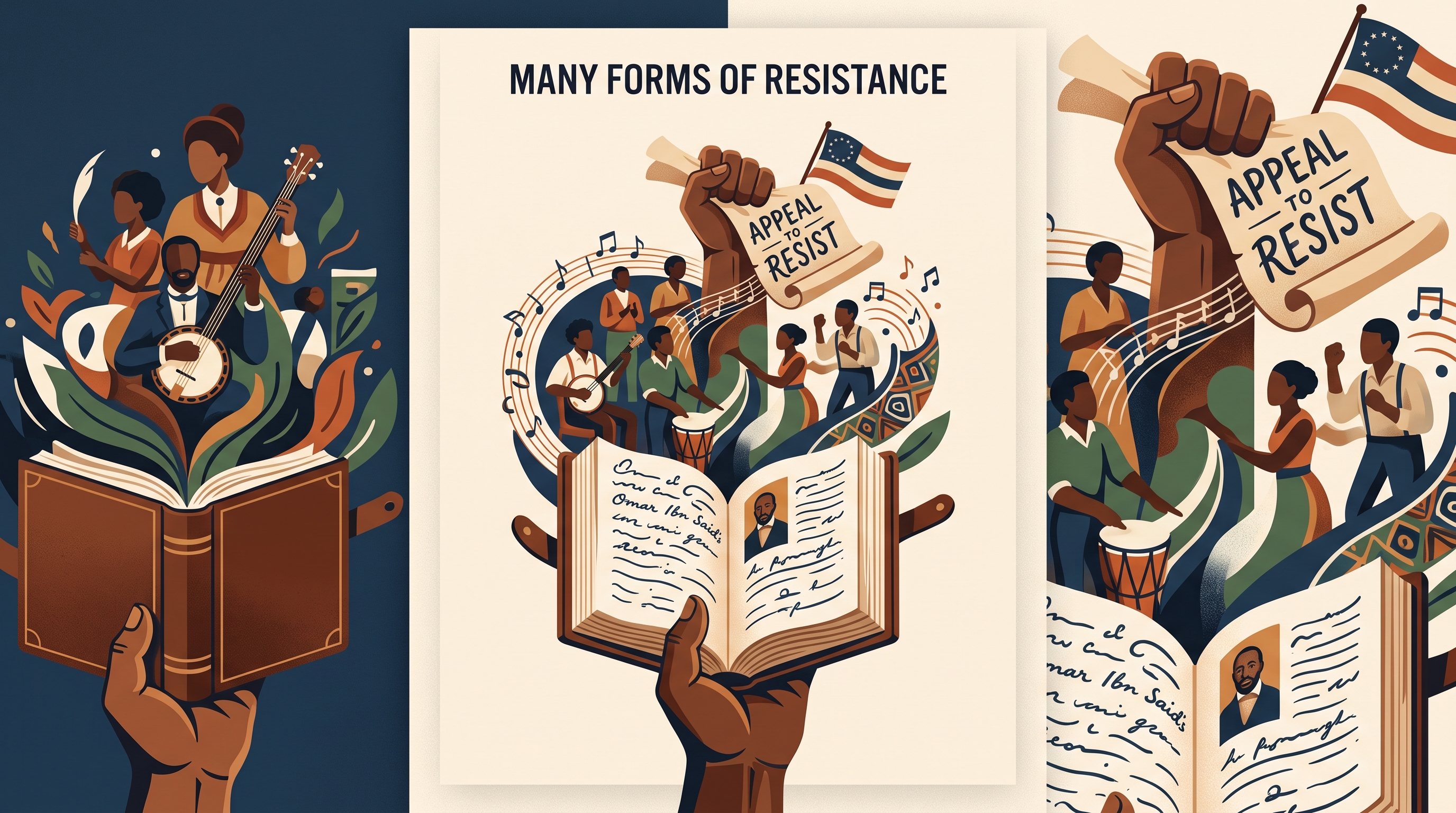
Resistance took many forms. Enslaved people preserved family and religious life, slowed or disrupted work, escaped, communicated secretly, learned despite restrictions, and sometimes rebelled openly. These actions differed in scale, but each asserted that enslaved people were human actors rather than property without will.
Omar Ibn Said’s autobiography provides an individual perspective on enslavement and resistance. An educated Muslim born in Africa, he described his early life, his arrival in the United States, and the circumstances of his enslavement. His act of writing—preserving his own voice and history—resisted the slave system’s attempt to define him solely as property.
A useful AP historical argument connects institutions and resistance: African American communities built organizations because slavery and racism threatened autonomy; those organizations then made education, worship, abolitionist activism, and collective resistance more sustainable. The African Meeting House is therefore evidence of both community formation and opposition to racial oppression.
Retrieval check and DBQ move
Quick check: Why is the African Meeting House stronger evidence of community agency than a simple example of religious practice? Because its functions extended across worship, education, abolitionism, and organization, demonstrating that free Black Bostonians created a coordinated public sphere.
DBQ-style prompt: Evaluate the extent to which African Americans shaped reform and resistance in the early republic. A defensible thesis would argue that African Americans were central actors: they built independent institutions, preserved cultural communities, produced testimony such as Omar Ibn Said’s autobiography, and resisted slavery through both everyday actions and organized abolitionism. A strong response should also explain the limits imposed by racial discrimination and proslavery ideology.
Source Materials
- AP U.S. History Course and Exam Description
- AP U.S. History Course and Exam Description Clarifications and Corrections
- AP U.S. History Course Overview
- AP U.S. History Course at a Glance
- AP United States History Course at a Glance Poster
- AP United States History
- AP United States History
- AP United States History Sample Syllabus 1