From the free course AP United States History on Lykke
8.15 Continuity and Change in Period 8
The United States changed dramatically between 1945 and 1980, yet many older patterns—racial inequality, economic competition, global power politics, and debates over federal authority—remained remarkably persistent.
8.15 Continuity and Change in Period 8
The United States changed dramatically between 1945 and 1980, yet many older patterns—racial inequality, economic competition, global power politics, and debates over federal authority—remained remarkably persistent. The central historical problem is therefore not whether the period changed, but which developments changed, which continued, and why.
8.15 Continuity and Change in the Period 8 asks you to weigh transformation against persistence across 1945–1980 rather than treating the period as one uninterrupted “modern” revolution.
The period at a glance
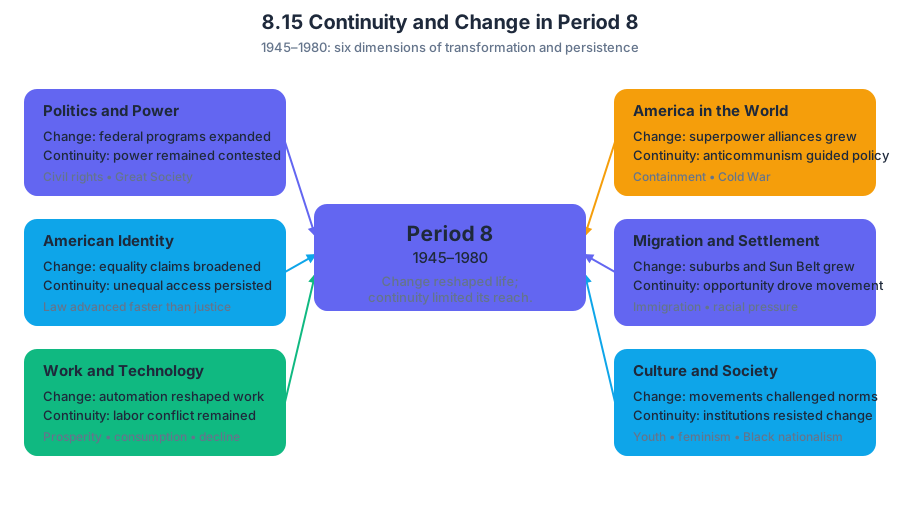
| Dimension | Major change, 1945–1980 | Important continuity |
|---|---|---|
| Politics and power | The federal government expanded its role through civil rights and Great Society programs, while later resistance challenged that expansion. | Americans continued debating how much power the federal government should possess. |
| American identity | Civil rights activism broadened public claims about equality and citizenship. | Racial discrimination and unequal access to power persisted despite legal victories. |
| America in the world | The United States became a permanent global superpower engaged in containment and military alliances. | Fear of communism continued to shape foreign and domestic policy. |
| Work, exchange, and technology | Postwar prosperity, automation, consumer culture, and deindustrialization reshaped daily life. | Economic inequality and conflict between labor and management remained. |
| Migration and settlement | Suburbanization, Sun Belt growth, and immigration transformed population patterns. | Migration continued to reflect economic opportunity and racial or political pressure. |
| Culture and society | Youth culture, feminism, Black nationalism, and other movements challenged older social norms. | Social movements still faced institutional resistance and unequal treatment. |
How to reason about continuity and change
Continuity means an important pattern remains recognizable across time. Change means a development alters institutions, relationships, beliefs, or lived experiences. Strong historical analysis does not merely list examples; it explains the extent of change and identifies the forces producing both outcomes.
A useful method is to build a three-part argument:
- Identify the baseline: What pattern existed around 1945?
- Measure the change: What was different by 1980?
- Qualify the claim: What persisted, limited, or redirected that change?
For example, civil rights produced major political change. Supreme Court decisions, federal legislation, and presidential enforcement weakened legalized segregation and expanded voting protections. Yet the persistence of residential segregation, economic inequality, and resistance to integration shows that legal transformation did not immediately create social equality.
Worked contextual example: federal power
In 1945, the federal government already possessed enormous authority because of the New Deal and World War II. Between 1945 and 1980, that authority expanded further through Brown v. Board of Education, the Civil Rights Act of 1964, the Voting Rights Act of 1965, Medicare, Medicaid, and other Great Society programs.
However, the direction of federal power changed by the 1970s. Opposition to busing, taxation, regulation, and welfare programs helped fuel a conservative political reaction. The continuity was the persistent national argument over federal intervention; the change was that the federal government moved from primarily managing economic crisis and war to directly confronting racial inequality and administering broader social programs.
Historically defensible claim: From 1945 to 1980, federal power expanded substantially in its responsibilities for civil rights and social welfare, but the legitimacy and limits of that expansion remained contested, producing a conservative backlash by the end of the period.
Skill focus: 6.D — Corroborate, qualify, or modify an argument
Topic 8.15 is aligned with Skill 6.D — Corroborate, Qualify, or Modify an Argument. To earn this skill, do more than attach a second fact to your claim. Use evidence that confirms the argument, reveals an exception, or forces a more precise conclusion.
Weak reasoning: “The civil rights movement changed America because segregation became illegal.”
Stronger reasoning: “The movement transformed federal law by outlawing segregation and protecting voting rights, but its effects were limited by local resistance, economic inequality, and continuing residential segregation. Thus, it changed the legal meaning of equality more quickly than it changed everyday social conditions.”
Common misconception
Misconception: “Continuity” means that nothing changed. In historical writing, continuity can coexist with major transformation. The civil rights era changed laws and political expectations while preserving many unequal economic and social structures.
Retrieval and interpretation check
Prompt: Which argument best demonstrates continuity and change in Period 8?
A. The United States experienced change in every area of life after 1945.
B. The period was mostly continuous because older problems remained.
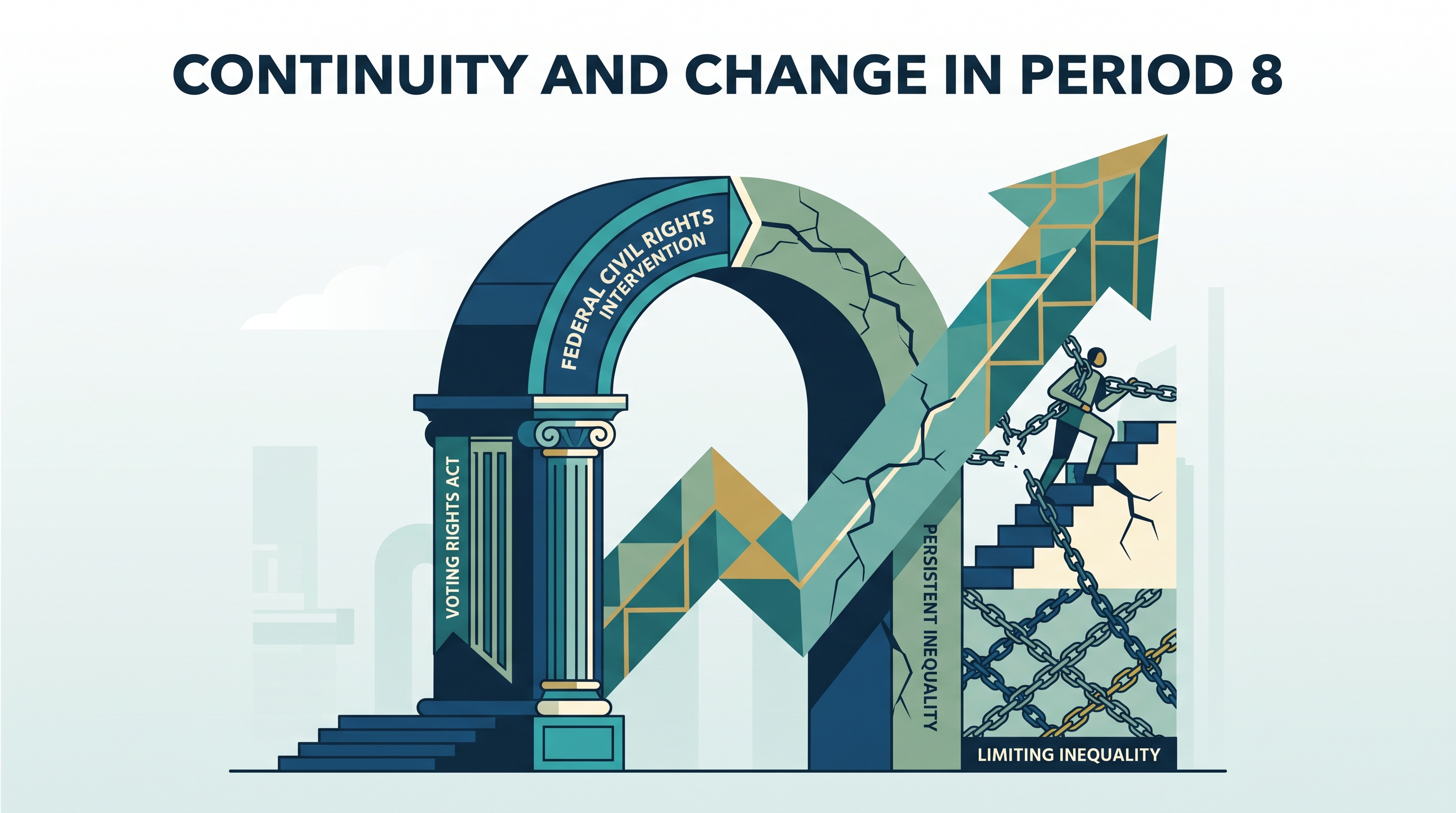
C. Federal civil rights intervention marked major political change, but persistent inequality limited the transformation’s reach.
D. Cultural change mattered more than political change because youth culture expanded.
Answer: C. It identifies a specific change, supplies a continuing pattern, and qualifies the overall judgment—the core reasoning required by Skill 6.D.
Source Materials
- AP U.S. History Course and Exam Description
- AP U.S. History Course and Exam Description Clarifications and Corrections
- AP U.S. History Course Overview
- AP U.S. History Course at a Glance
- AP United States History Course at a Glance Poster
- AP United States History
- AP United States History
- AP United States History Sample Syllabus 1