From the free course AP United States History on Lykke
3.9 The Constitution · 3.10 Shaping a New Republic
Key concepts: State constitutions · Massachusetts State Constitution of 1780 · Natural rights · Representative self-government · U.S. Constitution · Bill of Rights · Executive branch · Political parties · George Washington’s Farewell Address · National unity and foreign policy
The Constitution did more than create a national government: it created a system that had to be interpreted, operated, and defended by real people. The first presidents therefore established precedents—early examples that later leaders could follow—while disagreements over constitutional power helped produce the…
3.9 The Constitution · 3.10 Shaping a New Republic
The Constitution did more than create a national government: it created a system that had to be interpreted, operated, and defended by real people. The first presidents therefore established precedents—early examples that later leaders could follow—while disagreements over constitutional power helped produce the nation’s first political parties.
Learning Objective L: Explain how and why political ideas, institutions, and party systems developed and changed in the new republic.
State constitutions: rights and representation
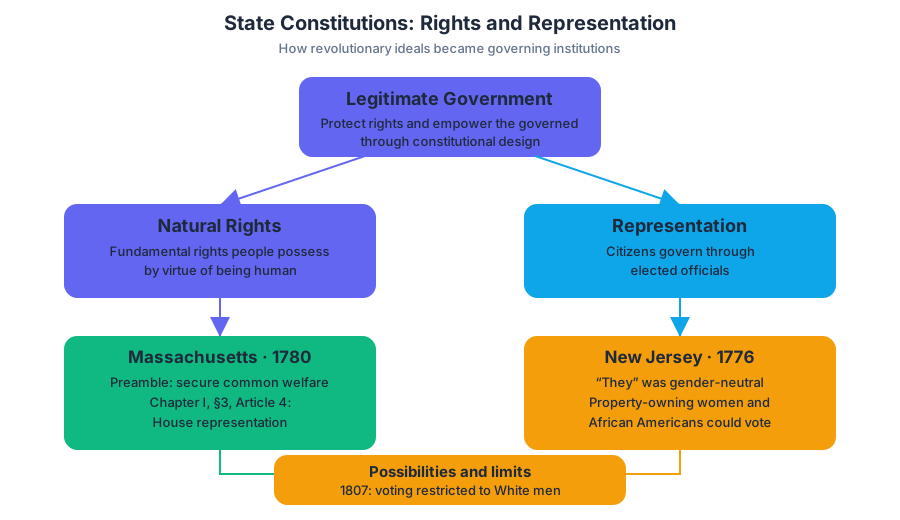
After independence, Americans wrote state constitutions to define government authority and the rights of citizens. The Massachusetts State Constitution of 1780 identified two foundations of legitimate government: protecting natural rights, the rights people possess by virtue of being human, and advancing representative self-government, the principle that citizens govern through elected officials.
The Massachusetts Constitution linked rights to institutions. Its Preamble presented government as responsible for securing the common welfare, while Chapter I, Section 3, Article 4 addressed representation in the House of Representatives. The underlying logic was clear: government existed to protect rights, but the people needed representative institutions to control how government exercised power.
State constitutions also revealed that revolutionary ideals were applied unevenly. The New Jersey State Constitution of 1776, for example, used gender-neutral language—“they” rather than “he”—and did not specify racial categories in its voting qualifications. As a result, property-owning women and African Americans could vote under the provision until the legislature restricted voting in 1807 to White male taxpayers. The contrast shows both the possibilities and limits of early republican government.
Natural rights + representation: A government could claim legitimacy only if it protected fundamental rights and allowed the governed some meaningful role in making public decisions.
The Constitution in operation
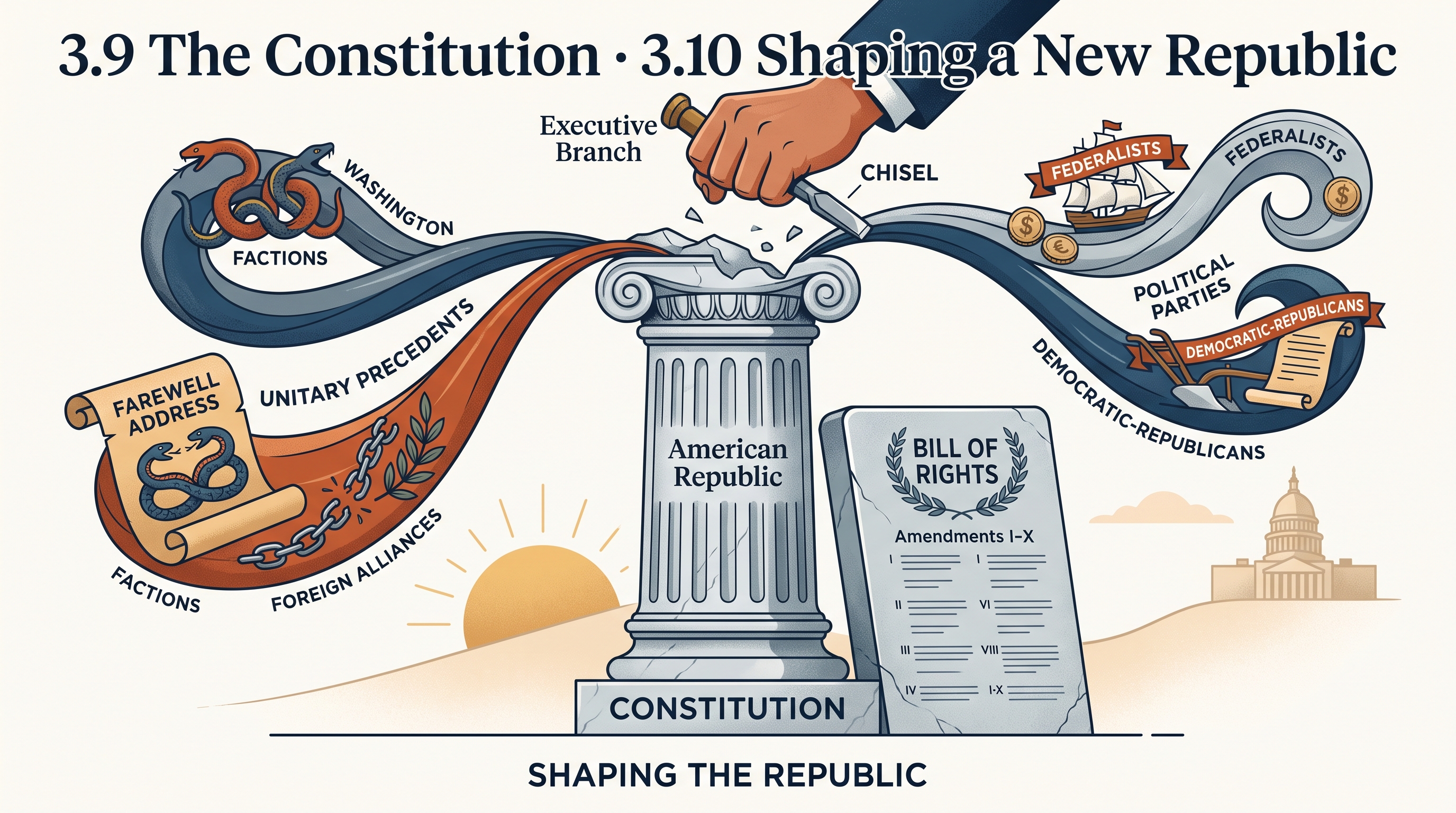
Ratification of the U.S. Constitution established the framework of the new national government. Its executive branch, headed by a president, gave the government a single institution responsible for enforcing laws, conducting diplomacy, and directing national administration. The Constitution also created legislative and judicial branches, but the presidency immediately raised a practical question: how much authority should the executive exercise?
George Washington’s administration answered that question through practice. Washington established a cabinet of department heads, consulted advisers even though the Constitution did not explicitly require a cabinet, and accepted the title “President of the United States.” These choices became precedents: later presidents inherited expectations about executive leadership without needing a constitutional amendment each time.
John Adams added another precedent by occupying the presidency during severe conflict with France and with the opposition Democratic-Republican Party. His administration demonstrated that constitutional government had to survive partisan disagreement, foreign-policy crises, and arguments over the boundaries between liberty and order.
Why political parties formed
The Constitution did not mention political parties, yet parties developed because leaders disagreed about how its powers should be used. In the 1790s, debates centered on the relationship between the national government and the states, economic policy, foreign policy, and the proper balance between liberty and order.
| Political group | Major leaders | General emphasis |
|---|---|---|
| Federalists | Alexander Hamilton | Strong national government, national economic programs, and order |
| Democratic-Republicans | Thomas Jefferson and James Madison | Greater emphasis on states’ rights, agrarian interests, and suspicion of concentrated national power |
These parties were not simply modern ideological teams. Both claimed to defend republican liberty, but they interpreted the Constitution differently. Hamilton’s financial policies represented one vision of energetic national power; Jefferson and Madison feared that such policies could recreate the hierarchy and dependence Americans had resisted.
Common misconception: Political parties did not appear because the Constitution formally authorized them. They emerged because constitutional choices required interpretation, and competing interpretations created organized political coalitions.
Washington’s Farewell Address
George Washington’s Farewell Address became a foundational document concerning national unity and foreign policy. Washington warned that intense factionalism could allow temporary political interests to overpower the nation’s long-term interests. He also cautioned against permanent alliances, especially when they might pull the United States into European conflicts.
To analyze the address, use Skill 2: Sourcing and Situation. Washington’s point of view reflected his experience as the first president and as a revolutionary leader; his purpose was to advise citizens as he left office; the historical situation included growing partisan conflict and international tension; and the likely audience was the American public and future political leaders.
A strong analysis connects those features to meaning: because Washington was leaving office after helping establish national institutions, his warning about faction and foreign entanglement carried unusual authority. The address was not proof that parties were unnecessary; it was an argument that party competition should not destroy national unity.
The Bill of Rights and the new republic
Ratification eventually resulted in the addition of the Bill of Rights, the first ten amendments to the Constitution. The amendments addressed concerns that the new national government might threaten individual liberties. Their addition demonstrated that constitutional government could be revised through an established process when political pressure exposed unresolved fears about rights.
This is a useful example of Skill 5: Making Connections: state constitutions’ concern with natural rights connected to the demand for federal protections. It also supports Skill 3: Claims and Evidence in Sources, because a constitutional document can serve as evidence of what its authors considered dangerous or necessary.
Worked example: sourcing a constitutional-era document
Suppose a document says that government must protect liberty but warns that organized factions may place party loyalty above the nation. Identify it as Washington’s Farewell Address, then reason through the four sourcing questions:
- Point of view: A retiring first president concerned with the survival of the Union.
- Purpose: To offer public advice about national unity and foreign policy.
- Historical situation: Partisan divisions and international pressures in the 1790s.
- Audience: Citizens and future officeholders.
The historical significance follows from the evidence: the document shows that the new republic’s central problem was no longer simply designing institutions, but maintaining constitutional government amid disagreement. An argument using this evidence demonstrates Skill 6: Argumentation when it makes a defensible claim about how early leaders shaped national political practice.
Retrieval check
Why did the Bill of Rights become part of the Constitution, and how did the first two presidents shape the new republic even when they were not changing the constitutional text? A complete answer should mention concerns about natural rights, the executive branch, presidential precedents, political parties, and Washington’s warnings about faction and foreign alliances.
Source Materials
- AP U.S. History Course and Exam Description
- AP U.S. History Course and Exam Description Clarifications and Corrections
- AP U.S. History Course Overview
- AP U.S. History Course at a Glance
- AP United States History Course at a Glance Poster
- AP United States History
- AP United States History
- AP United States History Sample Syllabus 1