From the free course AP United States History on Lykke
5.1 Contextualizing Period 5 · 5.2 Manifest Destiny
Key concepts: Manifest Destiny · westward expansion · contextualization · Period 5 · Louisiana Purchase · Native American-settler conflict · forced removal of Native Americans · closing of the frontier · national growth and identity · AP Historical Thinking Skill 4.B
Manifest Destiny was the belief that the United States was destined to expand westward across North America. In the 1840s, this idea transformed territorial growth from a government policy into a supposed national mission: settlers and politicians presented expansion as natural, progressive, and even ordained.
5.1 Contextualizing Period 5 · 5.2 Manifest Destiny
Manifest Destiny was the belief that the United States was destined to expand westward across North America. In the 1840s, this idea transformed territorial growth from a government policy into a supposed national mission: settlers and politicians presented expansion as natural, progressive, and even ordained.
Period 5 in the larger timeline
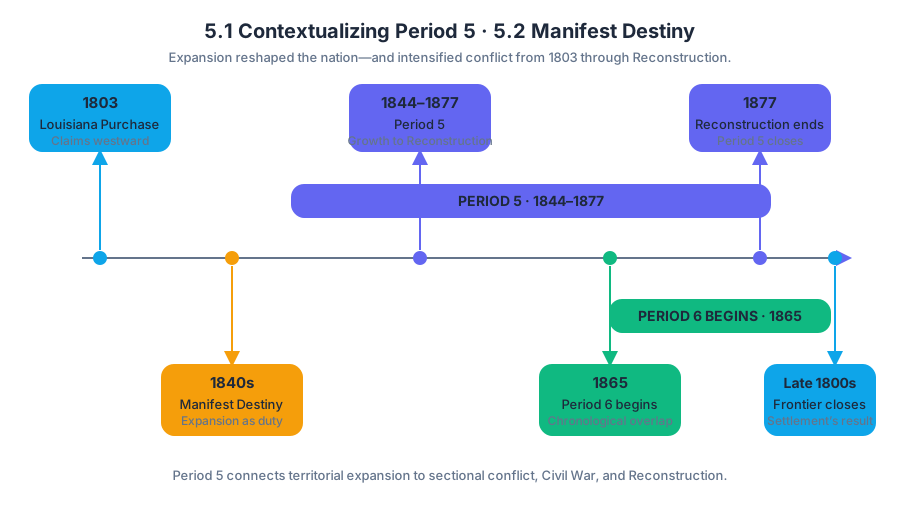
Period 5 covers 1844–1877, but its causes reach backward and its consequences continue forward. The Louisiana Purchase of 1803 greatly enlarged the United States before Manifest Destiny became the dominant language of expansion. Period 5 then includes the intensification of westward settlement, the Civil War, and Reconstruction. Period 6 begins in 1865, so the periods overlap: 1865–1877 belongs both to the end of Period 5’s chronological frame and the beginning of the later period’s developments.
A useful timeline is:
| Date or period | Development | Why it matters here |
|---|---|---|
| 1803 | Louisiana Purchase | Expanded U.S. claims west of the Mississippi River |
| 1840s | Manifest Destiny becomes a powerful public justification | Made expansion appear to be a national obligation |
| 1844–1877 | Period 5 | Links territorial growth to sectional conflict, war, and Reconstruction |
| 1865 | Beginning of Period 6 | Marks the chronological transition into the postwar era |
| Late nineteenth century | Closing of the frontier | Demonstrates the long-term result of continental settlement |
From the Louisiana Purchase to Manifest Destiny
The Louisiana Purchase illustrates the difference between territorial expansion and the later ideology used to justify it. In 1803, President Thomas Jefferson purchased French-controlled Louisiana for $15 million. The acquisition roughly doubled the nation’s territory and provided land for farming, settlement, and future political development. At that moment, however, the phrase “Manifest Destiny” had not yet become the central public argument for expansion.
By the 1840s, expansion was increasingly described as the fulfillment of America’s destiny. Supporters connected westward movement to national power, economic opportunity, and American identity. The language could make the seizure or incorporation of territory sound less like a contested political choice and more like the inevitable progress of the nation.
Key distinction: The Louisiana Purchase was an earlier development that enabled expansion; Manifest Destiny was a later belief used to justify continued expansion.
Expansion and Native American dispossession
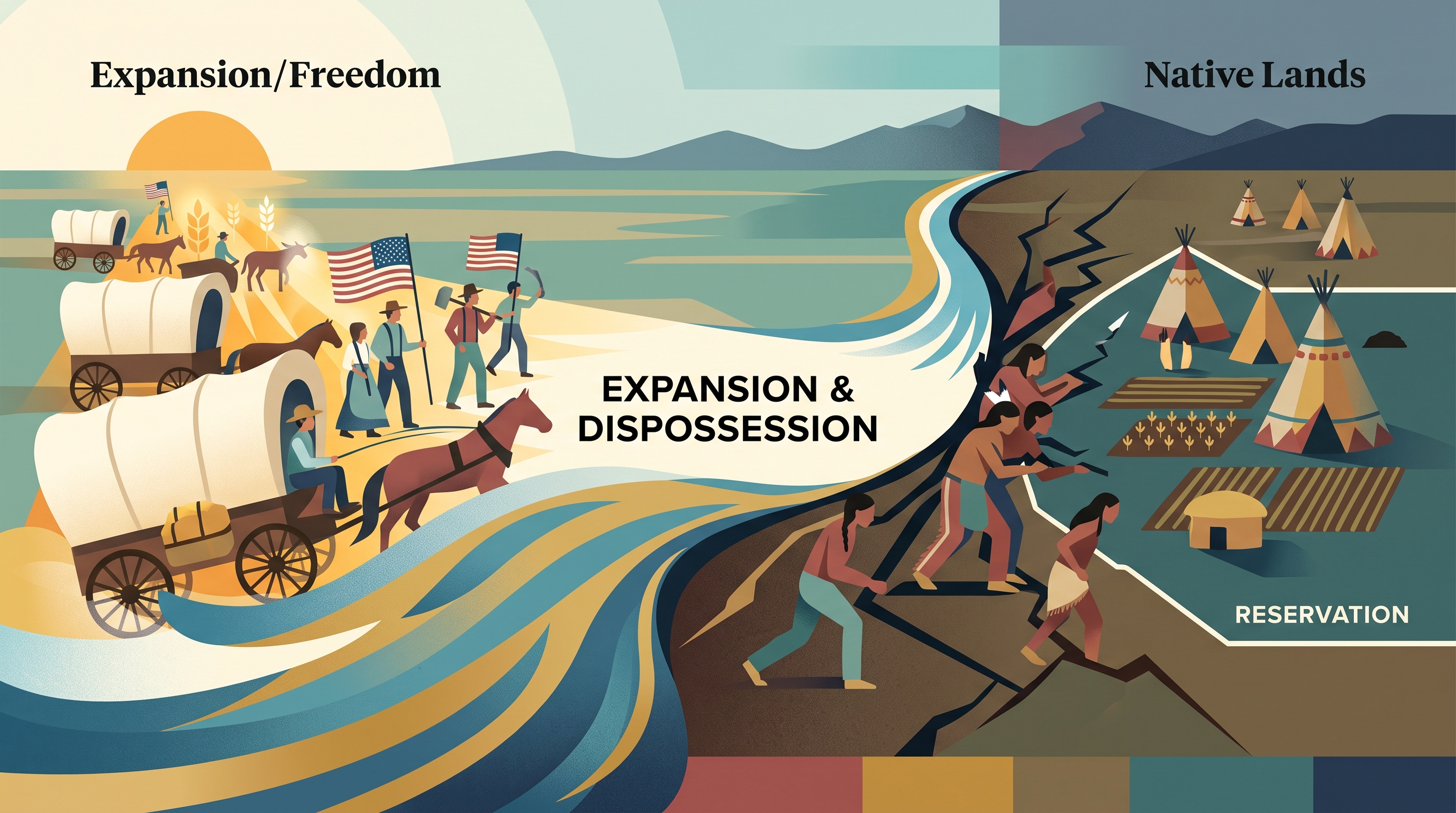
Westward expansion did not occur across empty land. Native American nations already occupied, governed, cultivated, and defended the territories that settlers entered. As the United States extended its claims and settlers moved west, Native Americans faced warfare, treaty violations, land seizure, and forced removal. Many displaced communities were confined to reservations, areas set aside by the federal government but controlled and restricted by it.
The central contradiction is important: supporters of Manifest Destiny described expansion as freedom for settlers while expansion meant the loss of land, sovereignty, and mobility for Native peoples. Thus, westward settlement created both opportunities for some Americans and coercion and dispossession for others.
Named misconception: “Manifest Destiny was just a harmless slogan”
Manifest Destiny was not merely decorative language. It helped shape policy and public debate during the 1840s by presenting expansion as morally legitimate. That justification did not mean every American supported expansion, nor did it erase political disagreements. It means the belief supplied a powerful rationale for actions that produced conflict with Native Americans and other populations living in or claiming the expanding territories.
What contextualization actually requires
Contextualization means situating a historical development within the broader conditions that made it possible or meaningful. It is not enough to mention several related facts. A contextual statement must explain the relationship between the background and the development being analyzed.
Worked contextual example: Suppose an argument concerns the importance of westward expansion to American national identity from 1800 to 1848. A weak context would say, “The United States bought Louisiana and later expanded west.” That is accurate but merely lists facts. A stronger context explains that the Louisiana Purchase created a much larger national territory, encouraged settlement and agricultural ambition, and helped establish expansion as a recurring feature of U.S. policy. By the 1840s, Manifest Destiny gave that earlier pattern a more explicit ideological justification.
This reasoning uses AP Skill 4: Contextualization because it connects Manifest Destiny to earlier territorial growth. It also uses AP Skill 1: Developments and Processes by tracing how expansion developed over time, and AP Skill 5: Making Connections by linking geography, migration, national identity, and Native American–settler conflict. In an argument, AP Skill 6: Argumentation requires turning those connections into a defensible claim rather than simply naming them.
The closing of the frontier
The closing of the frontier refers to the near-completion of U.S. settlement across the continent. It was a later consequence of the same expansion process described here: territorial acquisition, Native land seizure, settler migration, and the creation of farms and communities gradually reduced the areas that U.S. officials and settlers treated as available for further continental settlement. The phrase therefore signals not one single event, but the result of decades of expansion and dispossession.
Retrieval check
- Why is the Louisiana Purchase important but not identical to Manifest Destiny?
- What did westward expansion mean for Native American nations?
- Rewrite this weak context into a stronger one: “Americans believed in Manifest Destiny and moved west.”
Answer check: The Louisiana Purchase expanded U.S. territory in 1803, while Manifest Destiny became a major justification for expansion in the 1840s. Expansion brought settlement and national growth for many Americans but also conflict, land seizure, and forced removal of Native Americans to reservations. A stronger context would explain how the earlier territorial enlargement and settlement pattern made the later ideology and policies of expansion possible.
Source Materials
- AP U.S. History Course and Exam Description
- AP U.S. History Course and Exam Description Clarifications and Corrections
- AP U.S. History Course Overview
- AP U.S. History Course at a Glance
- AP United States History Course at a Glance Poster
- AP United States History
- AP United States History
- AP United States History Sample Syllabus 1
- AP US History Past Exam Questions — AP Central
- Khan Academy — AP US History
- Gilder Lehrman Institute — AP US History Study Guide
- AP US History Units — Save My Exams