From the free course AP United States History on Lykke
1.7 Causation in Period 1
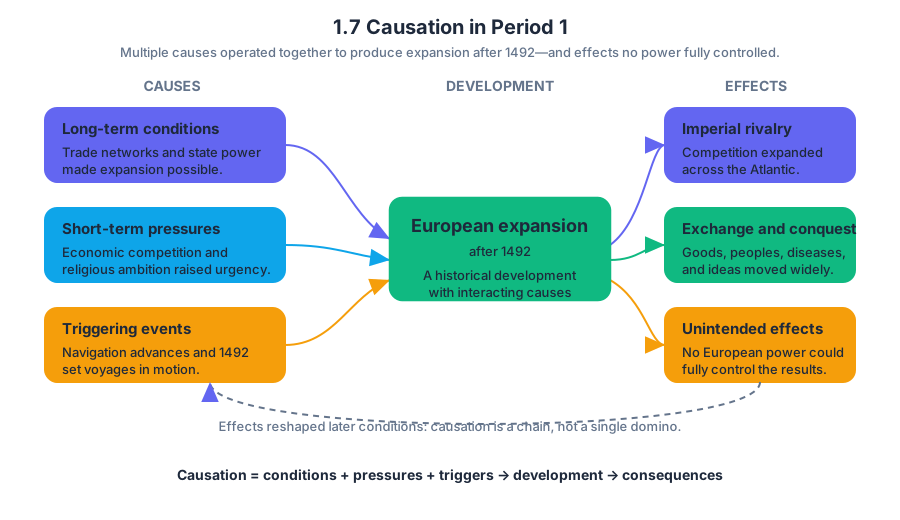
European expansion after 1492 did not result from a single motive. It emerged from a chain of causes—economic competition, religious ambition, technological change, and political rivalry—that produced consequences no European power could fully control.
1.7 Causation in Period 1
European expansion after 1492 did not result from a single motive. It emerged from a chain of causes—economic competition, religious ambition, technological change, and political rivalry—that produced consequences no European power could fully control. Causation means explaining how earlier conditions helped produce a historical development and how that development generated later effects.
CED traceability: Learning Objective 1.7.A, Essential Knowledge 1.7.A.1, and Skill 1: Developments and Processes—especially explaining the causes and effects of a historical development or process.
The key historical habit is to avoid treating causation like a single domino. A major development usually has several causes operating at different levels: long-term conditions make an event possible, short-term pressures make it likely, and triggering events set it in motion.
The Period 1 causal chain
The expansion of Europe into the Americas illustrates this layered structure:
- Long-term conditions: growth of centralized monarchies, Christian missionary goals, commercial ambitions, and competition among European states.
- Enabling factors: improved sailing technology, navigational knowledge, ship design, and access to Asian and African trade networks.
- Immediate motivations: the search for wealth, new trade routes, territorial claims, and opportunities to spread Christianity.
- Historical development: European voyages, colonization, Spanish conquest, and the creation of colonial labor systems.
- Consequences: the Columbian Exchange, demographic catastrophe among Native peoples, expansion of Atlantic slavery, new mixed societies, and intensified European rivalry.
The important distinction is between a cause and a condition. A cause helps produce an outcome; a condition creates the environment in which that outcome can occur. For example, Atlantic winds and improved ships helped make transoceanic travel possible, but they did not by themselves explain why monarchs financed voyages. Political competition and the pursuit of wealth supplied the motivation.
Worked example: Why did Spain conquer large American empires?
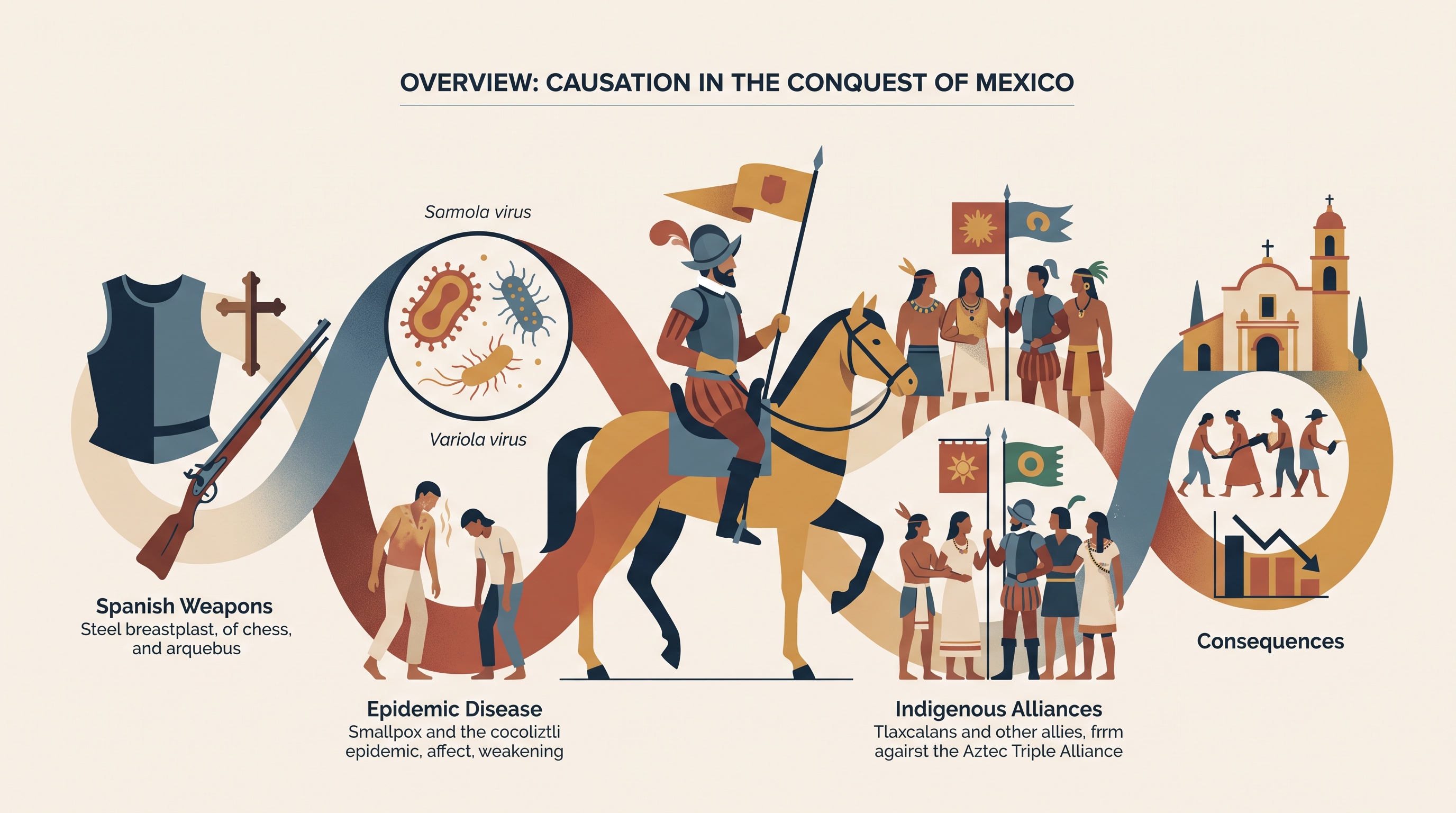
Suppose the question asks why Spanish conquest succeeded so rapidly in parts of the Americas. A weak answer names one factor: “Spain had better weapons.” A stronger causal explanation connects several factors and shows how they interacted.
Step 1—Identify the development: Spanish conquest brought regions such as the Aztec and Inca empires under Spanish control during the sixteenth century.
Step 2—Establish causes: Spanish forces possessed steel weapons, firearms, horses, and military experience. They also benefited from Native political divisions and from Indigenous allies who opposed imperial rule. Epidemic diseases, introduced through contact, caused devastating population losses and weakened the ability of Native societies to resist.
Step 3—Explain the relationship: Military technology mattered, but it worked together with local alliances and disease. A small Spanish force could not have defeated a large empire through weapons alone. Internal rivalries supplied allies, while disease disrupted leadership, armies, agriculture, and communication.
Step 4—Connect consequences: Conquest enabled Spain to impose colonial institutions, extract labor and wealth, spread Christianity, and reorganize societies through systems such as encomienda. Those institutions then produced further effects: coerced labor, racial and social hierarchies, cultural blending, and resistance.
This is causation rather than chronology because it answers why events occurred and how one development produced another. It also demonstrates Skill 1: Developments and Processes by identifying a process, explaining multiple causes, and tracing consequences across time.
The Columbian Exchange as a chain reaction
The Columbian Exchange—the movement of plants, animals, people, diseases, and commodities between the Americas and Afro-Eurasia—shows why historical consequences can be both intended and unintended. Europeans sought trade, territory, and conversion; they did not intend to create a biological exchange that would transform global populations.
European diseases, especially smallpox, measles, and influenza, spread among Native populations that lacked previous exposure. The resulting epidemics caused enormous mortality and weakened many communities. In Europe, American crops such as maize and potatoes increased the available food supply and contributed to population growth. In the Americas, European animals, crops, and colonial land-use practices altered environments and economies.
A causation argument must distinguish direct from indirect effects. Spanish conquest directly imposed colonial authority; indirectly, it encouraged expanded African slavery as colonizers sought labor after catastrophic Native population decline. Likewise, the search for labor helped create Atlantic commercial networks that connected the Americas, Europe, and Africa.
Misconception check: “Europeans won because they were inherently superior”
Named misconception—Technological determinism: the belief that technology alone explains Spanish victory. Europeans did possess military and maritime advantages, but conquest depended on Native alliances, political divisions, disease, geography, and Spanish exploitation of existing conflicts. Treating conquest as inevitable erases Indigenous decision-making and resistance.
A second misconception is that “contact” produced only European change. Native peoples adopted, rejected, adapted, and reshaped European technologies, animals, religions, and institutions. Causation in Period 1 is therefore multidirectional: Europeans transformed the Americas, but American environments, peoples, and resources also transformed Europe and Africa.
Retrieval and interpretation check
Explain in two or three sentences why Spanish conquest cannot be attributed to weapons alone. Your response should name two additional causes, explain how they interacted with military technology, and identify one consequence that followed from conquest.
A complete response would connect Spanish weapons and horses with Native alliances and epidemic disease, then trace conquest to colonial labor systems, Christianization, demographic change, or the expansion of Atlantic slavery. The goal is not to list factors; it is to show the causal links among them.
Source Materials
- AP U.S. History Course and Exam Description
- AP U.S. History Course and Exam Description Clarifications and Corrections
- AP U.S. History Course Overview
- AP U.S. History Course at a Glance
- AP United States History Course at a Glance Poster
- AP United States History
- AP United States History
- AP United States History Sample Syllabus 1