From the free course AP United States History on Lykke
1.3 European Exploration in the Americas · 1.4 Columbian Exchange, Spanish Exploration, and Conquest
Key concepts: European motivations for exploration and conquest · European economic, military, religious, and political competition · Joint-stock companies and organized international trade · Transatlantic voyages and changes in European and American societies · Spanish exploration, conquest, and incorporation of diverse populations · Indigenous responses and resistance to colonial encroachment · The role of horses and livestock in conquest and colonial change · The transatlantic slave trade and Portuguese involvement in West Africa · Columbian Exchange-era social, cultural, political, and economic changes · Indigenous perspectives on Spanish conquest and colonial expansion
European expansion into the Americas was driven by three linked motives: the search for wealth, competition among European states, and the desire to spread Christianity.
1.3 European Exploration in the Americas · 1.4 Columbian Exchange, Spanish Exploration, and Conquest
European expansion into the Americas was driven by three linked motives: the search for wealth, competition among European states, and the desire to spread Christianity. The result was not simply “discovery,” but a transformation of societies across the Atlantic through exploration, conquest, migration, disease, trade, and cultural conflict.
Unit 1: Learning Objective A · KC-1.2.I: European expansion into the Western Hemisphere generated intense social, religious, political, and economic competition and changes within European societies.
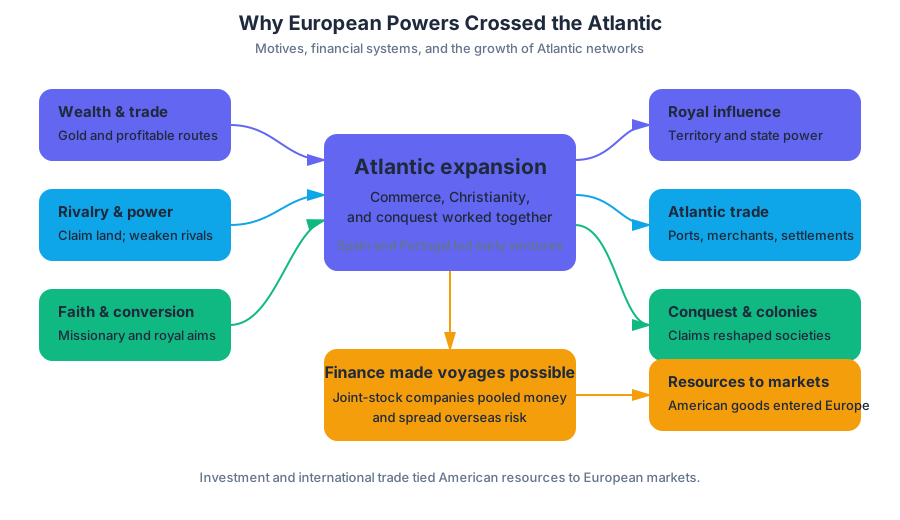
Why European powers crossed the Atlantic
Spain and Portugal sought precious metals, profitable trade routes, and political influence. European monarchies also competed with one another: an expedition could claim territory, weaken a rival, and increase royal power. Catholic rulers and missionaries presented conversion as a religious purpose, but Christianity, commerce, and conquest usually operated together rather than separately.
New financial systems made expensive voyages possible. Joint-stock companies pooled money from many investors, spreading the risk of overseas ventures; organized international trade connected merchants, monarchies, ports, and colonial settlements. These arrangements helped shift European economies toward larger Atlantic networks and tied American resources to European markets.
Transatlantic voyages and the Columbian Exchange
Christopher Columbus’s 1493 letter to Luis de Santángel illustrates how a contemporary European source described the first voyage to the Americas. Such a source is useful but not neutral: Columbus emphasized the lands, peoples, and resources that might interest Spanish officials and investors. Its purpose helps explain why exploration accounts often framed Indigenous societies as opportunities for empire, conversion, and wealth.
The Columbian Exchange was the movement of plants, animals, diseases, people, and commercial practices between the Americas, Europe, and Africa after sustained contact began. Its effects were demographic, economic, geographic, social, cultural, and political.
| Movement or development | Historical effect |
|---|---|
| European diseases | Epidemics caused catastrophic population losses among Indigenous peoples who lacked previous exposure to many Old World pathogens. |
| Horses | Spanish cavalry gained mobility and military advantages; horses later reshaped Indigenous travel, hunting, and warfare in parts of North America. |
| Cattle and pigs | Livestock altered landscapes and produced conflicts when animals damaged Indigenous crops and territory. |
| Wheat | An Old World crop supported new agricultural, milling, and trade economies, including colonial Pennsylvania’s movement from cultivation to milling, barreling, and export. |
| Enslaved Africans | Portuguese Atlantic networks connected West Africa, Europe, and American colonization. |
Portugal established trading forts and commercial networks along the West African coast. Portuguese merchants and officials participated in the capture and purchase of enslaved Africans through existing and expanding regional networks, then transported enslaved people across the Atlantic. A letter from Dom João III to the king of Kongo illustrates Portugal’s role in this West African trade and shows how Atlantic expansion linked African political relationships to American colonization. The later development of colonial labor systems depended on this connection, but the key point here is the formation of the transatlantic network itself.
The exchange also generated conflict over land use. Lion Gardener’s account of Narragansett leader Miantonomi records a call for Indigenous unity against colonial encroachment, including trespass and damage caused by cattle and other livestock. A 1662 Virginia law forbidding Indigenous people from killing English hogs reveals the unequal political response: colonial authorities protected settlers’ animals even when those animals threatened Indigenous land and food systems.
Spanish exploration and conquest
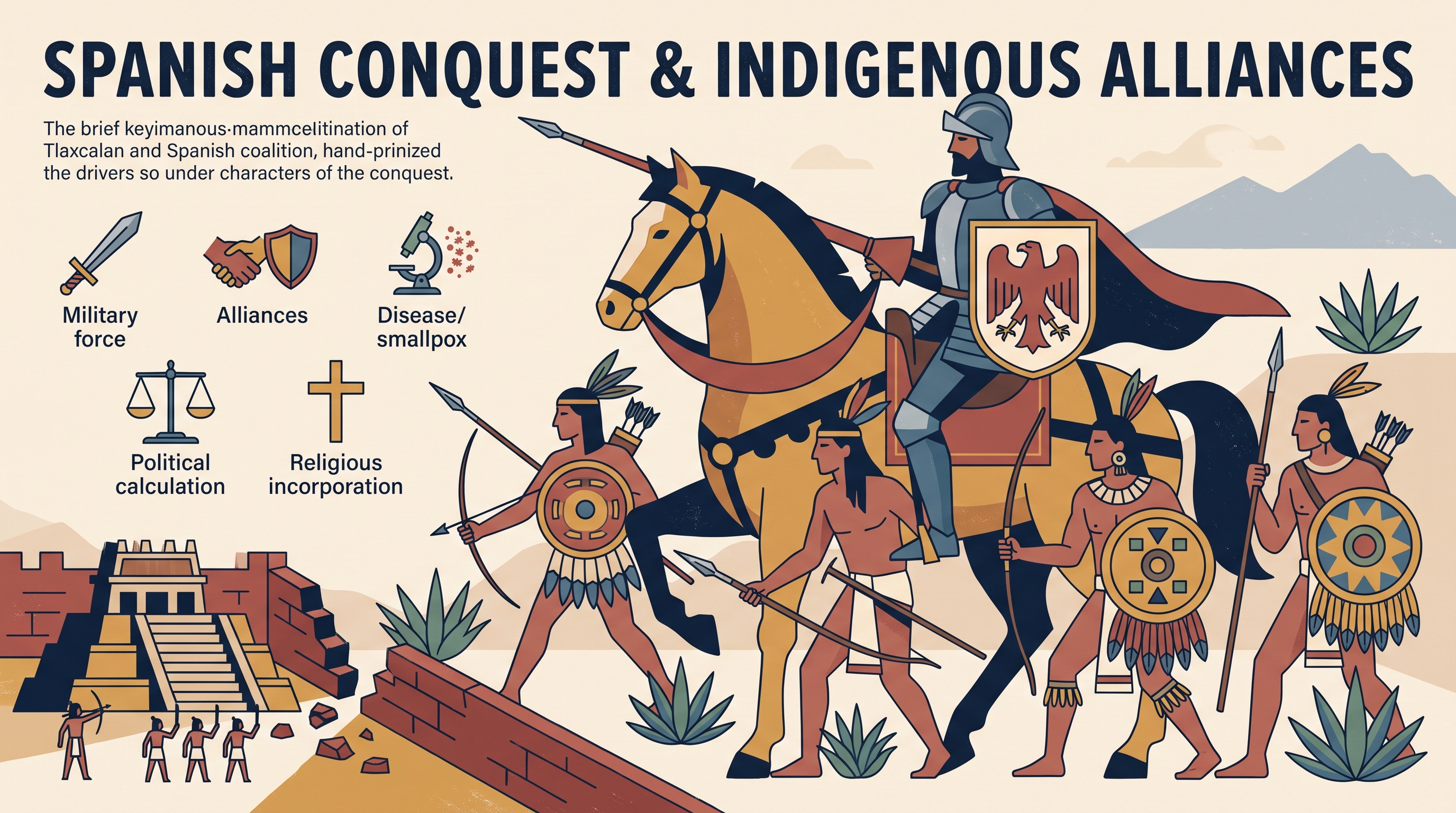
Spanish conquest combined military force, alliances, disease, political calculation, and religious incorporation. Spanish forces did not defeat large Indigenous states through European weapons alone; they also exploited divisions among Indigenous communities and recruited allies who opposed imperial rule.
The Lienzo de Tlaxcala, created around 1550, presents the conquest of Mexico from a Tlaxcalan perspective. Its images of Spanish soldiers on horseback record the military importance of horses, while the document’s viewpoint reminds us that Indigenous allies were historical actors rather than passive observers. The same visual tradition depicts the Mixton War, demonstrating that Spanish conquest continued to provoke resistance after initial victories.
Indigenous responses to Spanish exploration varied. Some communities formed alliances, negotiated, converted, or used Spanish institutions for their own purposes; others resisted directly or called for broader unity against colonial expansion. An Apache account of Oñate’s 1601 expedition illustrates that Spanish exploration was experienced as an encounter with armed outsiders entering Indigenous homelands—not as an empty-land “discovery.”
Worked historical reasoning example
Prompt: Identify one major theme affected by transatlantic voyages and support it with evidence.
Model reasoning: Choose geography and the environment. European cattle and pigs changed land use and damaged Indigenous fields, producing conflicts recorded by Gardener and reflected in Virginia’s livestock law. Horses altered warfare and mobility, as the Lienzo de Tlaxcala shows. Wheat created new agricultural and commercial landscapes. These examples support a defensible claim: transatlantic voyages transformed American environments, and those environmental changes redistributed power between colonizers and Indigenous communities.
AP skills and misconception check
This topic develops Skill 1: Developments and Processes, especially explaining how motives, voyages, conquest, and exchange produced connected changes. It uses Skill 2: Sourcing and Situation through Columbus’s letter, the Lienzo de Tlaxcala, the Apache account, and colonial laws; Skill 3: Claims and Evidence in Sources by connecting each source to a historical claim; Skill 4: Contextualization by placing Atlantic expansion within European competition and West African trade networks; Skill 5: Making Connections by linking environmental, demographic, economic, and political effects; and Skill 6: Argumentation by constructing a claim supported by specific evidence.
Misconception check: European conquest was not achieved by technology alone, and Indigenous peoples did not respond uniformly. Disease, alliances, internal rivalries, horses, weapons, religious institutions, and Indigenous resistance all mattered. Likewise, the Columbian Exchange was not an equal exchange of benefits: its effects were profoundly unequal, especially in Indigenous demographic loss and the expansion of coerced Atlantic labor.
Retrieval check: Explain how one European motive, one Atlantic institution or network, and one introduced organism changed societies in the Americas. Then name a source that would help you study the change and explain how its point of view shapes the evidence.
Source Materials
- AP U.S. History Course and Exam Description
- AP U.S. History Course and Exam Description Clarifications and Corrections
- AP U.S. History Course Overview
- AP U.S. History Course at a Glance
- AP United States History Course at a Glance Poster
- AP United States History
- AP United States History
- AP United States History Sample Syllabus 1
- (A) Briefly describe one way in which religion influenced European migration to the Americas from 1500 to 1700.
- (A) Briefly describe one way in which religion influenced European migration to the Americas from 1500 to 1700.