From the free course AP United States History on Lykke
6.9 Responses to Immigration in the Gilded Age · 6.10 Development of the Middle Class
Key concepts: Responses to immigration in the Gilded Age · Development of the middle class · Push and pull factors of immigration and internal migration · Demographic change and its effects on migrants and society · Anti-immigrant attitudes toward the Irish and Chinese · Chinese rights and exclusion in California · Labor unions and worker-management relations · Industrial capitalism and standards of living · Historical contextualization · Argumentation using primary sources
Crowded industrial cities transformed immigration from a private journey into a public argument about who could belong in the United States. The migration patterns established during the Gilded Age filled urban neighborhoods, expanded factories and markets, and intensified conflicts over race, religion,…
6.9 Responses to Immigration in the Gilded Age · 6.10 Development of the Middle Class
Crowded industrial cities transformed immigration from a private journey into a public argument about who could belong in the United States. The migration patterns established during the Gilded Age filled urban neighborhoods, expanded factories and markets, and intensified conflicts over race, religion, citizenship, labor, and political power.
From migration to public controversy
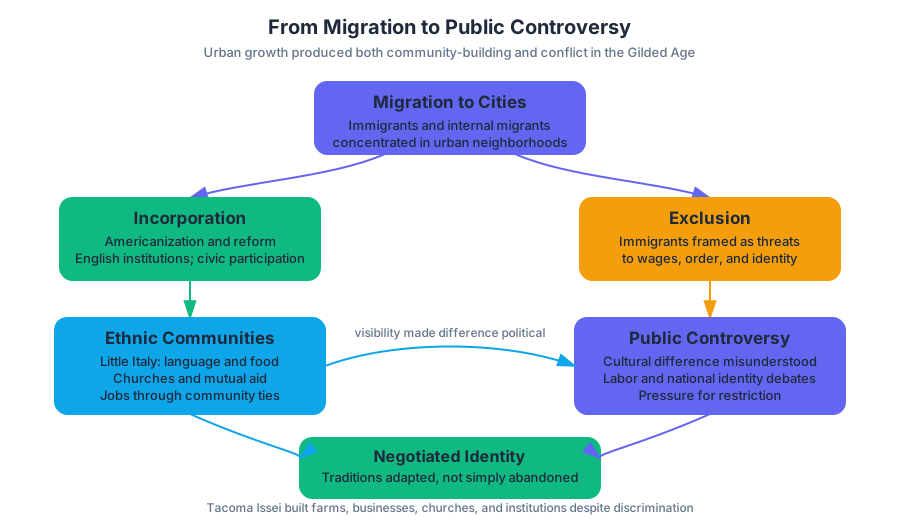
As immigrants and internal migrants concentrated in cities, American responses divided between incorporation and exclusion. Some reformers and employers promoted Americanization—the expectation that immigrants should adopt English-language institutions and dominant cultural practices—while many politicians and workers portrayed immigrants as threats to wages, public order, or national identity. Under KC-6.2.I.C, immigrants did not simply abandon their earlier cultures; they negotiated compromises between inherited traditions and the society they encountered.
The results were visible in ethnic urban communities. In New York, Little Italy provided Italian immigrants with familiar language, food, religious institutions, mutual-aid societies, and employment connections. Such neighborhoods could ease the shock of migration, but outsiders often interpreted cultural difference as evidence that immigrants were refusing to become “American.”
In Tacoma, Washington, Japanese Issei—first-generation immigrants from Japan—built businesses, farms, churches, and community institutions despite discrimination. Their experience shows that immigrant communities were not passive enclaves: they created social networks and economic opportunities while facing laws and public attitudes that restricted landownership, citizenship, and mobility.
Anti-Irish and anti-Chinese language
Earlier anti-Irish prejudice supplied a vocabulary that could be redirected toward Chinese immigrants. Nativists had described Irish Catholics as alien, politically dangerous, dependent, and incapable of republican self-government. In California, anti-Chinese writers reused similar language, depicting Chinese workers as permanently foreign, morally suspect, disease-bearing, and unwilling or unable to assimilate.
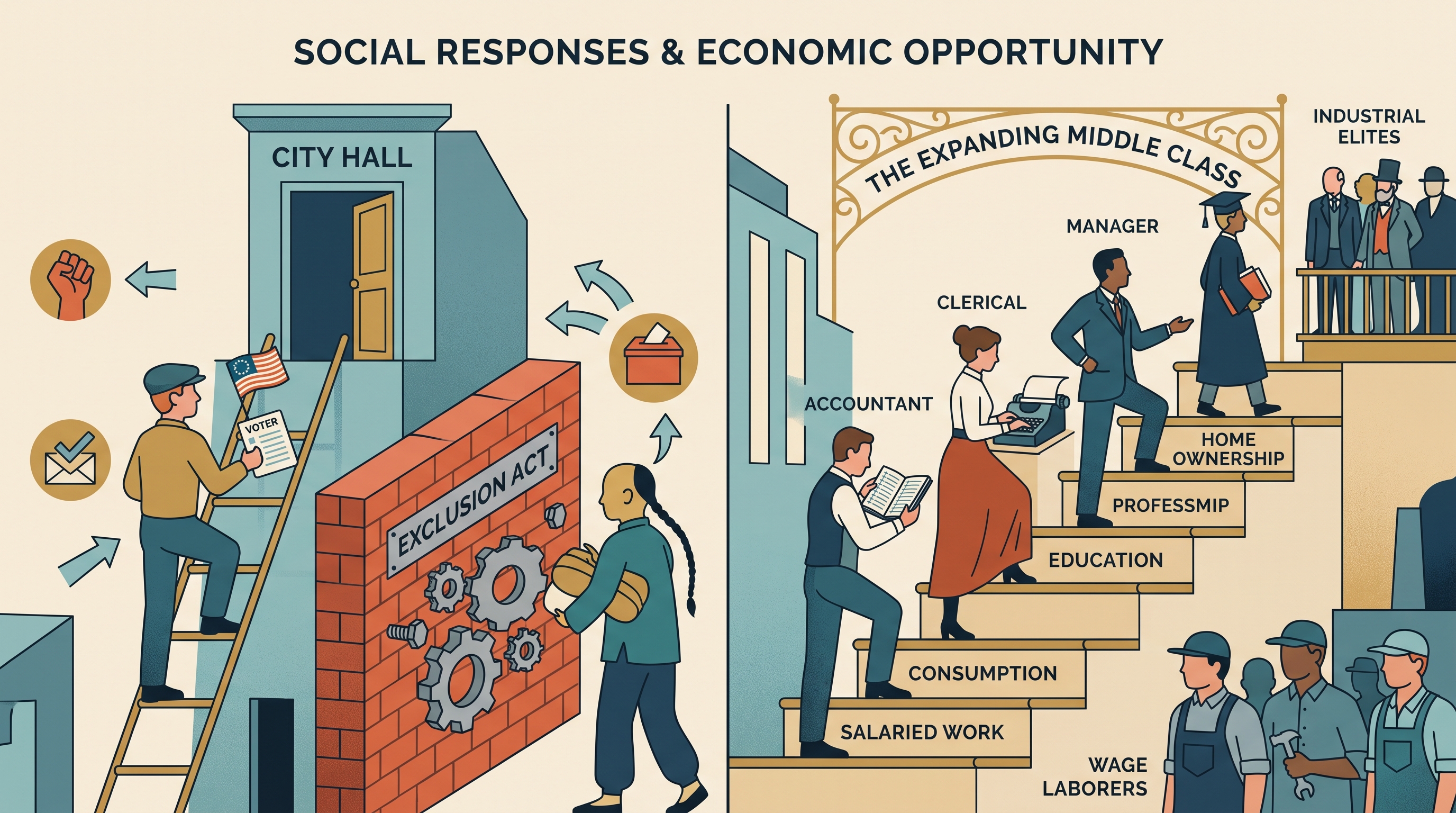
The comparison must be handled carefully. Anti-Irish discrimination was severe, but many Irish immigrants gradually entered the category of “white” in American racial politics and gained greater access to citizenship and political power. Chinese immigrants faced racial barriers that became explicit federal exclusion: the Page Act of 1875 restricted Chinese women’s entry, the Chinese Exclusion Act of 1882 barred most Chinese laborers, and later laws extended exclusion and limited reentry.
Key distinction: Similar stereotypes did not produce identical outcomes. Anti-Irish prejudice contributed to social marginalization; anti-Chinese racism helped justify a durable system of racialized immigration restriction.
A primary source can reveal this process through its wording. When a California newspaper or political speaker described Chinese people as a “race” that could never assimilate, the language did more than express dislike: it transformed a labor conflict into an argument for unequal rights. Ask what the author’s description assumes, whom it targets, and what policy the language makes seem reasonable. That is the evidence needed to connect rhetoric to exclusion.
Industrial capitalism and the expanding middle class
Industrial capitalism did not create prosperity equally, but it expanded the social space between corporate elites and wage laborers. Growing firms required salaried managers, bookkeepers, salespeople, teachers, clerks, engineers, lawyers, doctors, and other professionals. These occupations usually depended less on physical labor than factory work and offered more regular income, although clerical and service workers—especially women—often remained poorly paid and had limited authority.
The middle class also became visible through consumption and leisure. Industrial production and improved transportation made clothing, household goods, newspapers, entertainment, and urban recreation more accessible to many salaried families. Places such as Coney Island symbolized this change: mass entertainment reflected the new combination of industrial wages, transportation networks, commercial culture, and free time.
Industrial capitalism therefore produced a mixed social outcome. For some Americans, rising real wages, consumer access, and professional opportunities improved living standards. For others, long hours, dangerous conditions, insecure employment, and low wages persisted. The rise of labor unions altered relationships between workers and management because employees increasingly acted collectively rather than negotiating as isolated individuals.
Jane Addams illustrates another response to urban industrial society. As a middle-class woman, she used education, organizational skill, and social position to establish Hull House in Chicago, where reformers worked with immigrant communities through education, childcare, cultural programs, and assistance. Her work reflected both the expansion of middle-class women’s public roles and the belief that urban poverty required organized social action.
Worked historical claim
Claim: Industrial capitalism changed American society substantially, but unevenly. It expanded salaried and professional middle-class occupations, consumer culture, and organized reform while also deepening class divisions and provoking anti-immigrant politics. Evidence such as Little Italy, Issei communities in Tacoma, Chinese exclusion, labor unions, Coney Island, and Hull House supports a Skill 6.C: Argumentation explanation because each example connects economic change to altered relationships among workers, migrants, reformers, businesses, and government.
Misconception check
Misconception: “The middle class was simply wealthy factory owners.”
Correction: Industrial elites owned or controlled major businesses; wage laborers depended primarily on direct wages; the expanding middle class occupied varied salaried, clerical, managerial, and professional positions. Its members could enjoy greater stability and consumption while still facing gender, racial, and economic limits.
Retrieval check: Why did similar anti-immigrant language affect Irish and Chinese people differently? A strong answer should identify the shared language of foreignness and unassimilability, then explain the crucial difference: Irish immigrants increasingly gained access to whiteness and political inclusion, while Chinese immigrants faced formal exclusion and racially restricted citizenship.
Source Materials
- AP U.S. History Course and Exam Description
- AP U.S. History Course and Exam Description Clarifications and Corrections
- AP U.S. History Course Overview
- AP U.S. History Course at a Glance
- AP United States History Course at a Glance Poster
- AP United States History
- AP United States History
- AP United States History Sample Syllabus 1
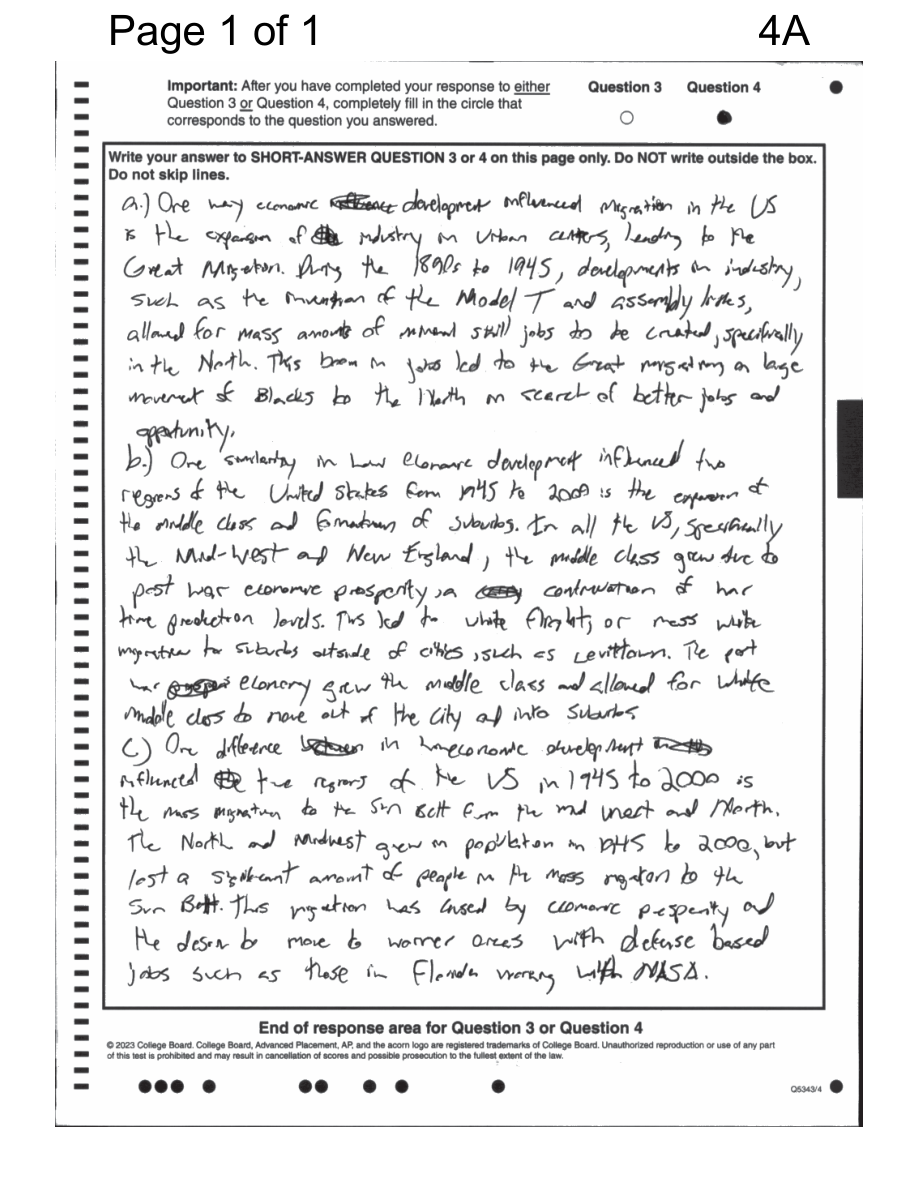
- Figure — Sample Responses - SAQ 4 - Set 2 (p. 4)
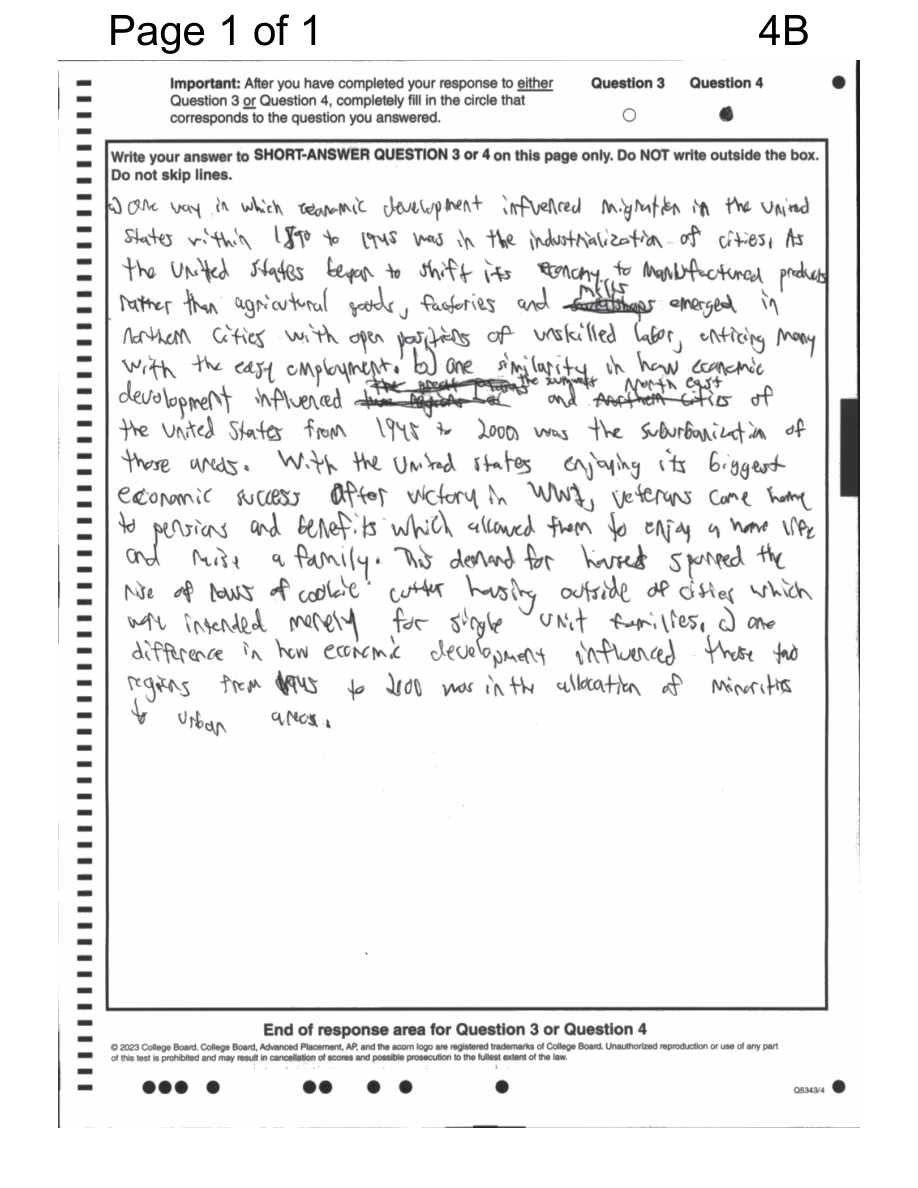
- Figure — Sample Responses - SAQ 4 - Set 2 (p. 5)
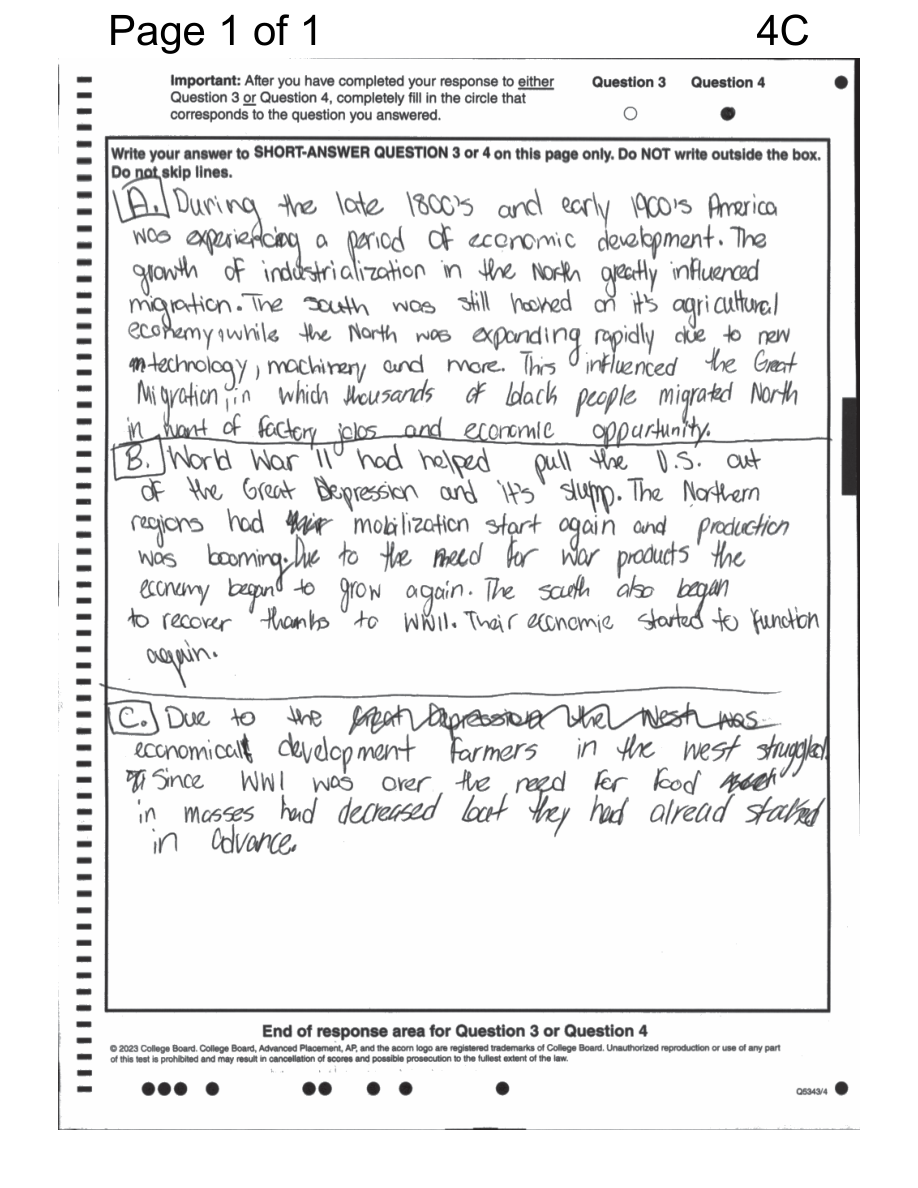
- Figure — Sample Responses - SAQ 4 - Set 2 (p. 6)
- Figure — Sample Responses - SAQ 1 - Set 1 (p. 4)