From the free course AP United States History on Lykke
AP Practice 3
A strong Long Essay Question (LEQ) answer does more than remember facts: it turns historical knowledge into a defensible argument. The writer must interpret a broad prompt, establish historical context, use specific evidence, and apply a historical reasoning process such as comparison, causation, or continuity and…
AP Practice 3
A strong Long Essay Question (LEQ) answer does more than remember facts: it turns historical knowledge into a defensible argument. The writer must interpret a broad prompt, establish historical context, use specific evidence, and apply a historical reasoning process such as comparison, causation, or continuity and change.
This original, unofficial practice uses the causation skill to connect developments across the course’s chronological periods. The AP U.S. History framework identifies five historical thinking skills: 1. Developments and Processes, 2. Sourcing and Situation, 3. Claims and Evidence in Sources, 4. Contextualization, and 5. Making Connections. An LEQ most directly emphasizes 1. Developments and Processes, 4. Contextualization, and 5. Making Connections, because no source set is supplied.
The task
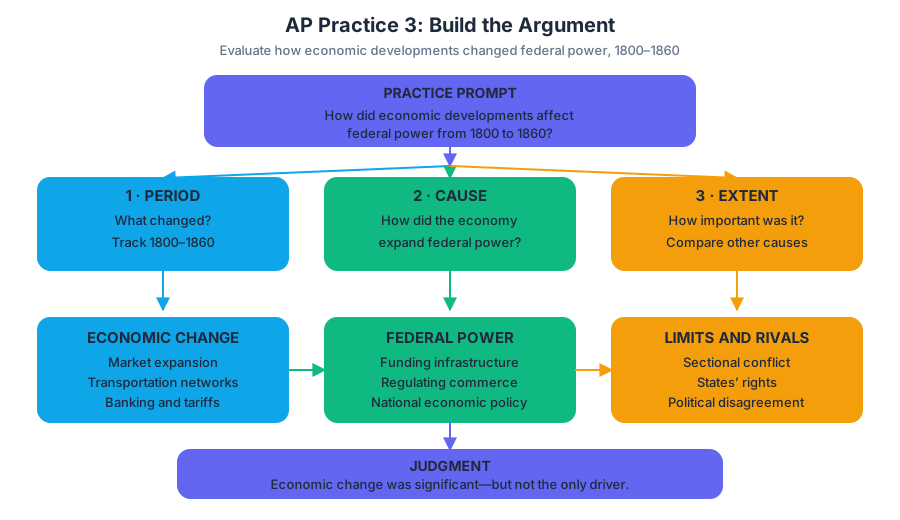
Practice prompt: Evaluate the extent to which economic developments contributed to changes in federal power in the United States from 1800 to 1860.
A useful first move is to convert the prompt into three questions:
| Prompt feature | Question to answer |
|---|---|
| Historical period | What was changing between 1800 and 1860? |
| Causal relationship | How did economic developments affect federal power? |
| “Evaluate the extent” | Were economic causes decisive, significant but limited, or less important than political or sectional causes? |
Build the argument before writing
A defensible thesis should make a judgment, not merely repeat the prompt. One possible thesis is:
Economic developments substantially expanded federal power between 1800 and 1860 because transportation improvements, national markets, and industrial growth encouraged federal support for infrastructure and economic regulation; however, economic change did not create a unified national policy, because sectional disagreements over tariffs, banking, and slavery repeatedly limited federal authority.
This thesis earns its force from qualification. It argues that economics mattered substantially, then identifies a limit: economic development expanded federal power unevenly because regional interests disagreed about which policies the federal government should pursue.
Contextualization: place the argument in motion
Before 1800, the new republic operated under political and economic uncertainty. The Constitution had created a stronger national government than the Articles of Confederation, but debates over the national bank, federal taxation, and the proper scope of federal authority showed that national power remained contested. After 1800, territorial expansion and increasing commercial connections created new pressure for the government to coordinate economic life across a much larger country.
Notice the difference between context and evidence. The Constitution and the Articles of Confederation establish the background, but the paragraph must still explain why that background matters: federal power was already a disputed issue before transportation, markets, and industry intensified the debate.
Worked evidence chain
Evidence 1: transportation and markets. The construction of roads, canals, and later railroads connected farmers, merchants, and manufacturers across regional boundaries. The Erie Canal, completed in 1825, linked the Great Lakes to the Atlantic trade through New York. This integration encouraged arguments that the federal government should promote internal improvements, although presidents and legislators disagreed over constitutional limits.
Evidence 2: national economic institutions. The Second Bank of the United States attempted to regulate credit and stabilize the national economy. Andrew Jackson’s opposition to the bank, culminating in the removal of federal deposits, demonstrated that economic policy could become a direct struggle over executive power and the authority of national institutions.
Evidence 3: tariffs and sectional interests. Protective tariffs aided some manufacturers in the Northeast but angered many southern planters, who feared higher prices and foreign retaliation. The Nullification Crisis showed that economic policy could provoke a constitutional confrontation over whether a state could resist federal law.
Each example does three jobs: it identifies a historical development, links that development to federal power, and advances the thesis. A list of the Erie Canal, the national bank, and tariffs without those explanations would be evidence mentioned, not evidence used.
Model body paragraph
Economic integration encouraged the federal government to take a more active role in national development. As canals, roads, and railroads connected previously separate markets, supporters of the American System argued that federal funding for transportation would promote commerce and national unity. The Second Bank also represented an expanded conception of federal authority because it regulated credit across state boundaries. These policies did not simply respond to economic growth; they attempted to organize and direct it, making the federal government a more visible participant in everyday economic life. At the same time, Jackson’s destruction of the bank revealed that expanded federal power was politically unstable rather than universally accepted.
The paragraph demonstrates 5. Making Connections through causation: economic integration encouraged national policies, while opposition to those policies produced conflict over federal authority. It also uses 1. Developments and Processes by explaining how several related developments formed a broader process rather than treating them as isolated events.
Complexity: explain the limit
The strongest responses avoid a one-directional story in which economic modernization automatically produced stronger federal power. Economic change expanded federal authority in some areas, but it also deepened sectional divisions. Tariffs and banking policy could strengthen national institutions while simultaneously provoking resistance from southern states. The result was not simply “more government”; it was an ongoing struggle over whose economic interests federal power would serve.
That qualification supplies a path toward the rubric’s complexity requirement. Complexity can appear through qualification, contrasting regional effects, multiple causes, or an explanation of both intended and unintended consequences. It must be woven into the argument, not appended as a sentence beginning “Although.”
Timing and scoring routine
For a timed LEQ, reserve approximately 5 minutes to read and plan, 30 minutes to write, and 5 minutes to revise. The exact timing should follow the current exam directions in effect for the test administration; College Board has announced that changes to AP history short-answer and long-essay formats begin with the May 2027 exam, while course content remains unchanged.
Use this self-check after writing:
- Thesis: Does the opening make a clear judgment and preview the reasoning?
- Contextualization: Does the background explain what was happening before or around the period?
- Evidence: Are at least two specific historical examples accurately explained?
- Reasoning: Does the essay consistently use causation rather than merely narrate events?
- Complexity: Does it explain a contradiction, limitation, regional difference, or alternative cause?
Named misconception check — “More economic activity always meant more federal power.” False. Economic growth created demands for national coordination, but it also generated resistance when federal policies appeared to favor one region. A historically accurate answer must distinguish between the expansion of economic connections and the contested political authority used to manage them.
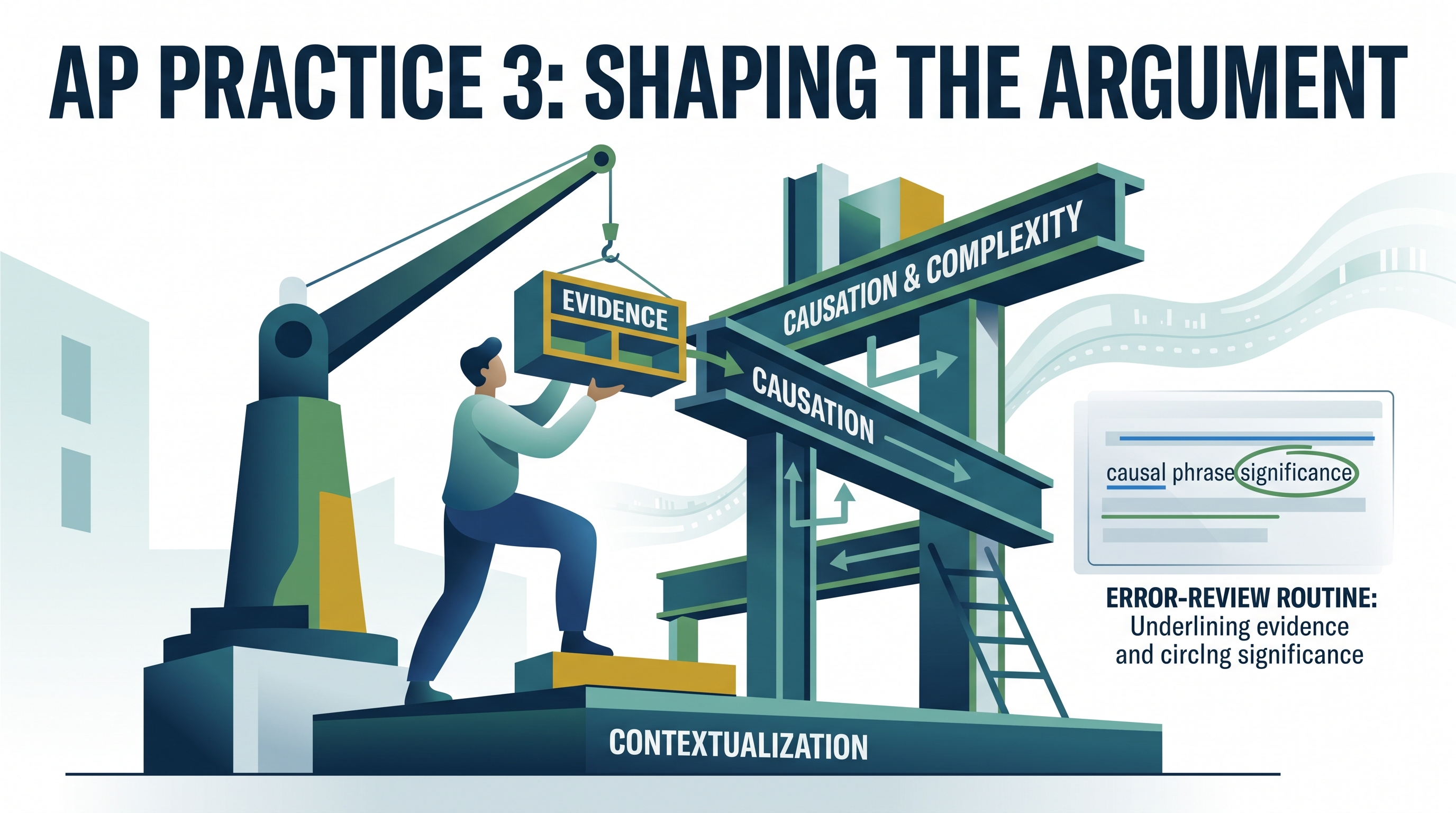
Error-review routine: After scoring, underline every sentence that names evidence and circle every sentence that explains significance. If an example has no circle, revise it with a causal connector such as “because,” “therefore,” or “this mattered because.” Then write one sentence identifying the essay’s strongest limitation or counterargument. That final step tests whether the response makes a historical argument rather than presenting a chronology.
Source Materials
- AP U.S. History Course and Exam Description
- AP U.S. History Course and Exam Description Clarifications and Corrections
- AP U.S. History Course Overview
- AP U.S. History Course at a Glance
- AP United States History Course at a Glance Poster
- AP United States History
- AP United States History
- AP United States History Sample Syllabus 1
- AP US History Past Exam Questions — AP Central
- Khan Academy — AP US History
- Gilder Lehrman Institute — AP US History Study Guide
- AP US History Units — Save My Exams