From the free course AP United States History on Lykke
4.9 The Development of an American Culture · 4.10 The Second Great Awakening
Key concepts: American culture · Creative expression · Religious beliefs · The First and Second Great Awakenings · George Whitefield’s preaching · Transcendentalism · Ralph Waldo Emerson · Alexis de Tocqueville’s analysis of American democracy · Cultural diversity and African American cultural expression · Universal suffrage and the expansion of voting rights
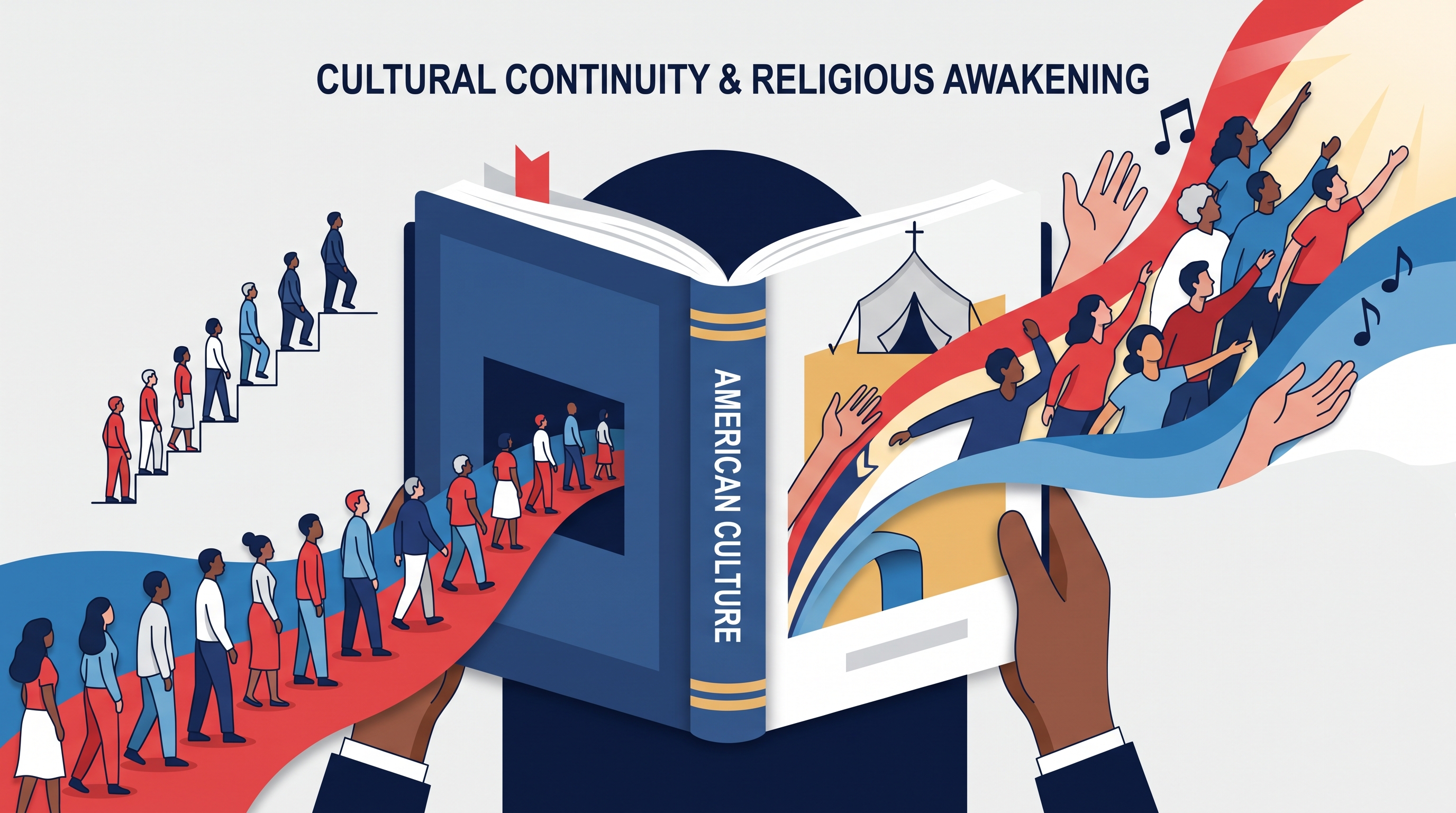
American culture developed through collision and exchange: creative expression, demographic change, philosophy, religious beliefs, scientific ideas, social mores, and technology continually reshaped how Americans understood themselves and their society.
4.9 The Development of an American Culture · 4.10 The Second Great Awakening
American culture developed through collision and exchange: creative expression, demographic change, philosophy, religious beliefs, scientific ideas, social mores, and technology continually reshaped how Americans understood themselves and their society. During the first half of the nineteenth century, expanding democracy and religious revival made culture especially dynamic—but not uniformly democratic or inclusive.
Investigative question: How did religious revival, intellectual movements, artistic traditions, and expanded political participation transform American culture while preserving older social boundaries?
A culture is plural, changing, and politically important
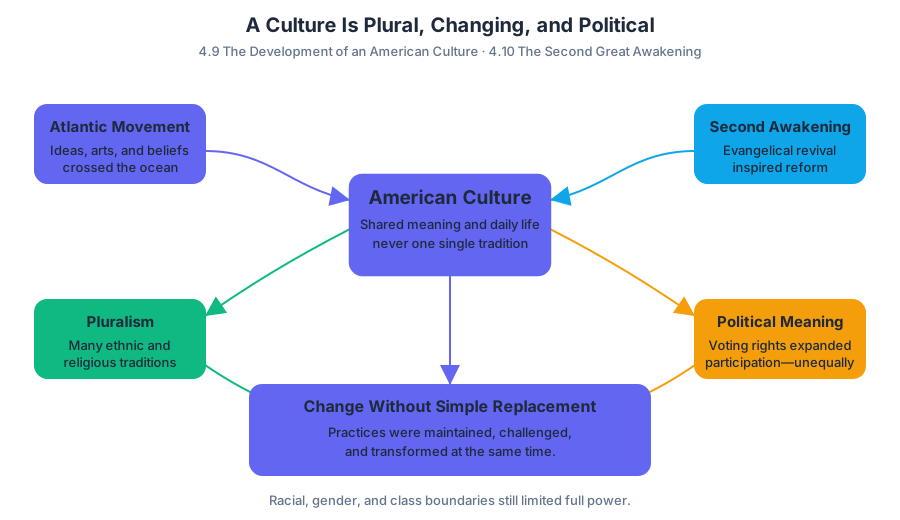
Culture means the ideas, beliefs, practices, arts, technologies, and social expectations through which a group organizes meaning and daily life. American culture was never a single national tradition: European ethnic and religious diversity encouraged pluralism, or the coexistence of multiple traditions, while Atlantic movement carried Enlightenment ideas, evangelical Christianity, artistic forms, and political arguments into North America.
The key historical process is not simple replacement. Cultural categories and practices could be maintained, challenged, and transformed at the same time. For example, expanding voting rights altered the meaning of political participation, while racial, gender, and class boundaries continued to restrict who could fully exercise power.
Religious revival: from the First to the Second Great Awakening
The First Great Awakening was an eighteenth-century wave of evangelical religious revival. Evangelical preaching emphasized emotional conversion—a personal experience of spiritual rebirth—rather than relying only on formal church membership or inherited religious authority.
George Whitefield’s 1741 preaching illustrates the revival’s cultural force. His powerful outdoor sermons attracted large crowds, including listeners such as Heaton, whose response demonstrates how revival preaching could move ordinary people emotionally and encourage them to evaluate their own spiritual condition. The significance was not merely theological: the revivals created shared public experiences, strengthened popular religious participation, and encouraged challenges to established authority.
The Second Great Awakening, which developed during the first half of the nineteenth century, extended this pattern of religious change. Revival meetings, conversion experiences, and energetic preaching helped make Protestant Christianity more participatory and socially visible. Religious enthusiasm also supplied language for individual moral responsibility and collective improvement, linking belief to the reform culture that expanded later in the period.
Misconception check: The First and Second Great Awakenings were not one continuous event. The First Great Awakening belonged primarily to the eighteenth century; the Second Great Awakening emerged in the early nineteenth century amid expanding democracy, westward movement, and social change.
Transcendentalism and the search for individual truth
Transcendentalism was an intellectual movement that emphasized individual conscience, intuition, spiritual experience, and the possibility of discovering truth beyond established institutions. Ralph Waldo Emerson became one of its leading nineteenth-century thinkers.
Emerson’s 1842 lecture “The Transcendentalist” exemplifies the movement’s thought. Rather than treating inherited customs or institutions as the final source of truth, transcendentalism encouraged individuals to trust moral insight and direct experience. Emerson also connected these ideas to abolitionist politics, showing how cultural and philosophical beliefs could influence arguments about government, slavery, and human freedom.
Democracy and political culture
Alexis de Tocqueville’s Democracy in America analyzed American democracy and its distinctive political culture. His work treated democracy as more than a voting system: it involved habits of association, ideas about equality, and expectations concerning popular participation.
The expansion of voting rights during the first half of the nineteenth century changed that political culture. States increasingly abolished property requirements, taxpayer requirements, and religious tests for voting, contributing to the movement toward universal white male suffrage. This broadened political participation for many white men, but it did not create universal democracy in the modern inclusive sense.
African American cultural expression
African American communities developed distinctive cultural traditions despite enslavement, displacement, and legal oppression. Musical instruments and practices—including the stick, drum, banjo, and sheguras—preserved and transformed African cultural elements in American settings.
Cultural expression also appeared in naming patterns. Research on Sea Island communities shows that African Americans created distinctive naming practices, demonstrating that culture survives not only in famous speeches or published books but also in family structures, sound, memory, and everyday language.
Skill application: explaining development and connection
1.B — Explain a historical concept, development, or process: To explain the development of American culture, identify multiple forces and show their interaction: Atlantic pluralism supplied diverse ideas; religious revivals expanded popular participation; transcendentalism elevated individual conscience; technological and demographic change spread practices; and expanded suffrage altered political expectations.
2.B — Explain how a historical development relates to another historical development: A strong connection links religious revival to later reform-oriented politics without claiming that revival automatically caused reform. Similarly, expanded suffrage strengthened democratic participation for white men while cultural practices and racial hierarchies continued to limit equality.
Worked interpretation
Suppose a historian places Whitefield’s sermon, Emerson’s 1842 lecture, Tocqueville’s analysis, and evidence of Sea Island naming practices in one collection. The best interpretation is that American culture developed through competing forms of participation: public religion, individual philosophy, political observation, and community-based African American expression. The evidence shows cultural creation from above and below—not a single national culture imposed uniformly on everyone.
Retrieval check
Answer without looking back: What is one continuity and one change in American culture during the first half of the nineteenth century? A defensible answer might identify continuity in unequal racial or social boundaries and change in evangelical participation, transcendentalist thought, African American cultural expression, or voting access.
Source Materials
- AP U.S. History Course and Exam Description
- AP U.S. History Course and Exam Description Clarifications and Corrections
- AP U.S. History Course Overview
- AP U.S. History Course at a Glance
- AP United States History Course at a Glance Poster
- AP United States History
- AP United States History
- AP United States History Sample Syllabus 1