From the free course AP United States History on Lykke
9.1 Contextualizing Period 9 · 9.2 Reagan and Conservatism
By 1980, many Americans no longer trusted the post–World War II political formula that had dominated national life: expanding federal programs, rising expectations of economic growth, and an active United States role in world affairs.
9.1 Contextualizing Period 9 · 9.2 Reagan and Conservatism
By 1980, many Americans no longer trusted the post–World War II political formula that had dominated national life: expanding federal programs, rising expectations of economic growth, and an active United States role in world affairs. Ronald Reagan’s election did not create this dissatisfaction; it converted decades of conflict over government, culture, race, and foreign policy into a powerful conservative movement.
Investigative question: Why did conservatism become such a successful national political force by 1980, and what did the Reagan presidency change?
9.1 Contextualizing Period 9: 1980–Present
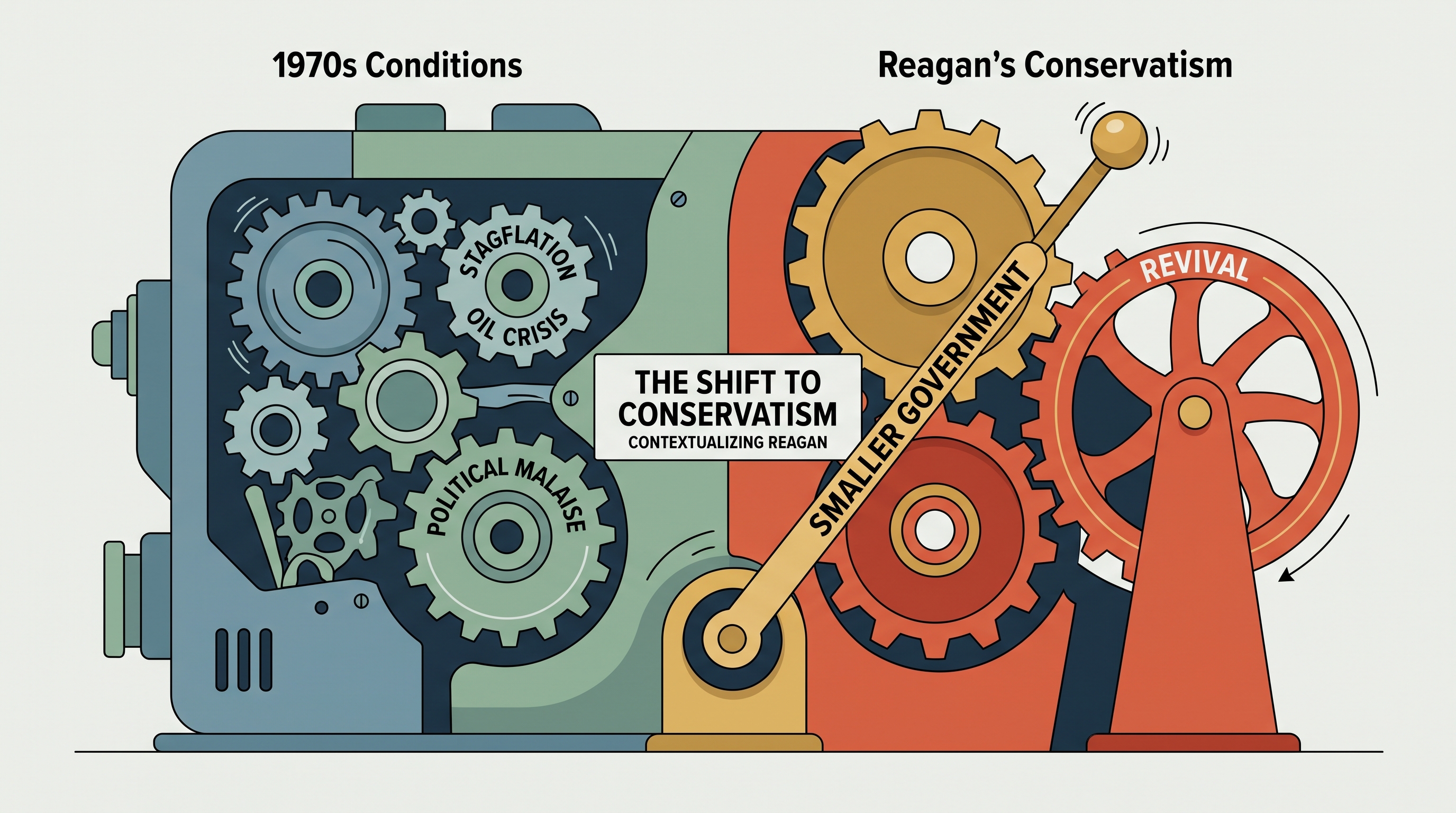
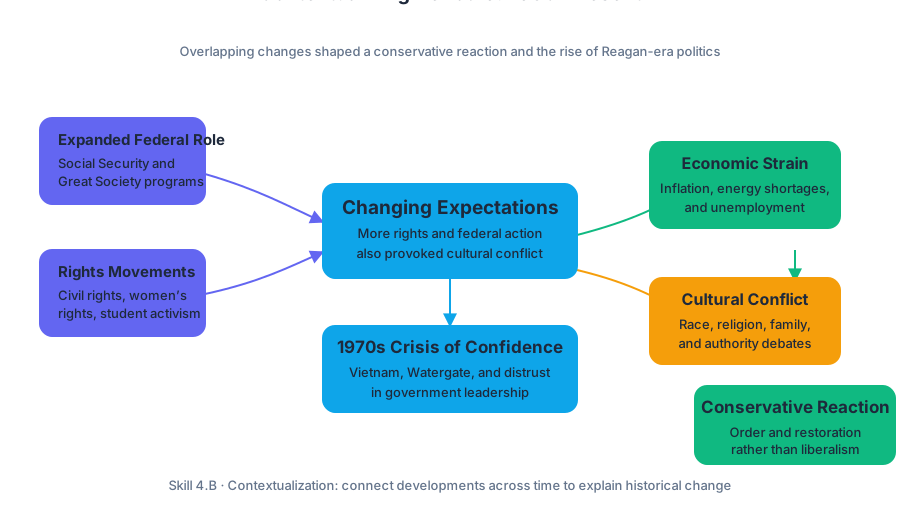
The period beginning in 1980 emerged from several overlapping developments. Since the New Deal, the federal government had taken greater responsibility for economic security through programs such as Social Security and had expanded its role further during the Great Society. At the same time, the civil rights movement, the women’s movement, student activism, and other movements challenged older social arrangements. These changes expanded rights but also produced a conservative reaction among Americans who believed that federal power, social protest, and cultural change had moved too far.
The 1970s intensified this reaction. The Vietnam War damaged confidence in government and complicated the United States’ position in the world. Watergate deepened distrust of political leaders. Inflation, energy shortages, and unemployment made economic problems feel immediate, while debates over school desegregation, abortion, feminism, and affirmative action connected politics to questions of religion, race, family, and authority. These developments created the setting in which conservative ideas could be presented as a restoration of order rather than merely an opposition to liberalism.
Skill 4.B: Contextualization means connecting a historical development to broader conditions that preceded or surrounded it. For 9.1, do not treat Reagan’s victory as an isolated election result. A strong contextual explanation links it to the crisis of confidence after Vietnam and Watergate, economic troubles in the 1970s, and the mobilization of conservative voters around cultural and religious issues.
Worked contextual example
Suppose a prompt asks why a conservative presidential candidate could attract support in 1980. A weak answer says, “People voted for Reagan because they liked conservative ideas.” A stronger answer reasons through context: the Great Society had expanded federal activism; the Vietnam and Watergate eras weakened trust in government; economic instability made existing policies appear ineffective; and movements for racial, gender, and cultural change encouraged some voters to seek a return to traditional authority. Reagan’s campaign succeeded because it joined these concerns into one political message.
9.2 Reagan and Conservatism
Conservatism is a political outlook that generally emphasizes limited government, individual responsibility, private enterprise, traditional social values, strong national defense, and skepticism toward rapid social change. Reagan assembled different conservative groups rather than representing only one of them.
His coalition included economic conservatives who favored lower taxes and less regulation, social conservatives who opposed abortion and defended traditional family structures, anticommunist voters who wanted a stronger military, and many white voters who opposed federal civil-rights policies or perceived government programs as unfair. Religious conservatives, associated with leaders such as Jerry Falwell, helped turn evangelical activism into an important force in national elections. Earlier conservatives such as Barry Goldwater supplied intellectual and political foundations for this movement.
Reagan’s 1980 campaign presented government as part of the problem rather than the universal solution. His program emphasized tax reduction, deregulation, a larger defense budget, and a smaller role for some domestic programs. The phrase “Reagan Revolution” describes this effort to shift national policy and political debate toward conservative assumptions, even though the federal government did not disappear and many established programs survived.
Skill 3.C: Claims and Evidence in Sources requires more than identifying what a source says. It requires using evidence to support a historical claim. For example, a conservative platform criticizing federal power can support the claim that the movement opposed the expansion of government; a speech by a religious activist can support the claim that cultural and religious issues helped broaden conservatism beyond economics. The source’s purpose and audience also matter: a campaign document seeks votes, while a movement leader seeks mobilization.
Misconception check: “Reaganism meant abolishing government”
Reagan did not eliminate federal authority. His administration expanded military spending and used national power in other ways. The more precise argument is that Reagan sought to redirect government: reduce or restrain some domestic interventions, lower taxes, weaken certain regulations, and strengthen defense and anticommunist policies. Conservatism therefore involved a debate over the purposes of government, not simply a demand for no government.
Another misconception is that all conservatives shared identical motives. Economic conservatives, religious conservatives, anticommunists, and voters reacting against civil-rights-era changes sometimes formed a common coalition while disagreeing about priorities. Historical analysis should explain both the coalition’s shared goals and its internal tensions.
Retrieval and interpretation check
Answer in two or three sentences: How did conditions in the 1970s help Reagan’s conservatism succeed? Your answer should name one political or cultural development, one economic or institutional problem, and explain how Reagan connected them to a broader argument about government.
Source Materials
- AP U.S. History Course and Exam Description
- AP U.S. History Course and Exam Description Clarifications and Corrections
- AP U.S. History Course Overview
- AP U.S. History Course at a Glance
- AP United States History Course at a Glance Poster
- AP United States History
- AP United States History
- AP United States History Sample Syllabus 1
- AP US History Past Exam Questions — AP Central
- Khan Academy — AP US History
- Gilder Lehrman Institute — AP US History Study Guide
- AP US History Units — Save My Exams