From the free course AP United States History on Lykke
8.11 The Civil Rights Movement Expands · 8.12 Youth Culture of the 1960s
Key concepts: Expansion of the Civil Rights Movement, 1960–1980 · Latino and Chicano civil rights activism · United Farm Workers · Cesar Chavez · Dolores Huerta · Farm workers’ poor working conditions · Brown Berets and militant activism · Martin Luther King Jr.’s opposition to or decision regarding the Vietnam War · Kent State shootings, May 4, 1970 · 1960s youth culture and commercial dance halls
By 1968, civil rights activism had moved far beyond a single movement or community. Latino farm workers, Chicano students, American Indian activists, antiwar demonstrators, and young people challenging social conventions all demanded a broader meaning of equality, dignity, and political power.
8.11 The Civil Rights Movement Expands · 8.12 Youth Culture of the 1960s
By 1968, civil rights activism had moved far beyond a single movement or community. Latino farm workers, Chicano students, American Indian activists, antiwar demonstrators, and young people challenging social conventions all demanded a broader meaning of equality, dignity, and political power. The sharp question is: why did the language of civil rights expand so dramatically between 1960 and 1980?
Expansion of civil rights activism
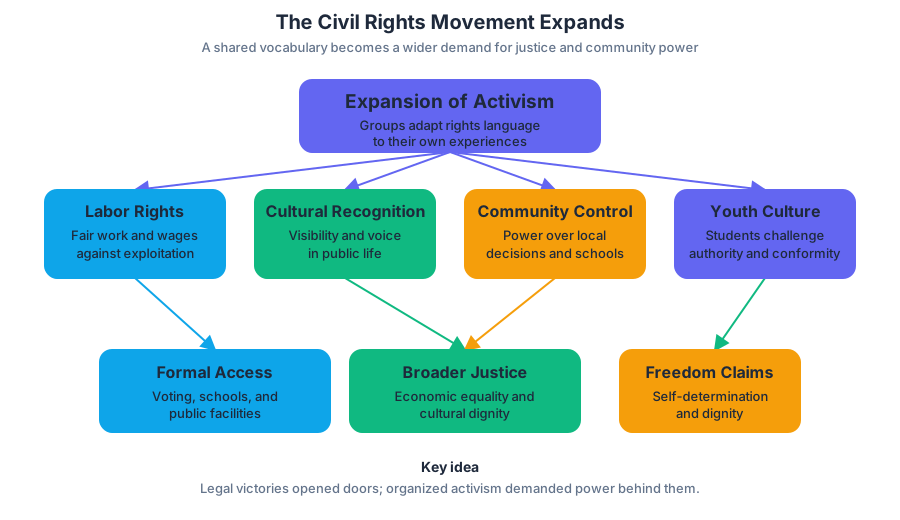
The African American civil rights movement created a powerful political vocabulary—rights, equality, self-determination, and freedom from discrimination. Other groups adapted that vocabulary to problems that were specific to their own experiences. This was not simply imitation: activists connected racial discrimination to labor exploitation, cultural invisibility, unequal schooling, police violence, and exclusion from political decision-making.
Key idea: The expansion of the Civil Rights Movement meant that more groups claimed rights through organized activism, while also redefining what civil rights required in their own communities.
A useful historical connection is that earlier federal civil rights victories supplied legal and moral leverage, but those victories did not automatically eliminate inequality. Activists therefore shifted from demanding formal access—such as the right to vote or attend public facilities—to demanding economic justice, cultural recognition, and community control.
Latino and Chicano activism
Mexican American activists developed the Chicano Movement, a broad campaign for Mexican American political power, cultural pride, educational equality, and improved working and living conditions. The movement’s name itself challenged the assumption that Mexican Americans should assimilate quietly into an Anglo-American culture. Chicano activists instead asserted that their history, language, and identity belonged at the center of American public life.
The United Farm Workers (UFW) demonstrated how civil rights and labor rights could reinforce one another. Cesar Chavez and Dolores Huerta organized agricultural workers, especially in California, to challenge low wages, racial discrimination, unsafe conditions, and the weak bargaining position of seasonal laborers. The Delano Grape Strike became a national struggle because the UFW sought support from consumers and residents beyond the fields.
Huerta’s 1968 interview with Maria Huffman is valuable historical evidence because it directs attention to workers’ lived experiences. Farm workers faced poor working conditions and racial discrimination; their work was essential to agricultural production, yet their labor often brought insecurity rather than economic stability. Chavez’s 1968 open letter to Los Angeles supporters shows the movement’s strategy: build public pressure, sustain the grape strike, and turn a local labor dispute into a wider civil rights issue.
The Brown Berets represented a more militant branch of Chicano activism. Their activism, alongside the broader Chicano Movement, illustrates how civil rights groups increasingly linked identity, community defense, education, and economic justice rather than limiting their demands to courtroom equality.
Misconception check
Misconception: “The UFW was only a labor union.” The UFW certainly organized workers, but its demands also confronted racial discrimination and unequal power. On an AP question, the strongest answer explains the connection: farm workers used labor organizing as a vehicle for civil rights and economic justice.
Youth culture and opposition to war
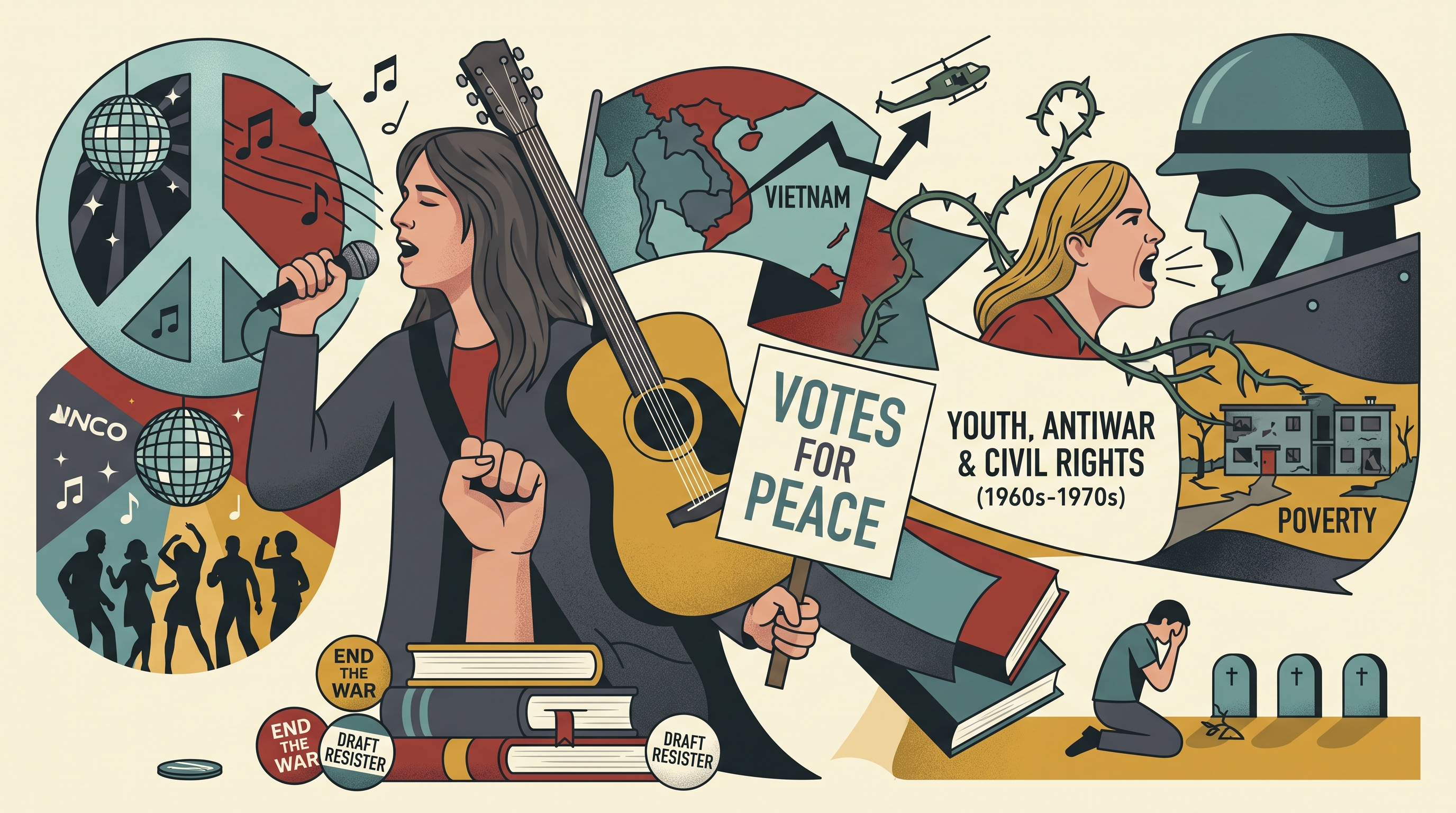
Youth culture in the 1960s challenged established expectations about authority, consumption, sexuality, music, clothing, and political participation. Young people created or expanded public spaces—including dance halls and dance palaces—that served as social environments for female patrons and working-class youth. These spaces mattered because they allowed young people to form identities and relationships outside older institutions’ control.
Youth politics became especially visible in opposition to the Vietnam War. Martin Luther King Jr.’s involvement in discussions about the war showed that opposition to militarism could be connected to civil rights: money and political attention devoted to Vietnam could compete with efforts to address poverty and racial inequality. The antiwar movement therefore contained both moral arguments against the war and criticisms of federal priorities.
The May 4, 1970, Kent State shootings intensified distrust of government authority. After President Nixon announced that American and allied troops had entered Cambodia, unrest spread on campuses. The Ohio National Guard was sent to quell the protests, and four students were killed. John Paul Filo’s photograph captures the emotional aftermath, making the event a powerful example of how visual evidence can communicate grief, shock, and the human cost of political conflict.
How to analyze evidence
Use the AP historical thinking skills 2.A Sourcing and Situation and 2.B Sourcing and Situation by asking who created a source, when, for whom, and under what circumstances. Huerta’s interview gives access to a farm worker movement’s concerns; Chavez’s open letter reveals an organizing strategy; Filo’s photograph documents the aftermath of state violence but does not, by itself, explain every cause of the protest.
Use 3.A Claims and Evidence in Sources and 3.B Claims and Evidence in Sources to connect evidence to an argument. Use 4.A Contextualization to place Latino activism and youth protest within the larger expansion of civil rights after 1960. Use 5.A Argumentation to make a defensible claim rather than merely listing movements.
Worked example: Claim: From 1960 to 1980, civil rights activism expanded because groups applied earlier rights language to economic, cultural, and foreign-policy conflicts. Evidence: Huerta described farm workers’ poor conditions and discrimination; Chavez mobilized public support for the grape strike; Kent State revealed the widening conflict between youth protest and government authority. Reasoning: these examples show that civil rights activism increasingly addressed the distribution of power in workplaces, communities, and national policy.
Retrieval check
- How did the UFW connect labor rights to civil rights?
- Why is Huerta’s 1968 interview useful evidence?
- What did the Kent State shootings reveal about youth protest and government authority?
- How did youth culture create spaces for social independence?
A complete response should identify the group or event, explain its specific grievance, and connect it to the broader expansion of civil rights between 1960 and 1980.
Source Materials
- AP U.S. History Course and Exam Description
- AP U.S. History Course and Exam Description Clarifications and Corrections
- AP U.S. History Course Overview
- AP U.S. History Course at a Glance
- AP United States History Course at a Glance Poster
- AP United States History
- AP United States History
- AP United States History Sample Syllabus 1