From the free course AP United States History on Lykke
3.11 Developing an American Identity · 3.12 Movement in the Early Republic
Key concepts: Developing an American identity · American and regional culture · Regional variations and cultural change from 1754 to 1800 · Ethnic and religious diversity in colonial America · Patriotism and resistance to British policies · Women’s political activism during the American Revolution · Indigenous cultures and early historical accounts · Historical source analysis: point of view, purpose, context, and limitations · The Patriot cause and the Battle of Trenton · Early-republic development, including territorial settlement, frontier defense, self-rule, trade, political parties, citizens’ rights, and the American System
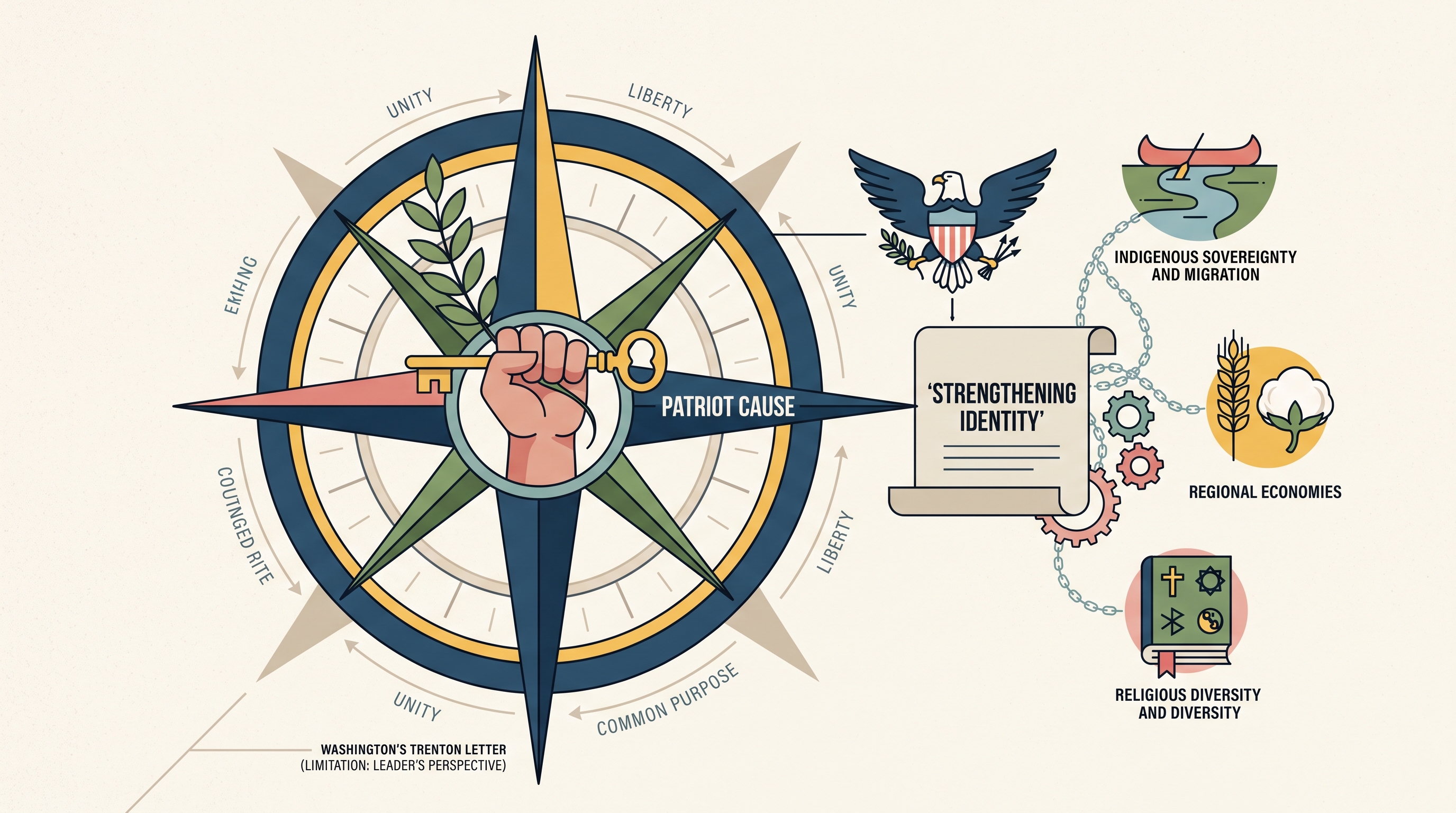
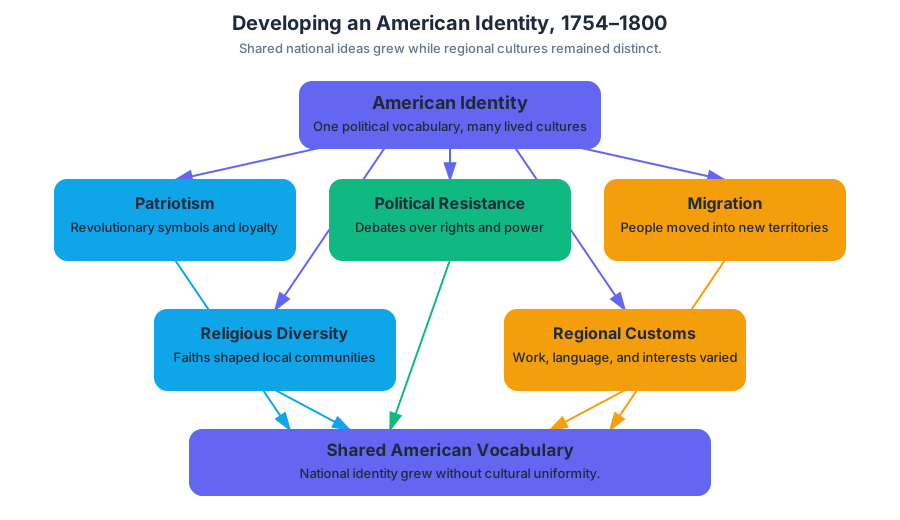
Between 1754 and 1800, Americans developed new ideas of national identity without becoming culturally uniform. Patriotism, political resistance, migration, religious diversity, and regional customs produced a shared American vocabulary—but not a single American culture.
3.11 Developing an American Identity · 3.12 Movement in the Early Republic
Between $1754$ and $1800$, Americans developed a stronger sense of belonging to a single nation without becoming culturally uniform. Patriotism, resistance to British policies, migration, religious diversity, women’s activism, and regional customs created a shared American vocabulary—but not one shared American culture.
A national identity built from difference
American identity means the ideas, loyalties, practices, and symbols through which people understood what it meant to belong to the United States. After independence, Americans created new forms of national culture while preserving major regional variations.
The key tension was visible everywhere: people increasingly described themselves as Americans, yet they continued to identify as New Englanders, Virginians, backcountry settlers, Native peoples, members of ethnic communities, or adherents of different churches. National identity therefore developed through negotiation rather than cultural sameness.
KC-3.2.III.ii: New forms of national culture developed in the United States alongside continued regional variations.
Patriotism and resistance
Before independence, opposition to British policies helped transform local grievances into a broader political identity. Resistance to taxation and imperial control encouraged colonists to use shared language—liberty, rights, representation, and tyranny—even though different colonies experienced British rule differently.
Patriotism became visible through public rituals and symbols: resistance organizations, boycotts, revolutionary committees, militia service, printed arguments, and eventually loyalty to the Continental cause. The term Patriot described colonists who supported resistance and independence, but not every colonist accepted that identity. Loyalists remained attached to the British Empire, while others tried to avoid choosing sides.
A common misconception is that the Revolution instantly erased older identities. In reality, revolutionary unity was powerful but conditional. Americans cooperated against a common imperial opponent while continuing to disagree about religion, slavery, political authority, economic interests, and the proper balance between state and national power.
American and regional culture
The American and Regional Culture theme, or ARC, emphasizes that creative expression, demographic change, philosophy, religious beliefs, scientific ideas, social mores, and technology shape national, regional, and group cultures. These cultures can then influence government policy and economic systems.
From $1754$ to $1800$, national culture grew through shared revolutionary experiences, republican political language, new state and national institutions, and symbols of independence. Yet regional differences remained substantial.
| Region or cultural setting | Important characteristics | Effect on identity |
|---|---|---|
| New England | Commercial communities, Congregational religious traditions, town-centered political life | Encouraged civic participation and a strong local identity |
| Middle Colonies and states | Greater ethnic and religious diversity, including Quakers and other Protestant groups | Made pluralism an important part of American life |
| Chesapeake and Southern regions | Plantation agriculture, Anglican influence, and racial slavery | Produced a hierarchical regional culture that conflicted with revolutionary ideals |
| Backcountry | New migration, frontier communities, and conflict over land | Strengthened demands for local control while intensifying conflict with Native peoples |
Regional culture did not merely decorate political life; it shaped policy. Different ideas about land, labor, religion, and political authority influenced debates over state constitutions, representation, western settlement, and the powers of the new federal government.
Ethnic and religious diversity
Colonial America contained people of English, Scottish, Irish, German, Dutch, African, and other backgrounds, as well as many American Indian nations. Enslaved Africans and their descendants created and preserved cultural traditions despite the violence of slavery. German-speaking communities, Dutch settlements, and other ethnic groups retained languages, customs, and religious practices while participating in wider colonial and revolutionary society.
Religious diversity also expanded beyond the older dominance of established churches. Congregationalists, Anglicans, Quakers, Presbyterians, Baptists, Catholics, Jews, and other communities practiced different forms of worship. The Revolution encouraged arguments that political membership should not depend entirely on belonging to one established church.
The important distinction is between diversity and equality. Revolutionary language broadened claims about liberty, but women, enslaved people, free African Americans, Native peoples, and many others remained excluded from full political power.
Women’s political activism
Women participated actively in the revolutionary movement even though most could not vote or hold office. They organized boycotts, produced homespun cloth, managed farms and businesses while men served in armies, circulated political information, and supported the Patriot cause through consumer choices.
The Daughters of Liberty became a prominent example of women turning household labor into political action. By making homespun goods and refusing imported products, women helped enforce resistance to British trade policies. Their activity challenged the idea that politics happened only in legislatures or battlefields.
Abigail Adams’s call to “remember the ladies” illustrates a related argument: revolutionary claims about liberty could be applied to women’s legal and political status. Yet the immediate result was limited. Women gained greater visibility as republican citizens and moral participants, but the dominant expectation remained republican motherhood—the idea that women should educate virtuous future citizens within the household rather than exercise equal formal political power.
Movement, migration, and conflict in the early republic
After independence, increasing numbers of migrants moved westward within North America. Frontier cultures that had emerged during the colonial period continued to grow, producing new communities but also intensifying social, political, and ethnic tensions.
Migration placed settlers and Native nations in direct conflict over land and natural resources. American Indian groups repeatedly evaluated and adjusted alliances with Europeans, other tribes, and the United States in an effort to limit white settlement and preserve control of their territories. These were strategic political decisions, not signs of passive resistance.
British alliances with American Indian groups contributed to continuing tensions between the United States and Britain after the Revolution. The existence of an independent United States did not end imperial competition or Native resistance; instead, western migration made sovereignty and land control central problems for the early republic.
Work the AP historical skill
The suggested skill is 1.B: Explain a historical concept, development, or process. A strong explanation must identify a development, describe how it operated, and connect it to a broader historical result.
For example: Women’s participation in boycotts and homespun production helped the Patriot movement by turning domestic consumption into organized resistance. This broadened political activism beyond male officeholders, although it did not produce equal voting rights for women.
This answer explains a process rather than merely naming the Daughters of Liberty. It identifies the action, the mechanism, and the limitation.
Retrieval and DBQ practice
Quick check: Why did a shared American identity coexist with regional variation?
Answer: Revolutionary institutions and symbols created national loyalties, while differences in religion, economy, ethnicity, geography, labor systems, and relations with Native peoples preserved distinct regional cultures.
DBQ-oriented prompt: Evaluate the extent to which the American Revolution expanded political participation between $1754$ and $1800$.
A defensible thesis would argue that the Revolution expanded participation by encouraging women’s activism, public political debate, and new ideas of citizenship, but that expansion remained sharply limited by slavery, gender restrictions, Native dispossession, and continuing social hierarchy. To develop the argument, connect each document’s point of view and historical situation to the larger conflict between revolutionary ideals and unequal power.
Source Materials
- AP U.S. History Course and Exam Description
- AP U.S. History Course and Exam Description Clarifications and Corrections
- AP U.S. History Course Overview
- AP U.S. History Course at a Glance
- AP United States History Course at a Glance Poster
- AP United States History
- AP United States History
- AP United States History Sample Syllabus 1
- (A) Briefly describe one purpose of the women’s organization in producing the pamphlet.
- (A) Briefly describe one purpose of the women’s organization in producing the pamphlet.
- [a] Briefly describe one major difference between Melder’s and Lerner’s interpretations of the origins of the women’s rights movement in the early nineteenth century.