From the free course AP United States History on Lykke
5.7 Election of 1860 and Secession · 5.8 Military Conflict in the Civil War
Key concepts: Election of 1860 · Secession and debates over leaving the Union · Slavery as the central cause of sectional conflict · Regional differences between the North and South · States’ rights arguments · Proslavery racial doctrines and the belief that slavery was a positive social good · Alexander Stephens’s Cornerstone Speech · Union and Confederate economic and societal mobilization · Military conflict in the Civil War · Union military victory over the Confederacy
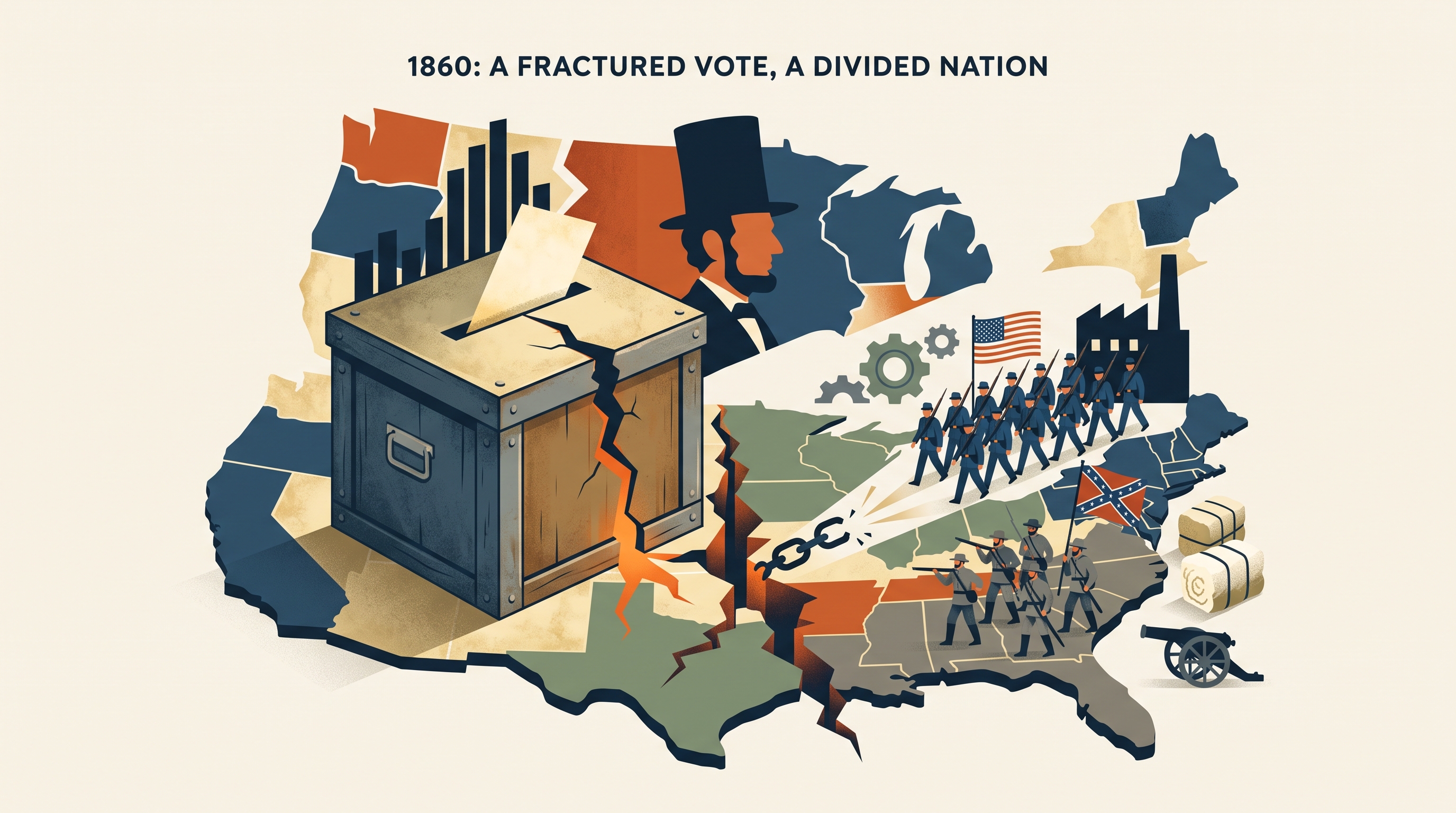
Abraham Lincoln won the presidency in 1860 without carrying a single Southern state, and that fact exposed the central crisis of the Union: could a nation remain united when one section believed slavery must expand and the other increasingly opposed its expansion?
5.7 Election of 1860 and Secession · 5.8 Military Conflict in the Civil War
Abraham Lincoln won the presidency in 1860 without carrying a single Southern state, and that fact exposed the central crisis of the Union: could a nation remain united when one section believed slavery must expand and the other increasingly opposed its expansion?
Investigative question: Why did the election of one Republican president lead to secession—and why did the resulting war end in Union victory?
Unit 5 Learning Objective A: Explain the context in which sectional conflict emerged from 1844 to 1877.
CED traceability: KC-5.2, KC-5.2.I, KC-5.2.II, KC-5.3, and KC-5.3.I are central to this topic. The most useful AP Historical Thinking Skills are Skill 1: Developments and Processes, Skill 2: Sourcing and Situation, Skill 3: Claims and Evidence in Sources, Skill 4: Contextualization, Skill 5: Making Connections, and Skill 6: Argumentation.
The election that broke the two-party system
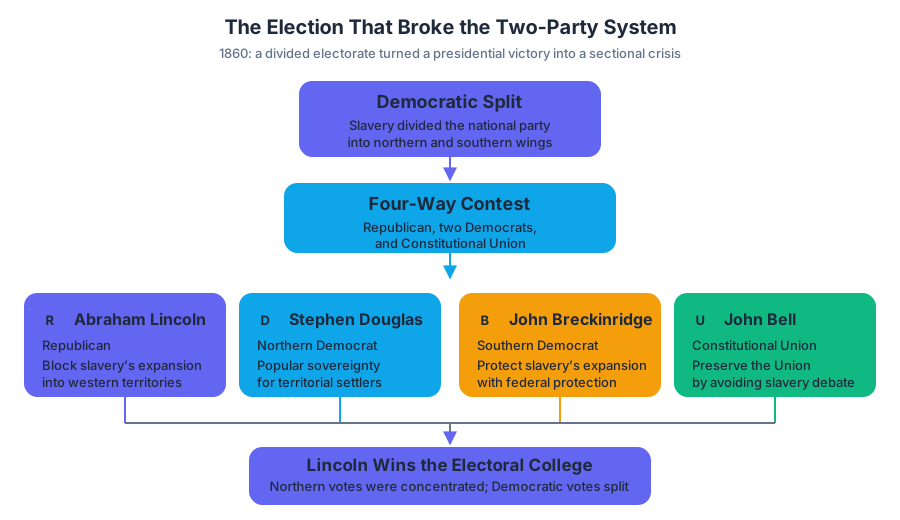
The election of 1860 occurred after the national Democratic Party split over slavery. The Republican Party, founded in the 1850s, opposed the expansion of slavery into western territories. Its candidate, Abraham Lincoln, presented the Republican position as a defense of free labor and the belief that slavery should not gain new political power.
Four major candidates divided the electorate:
| Candidate | Party or coalition | Core political position |
|---|---|---|
| Abraham Lincoln | Republican | Block slavery’s expansion into the territories |
| Stephen Douglas | Northern Democrat | Allow territorial settlers to decide through popular sovereignty |
| John C. Breckinridge | Southern Democrat | Protect slavery’s expansion and federal protection |
| John Bell | Constitutional Union | Preserve the Union by avoiding the slavery issue |
Lincoln won the Electoral College because the Republican vote was concentrated in the North, while the Democratic vote was divided among Douglas, Breckinridge, and Bell. His victory did not immediately abolish slavery where it already existed. Southern secessionists nevertheless interpreted a Republican victory as evidence that the South had lost national political influence and that slavery’s future was endangered.
Secession: constitutional argument and practical purpose
Secession was the formal withdrawal of a state from the Union. South Carolina seceded in December 1860, followed by Mississippi, Florida, Alabama, Georgia, Louisiana, and Texas before Lincoln’s inauguration. These states formed the Confederate States of America, with Jefferson Davis as president. Virginia, Arkansas, Tennessee, and North Carolina later joined after fighting began.
Secessionists often used states’ rights, the claim that states retained authority to resist or reject federal power, as their constitutional justification. Yet the immediate issue protected by that argument was slavery. Mississippi’s secession declaration, for example, identified its society and economy with slavery. States’ rights functioned less as an abstract principle than as a defense against federal action threatening slaveholders’ power.
Misconception check: “The Civil War was mainly about states’ rights, unrelated to slavery.”
Correction: States’ rights was a major argument, but slavery was the central issue that made secession urgent. The relevant historical question is: states’ rights to do what? In 1860–1861, the answer was primarily the right to preserve and protect slavery.
KC-5.2.I requires attention to competing responses. Many white Northerners opposed slavery’s expansion because they feared competition with enslaved labor, not because they supported racial equality. Abolitionists such as Frederick Douglass and other antislavery activists made stronger moral arguments, condemned slavery as a violation of human rights, assisted freedom seekers, and sometimes accepted resistance or violence. Southern defenders claimed that racial hierarchy was natural, that slavery benefited enslaved people, and that the Constitution protected slave property.
From political crisis to military conflict
Lincoln initially sought to preserve the Union without immediately attacking slavery where it already existed. The Confederacy, however, claimed federal forts and military installations located inside seceded states. When Confederate forces fired on Fort Sumter in April 1861, Lincoln called for troops to suppress the rebellion. The conflict became a war over national sovereignty: could individual states leave the Union by force?
The North and South entered the war with sharply different strengths:
| Union advantage | Confederate advantage |
|---|---|
| Larger population and manpower | Fighting largely on home territory |
| Greater industrial capacity | Strong military tradition among many officers |
| More railroad, banking, and manufacturing resources | Defensive strategy could make Union conquest costly |
| Established navy and ability to blockade ports | Hope that Britain or France might intervene |
The Confederacy’s strategy was largely defensive: survive, defend its territory, and persuade the North that victory would cost too much. The Union developed a broader strategy—blockade Southern ports, control the Mississippi River, divide the Confederacy, and capture its political and economic centers. The Union’s resources mattered, but resources alone did not guarantee victory; military leadership, political will, and emancipation also changed the war’s meaning and direction.
Why emancipation became a military strategy
KC-5.3.I identifies three connected causes of Union victory: Northern manpower and industrial resources, leadership including Abraham Lincoln’s, and the decision to emancipate enslaved people. The Emancipation Proclamation of 1863 declared enslaved people in areas still rebelling against the Union to be free. It did not immediately free every enslaved person, but it transformed Union war aims and weakened the Confederacy.
Emancipation damaged the Confederate labor system, encouraged enslaved people to flee plantations or seek Union protection, and allowed African American men to enlist in the Union army. Nearly 180,000 Black soldiers served in the United States Colored Troops. Their military participation made freedom an active part of Union victory rather than merely a postwar promise.
The war’s major turning points included the Union victory at Antietam, which gave Lincoln the opportunity to announce emancipation; the Union victories at Gettysburg and Vicksburg in 1863, which checked Confederate offensives and secured the Mississippi River; and the campaigns of Ulysses S. Grant and William Tecumseh Sherman, which increasingly targeted Confederate armies, transportation, supplies, and morale.
Worked causal example: from election to war
Prompt: Explain how the election of 1860 contributed to the outbreak of the Civil War.
Step 1—Contextualize: Expansion into western territories had intensified disagreement over whether slavery would spread.
Step 2—Identify the development: Lincoln’s Republican victory demonstrated that a candidate opposed to slavery’s expansion could win through Northern electoral strength.
Step 3—Explain the reaction: Southern leaders feared permanent minority status and believed Republican control threatened slavery’s security.
Step 4—Connect cause to outcome: Several slave states seceded, formed a Confederacy, and seized federal property. The Fort Sumter attack prompted Lincoln to use military force, turning secession into civil war.
This chain earns a causal explanation because it connects political change, sectional interpretation, secession, and military escalation rather than merely listing events.
In-flow retrieval check
- Why did Lincoln win the Electoral College even though he received no electoral votes from the Deep South?
- How did the Emancipation Proclamation affect the Union war effort?
- Give one Union advantage and one Confederate advantage.
- Why is “states’ rights” an incomplete explanation unless the specific right is identified?
Answers: The Democratic vote split among several candidates, while Republican support was concentrated in the North. Emancipation weakened Confederate labor, encouraged escape, and opened Union service to Black soldiers. The Union had greater manpower and industry; the Confederacy fought defensively on familiar territory. The claimed right primarily concerned protecting slavery and resisting federal authority over it.
Skill connection: A strong AP response uses Skill 1: Developments and Processes to connect election, secession, and war; Skill 4: Contextualization to place 1860 within expanding sectional conflict; Skill 5: Making Connections to link emancipation with military victory; and Skill 6: Argumentation to make a defensible claim that recognizes both constitutional language and slavery’s central role.
Source Materials
- AP U.S. History Course and Exam Description
- AP U.S. History Course and Exam Description Clarifications and Corrections
- AP U.S. History Course Overview
- AP U.S. History Course at a Glance
- AP United States History Course at a Glance Poster
- AP United States History
- AP United States History
- AP United States History Sample Syllabus 1
- (A) Briefly describe one way that agricultural interests influenced societal debates in the United States from 1865 to 1900.
- (A) Briefly describe one way that agricultural interests influenced societal debates in the United States from 1865 to 1900.