From the free course AP United States History on Lykke
8.3 The Red Scare · 8.4 Economy After 1945
Key concepts: Red Scare after World War II · Containment of communism · McCarthyism · Lavender Scare · American and National Identity · Sourcing and situation · Post-1945 economic transformation · Shift from the industrial Midwest to the Sun Belt · Free trade and global economic competition · Economic inequality and conservatism
The post–World War II United States confronted two linked questions: How much freedom could be restricted to defend democracy? and Who would benefit from the new economy?
8.3 The Red Scare · 8.4 Economy After 1945
The post–World War II United States confronted two linked questions: How much freedom could be restricted to defend democracy? and Who would benefit from the new economy? The Red Scare answered the first question through investigations, loyalty programs, and public accusations; the postwar economy reshaped the second through technology, migration, regional change, and expanding global trade.
8.3 The Red Scare: Defending Democracy by Limiting Freedom?
Unit 8: Learning Objective C asks students to “Explain the causes and effects of the Red Scare after World War II.” The required historical development, KC-8.1.II.A, emphasizes a crucial distinction: Americans debated the policies and methods used to expose suspected communists inside the United States, even while both major political parties supported the broader foreign-policy strategy of containing communism.
American and National Identity (NAT): Debates about democracy, freedom, citizenship, diversity, and individualism shaped American beliefs about national identity—and those beliefs shaped political institutions and society.
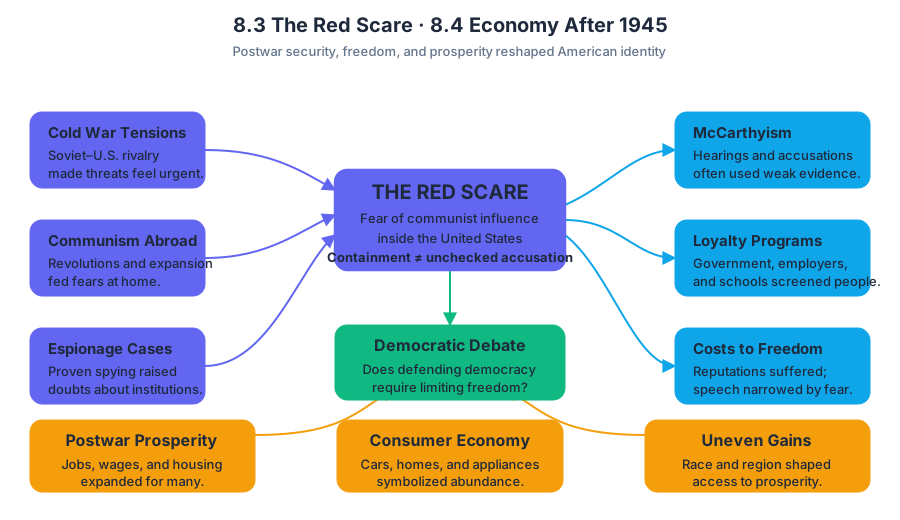
The Red Scare was the postwar fear that communist influence threatened the United States from within. Its causes included tensions with the Soviet Union, the spread of communism abroad, espionage cases, and anxiety that American institutions were vulnerable. Its effects reached far beyond proven espionage: investigations damaged reputations, encouraged conformity, narrowed acceptable political speech, and forced Americans to debate whether suppressing dissent protected or undermined democracy.
McCarthyism describes the aggressive use of accusations, investigations, and public hearings to identify alleged communist sympathizers, especially when evidence was weak or selectively presented. Senator Joseph McCarthy became its most recognizable figure, but anticommunist activity also involved congressional investigations, executive-branch loyalty programs, employers, schools, and private organizations.
The political conflict was therefore not simply “communists versus anticommunists.” Many Americans agreed that communist expansion abroad should be contained, but they disagreed over due process, evidence, congressional authority, and the boundary between legitimate security concerns and political intimidation. Dwight D. Eisenhower’s frustration with McCarthyism appears clearly in an October 9, 1953, letter to his brother Milton S. Eisenhower: the president opposed McCarthy’s methods even though Eisenhower’s administration remained firmly anticommunist.
The Lavender Scare
The Lavender Scare involved efforts to identify and remove suspected LGBTQ people from federal employment. Officials connected homosexuality to supposed vulnerability, disloyalty, or blackmail, linking the campaign to broader anticommunist fears. This reveals how the Red Scare policed not only political beliefs but also citizenship, identity, privacy, and acceptable behavior.
Misconception check — “The Red Scare targeted only actual spies.”
Many targets were accused or investigated without reliable proof. The historical significance lies partly in how fear expanded the definition of danger and made suspicion itself socially and professionally destructive.
Sourcing and Situation: Why Context Changes Meaning
Skill 2.B: Sourcing and Situation means explaining a source’s point of view, purpose, historical situation, and/or audience. “Situation” asks what was happening around the author when the document was created—not merely what the author says.
Paul Robeson’s testimony illustrates this method. Robeson was an African American performer and political activist speaking in a period shaped simultaneously by the Red Scare and Jim Crow. That situation helps explain why his arguments and point of view cannot be read as an abstract debate about communism: racial inequality, citizenship, political repression, and the risks of public dissent shaped what he said and how audiences might interpret it.
Worked sourcing example: If a document defends an accused person’s right to dissent, first identify the author and date; next place the document in the postwar anticommunist climate; then connect that situation to the argument. A strong explanation would say that the author’s concern about government investigations reflects a period when accusations could threaten employment and reputation, making civil liberties—not simply foreign policy—the central issue.
8.4 Economy After 1945: Growth, Movement, and Unequal Rewards
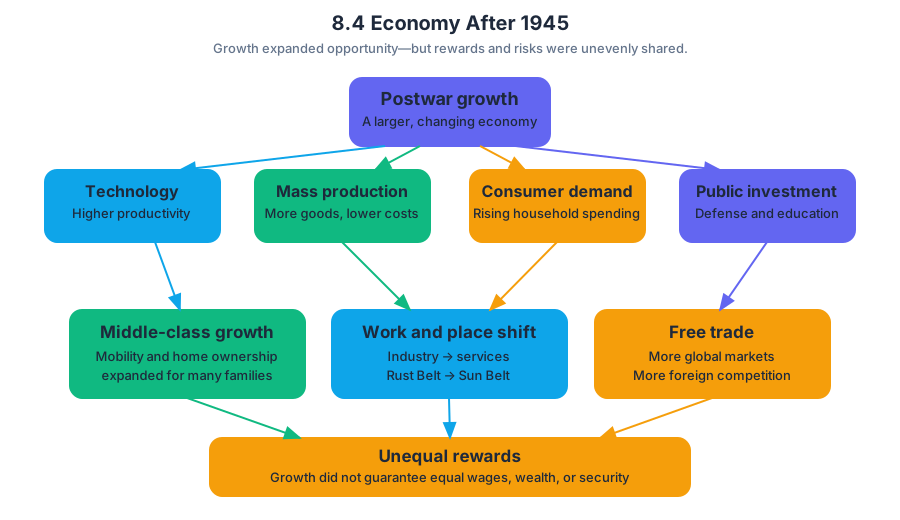
Unit 8: Learning Objective D focuses on explaining the causes and effects of economic changes after 1945. The postwar economy benefited from technological innovation, mass production, expanded consumer demand, military spending, and increased access to education and economic opportunity. These forces helped enlarge the middle class and encouraged economic mobility, although prosperity was distributed unevenly.
Technology transformed both work and daily life. New systems of transportation, communication, manufacturing, and information processing increased productivity and helped shift employment away from traditional industrial labor toward services. The geographic result was a movement from the industrial Midwest—the “Rust Belt”—toward the Sun Belt of the South and West, where newer industries, defense contracts, lower taxes, air-conditioning, and population growth encouraged investment.
The United States also turned toward free trade, meaning fewer barriers to international exchange, as it competed in an increasingly global economy. This strengthened access to overseas markets and encouraged international economic integration, but it also exposed some American workers and industries to foreign competition.
Economic inequality remained an important feature of postwar change. Aggregate growth and a larger middle class did not mean that every group experienced equal wages, wealth, security, or opportunity. Conservatism gained strength partly through reactions against taxation, regulation, labor power, and federal activism, especially as economic restructuring created winners and losers.
Misconception check — “Postwar prosperity affected everyone equally.”
The economy grew dramatically, but regional decline, racial discrimination, gender inequality, unequal educational access, and later deindustrialization complicated the idea of universal prosperity.
Connecting the Two Topics
The Red Scare and the postwar economy were connected through competing ideas of American identity. Anticommunism portrayed private property, individualism, and political loyalty as markers of American freedom, while economic change raised difficult questions about mobility, inequality, labor, and the government’s responsibility to citizens.
Retrieval check: Explain one cause and two effects of the Red Scare after World War II. Then explain how the shift from the industrial Midwest to the Sun Belt reflected technological and economic change. Finally, for a Paul Robeson document, name one feature of its historical situation that could shape the author’s point of view.

Source Materials
- AP U.S. History Course and Exam Description
- AP U.S. History Course and Exam Description Clarifications and Corrections
- AP U.S. History Course Overview
- AP U.S. History Course at a Glance
- AP United States History Course at a Glance Poster
- AP United States History
- AP United States History
- AP United States History Sample Syllabus 1