From the free course AP United States History on Lykke
2.5 Interactions Between American Indians and Europeans · 2.6 Slavery in the British Colonies
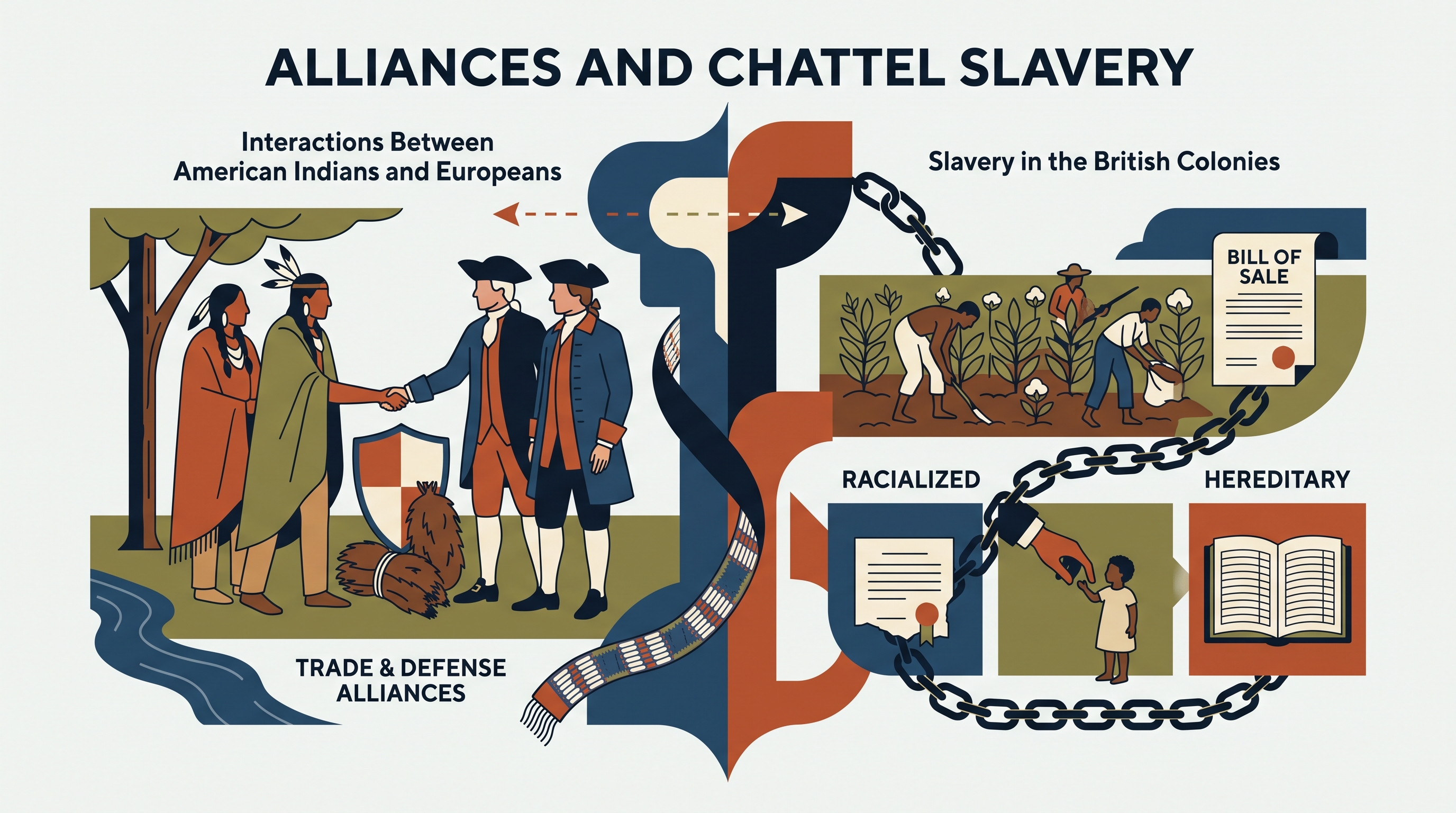
European colonization created neither simple cooperation nor constant warfare: American Indians and Europeans repeatedly negotiated, traded, allied, resisted, and fought according to changing political and economic interests.
2.5 Interactions Between American Indians and Europeans · 2.6 Slavery in the British Colonies
European colonization created neither simple cooperation nor constant warfare: American Indians and Europeans repeatedly negotiated, traded, allied, resisted, and fought according to changing political and economic interests. At the same time, British colonists built a racialized system of hereditary slavery that transformed labor, law, demography, and power across the colonies.
Investigative question: Why did some American Indian groups cooperate with European empires while others resisted them—and why did British colonies increasingly rely on African slavery?
2.5 Interactions Between American Indians and Europeans
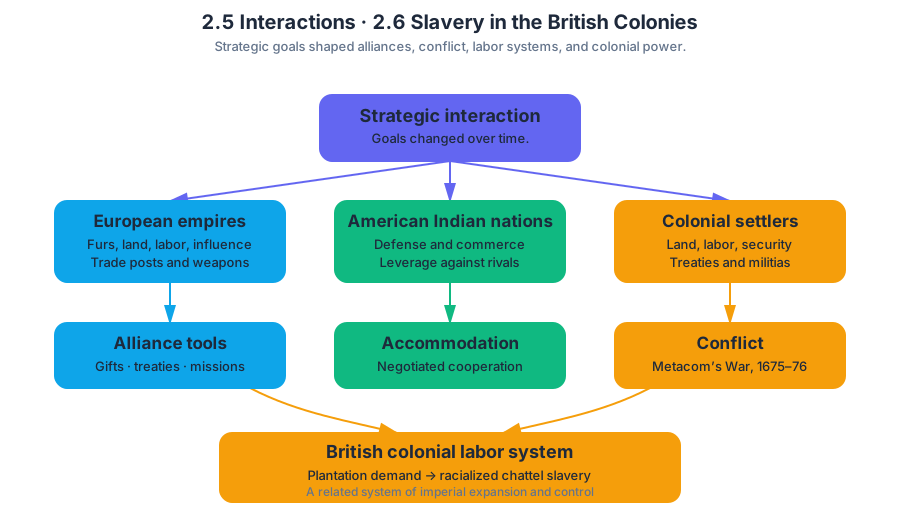
The central idea in Unit 2: Learning Objective E is that interactions between European nations and American Indians changed over time because both sides pursued strategic goals. Europeans competed for land, labor, trade, and imperial influence; American Indian nations sought to protect territory, control commerce, defeat rivals, and preserve political independence.
The CED identifier KC-2.1.III.C captures this flexibility: European rivals—including French, Dutch, British, and Spanish colonists—formed alliances with and armed American Indian groups. American Indian leaders were not merely responding to European decisions; they often sought alliances themselves against neighboring Native nations. These relationships could produce accommodation, meaning negotiated cooperation, as well as conflict.
A useful way to analyze an alliance is to ask what each participant expected to gain:
| Participant | Possible objective | Typical strategy |
|---|---|---|
| European empire | Furs, military support, territory, trade access | Gifts, weapons, treaties, missionaries, trade posts |
| American Indian nation | Defense, commerce, political leverage, advantage over rivals | Diplomacy, selective alliance, trade, warfare |
| Colonial settlers | Land, labor, local security, economic opportunity | Settlement, treaties, militias, expansion |
Worked contextual example: Metacom’s War. In New England, expanding English settlement intensified disputes over land, resources, and political boundaries. These pressures contributed to Metacom’s War (King Philip’s War), identified in KC-2.1.III.E. The conflict demonstrates that “trade” and “alliance” did not eliminate underlying competition: when English colonists continued to expand, many Native communities viewed accommodation as increasingly dangerous.
Spanish colonization produced a different pattern in the Southwest. American Indian resistance to Spanish efforts—especially after the Pueblo Revolt—forced Spanish authorities to accommodate some aspects of Native culture. This development, specified in KC-2.1.III.F, shows that resistance could alter imperial policy even when it did not remove Spanish influence entirely.
Misconception check: American Indians did not “fail to unite” because they lacked political organization. Native nations possessed their own governments, diplomatic traditions, economies, and rivalries. Europeans exploited those divisions, but American Indian leaders made calculated choices within a complex international environment.
2.6 Slavery in the British Colonies
Unit 2: Learning Objective F requires explaining how and why slavery developed and expanded in the British colonies. The key development is KC-2.2.II: like other European empires participating in the Atlantic slave trade, the English colonies developed slavery in forms shaped by specific economic, demographic, and geographic conditions.
At first, many English colonies used a mixture of Indigenous labor, indentured European servants, and enslaved Africans. Over time, plantation agriculture—especially tobacco in the Chesapeake and rice and indigo in the Carolina lowcountry—created intense demand for labor. As the supply of enslaved Africans increased and colonial laws hardened, slavery became increasingly hereditary and identified with African ancestry.
The system was not simply “labor shortage plus plantations.” Colonial governments converted racial assumptions into law. The result was racialized chattel slavery: enslaved people were treated as property, slavery generally passed from mother to child, and enslaved Africans and their descendants could be denied legal rights regardless of individual skill, religion, or status.
Regional conditions mattered. Chesapeake tobacco plantations often relied on dispersed farms and developed a large enslaved population over time. In South Carolina and Georgia, rice cultivation required specialized knowledge and arduous labor in disease-heavy environments, encouraging planters to import large numbers of Africans. New England had fewer plantation exports, but merchants, shipowners, and consumers still participated in Atlantic slavery and profited from the wider commercial system.
Enslaved people resisted slavery in both direct and indirect ways. Resistance included slowing work, breaking tools, preserving family and religious traditions, negotiating for limited autonomy, running away, and participating in revolts. These actions did not always overthrow slavery, but they demonstrate that enslaved people were historical actors who continually challenged the system imposed upon them.
Misconception check: Slavery was not confined to the plantation South, and enslaved people were not passive. Northern colonies also held enslaved people and benefited from Atlantic commerce, while resistance appeared wherever slavery existed.
Connecting the Two Topics
These topics connect through power and adaptation. European empires adjusted their diplomacy when American Indian resistance threatened colonial authority; British colonists adjusted labor systems when plantation economies demanded a more controllable workforce. In both cases, historical outcomes emerged from conflict among competing groups—not from a single European plan that everyone else simply accepted.
AP Historical Reasoning in Practice
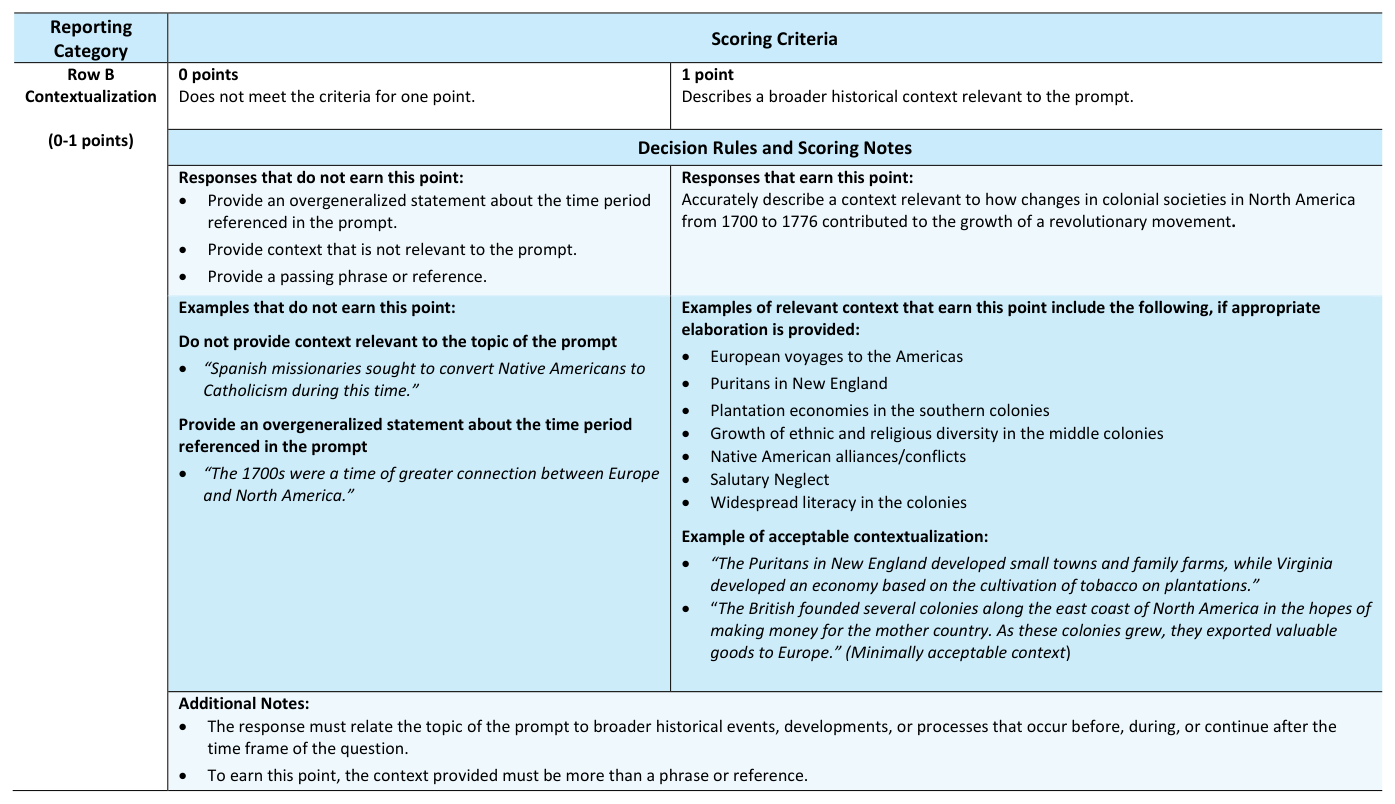
For Skill 1.A: Identify and describe a claim, identify whether a source presents alliance, resistance, or slavery as its central argument. For Skill 2.A: Analyze features of historical sources, examine who created a treaty, colonial law, missionary account, or enslaved person’s testimony. For Skill 2.B: Explain the point of view, purpose, audience, and historical situation, ask why a colonial official might describe an alliance differently from an American Indian leader.
For Skill 3.B: Explain the causes and effects of historical developments, connect plantation production and labor demand to the expansion of slavery, or connect land pressure to Metacom’s War. For Skill 5.A: Compare historical developments, compare French trade alliances with American Indians to English settler expansion. For Skill 6.A: Develop a thesis, make a defensible claim that explains both cooperation and conflict rather than treating either as universal.
Retrieval Check
Answer without looking back: What were two reasons American Indian nations formed alliances with European powers, and how did British colonial slavery become different from temporary forms of labor? A strong response should identify Native strategic goals—such as defense or rivalry—and explain that British slavery became hereditary, racialized, and legally treated enslaved people as property.
Source Materials
- AP U.S. History Course and Exam Description
- AP U.S. History Course and Exam Description Clarifications and Corrections
- AP U.S. History Course Overview
- AP U.S. History Course at a Glance
- AP United States History Course at a Glance Poster
- AP United States History
- AP United States History
- AP United States History Sample Syllabus 1
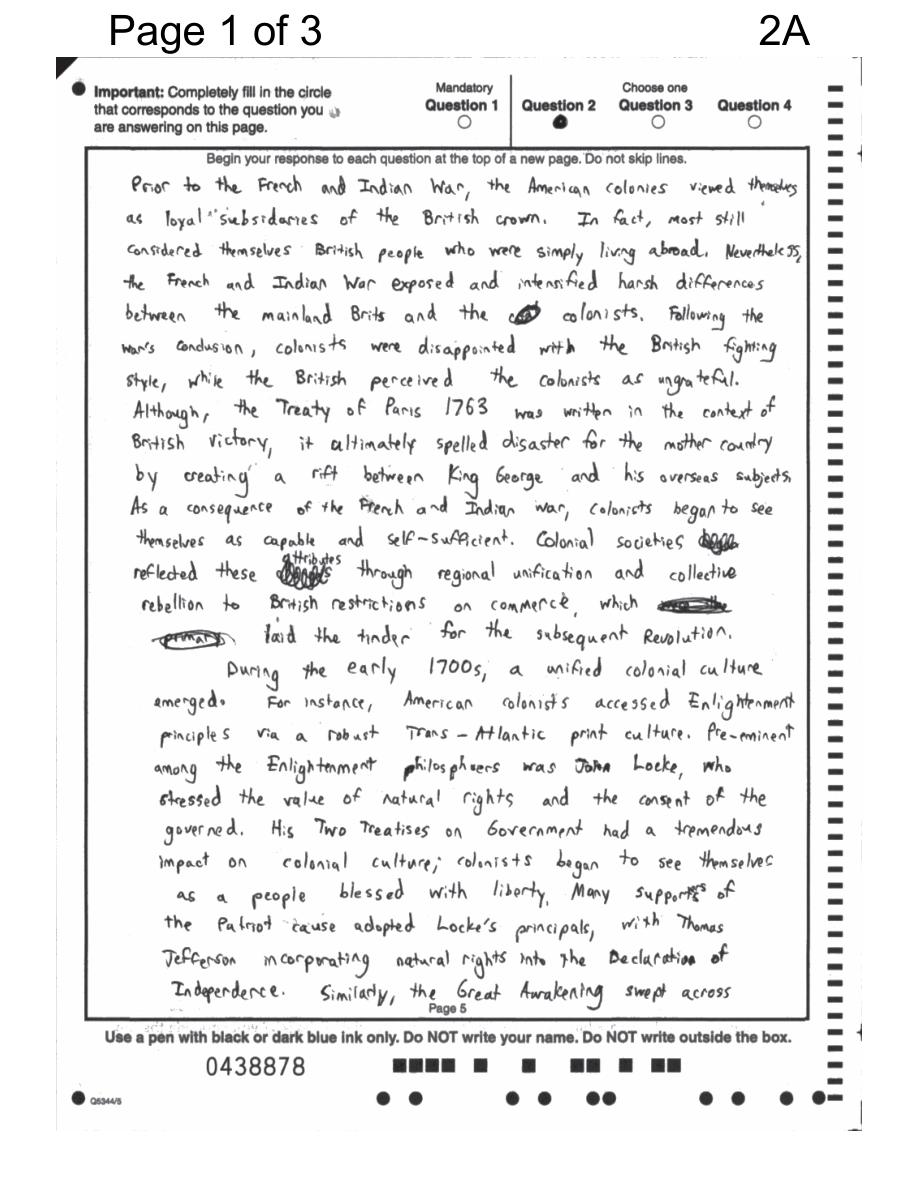
- Figure — Sample Responses - LEQ 2 - Set 2 (p. 4)
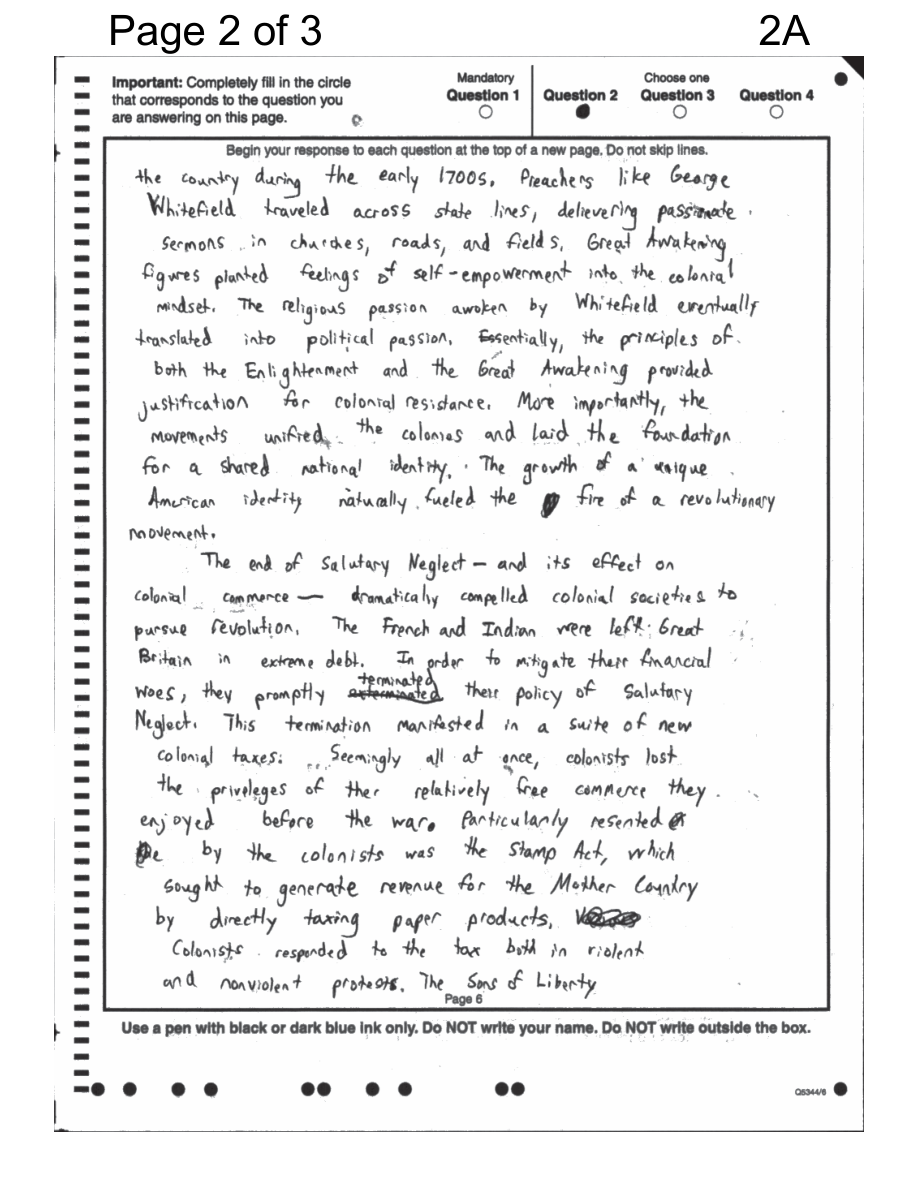
- Figure — Sample Responses - LEQ 2 - Set 2 (p. 7)
- Figure — Sample Responses - LEQ 2 - Set 2 (p. 8)
- Figure — Sample Responses - LEQ 2 - Set 2 (p. 9)