From the free course AP United States History on Lykke
7.3 The Spanish–American War · 7.4 The Progressives
The Spanish–American War of 1898 transformed the United States from a nation mainly focused on continental expansion into an overseas power, while Progressivism tried to control the social and political consequences of rapid industrialization.
7.3 The Spanish–American War · 7.4 The Progressives
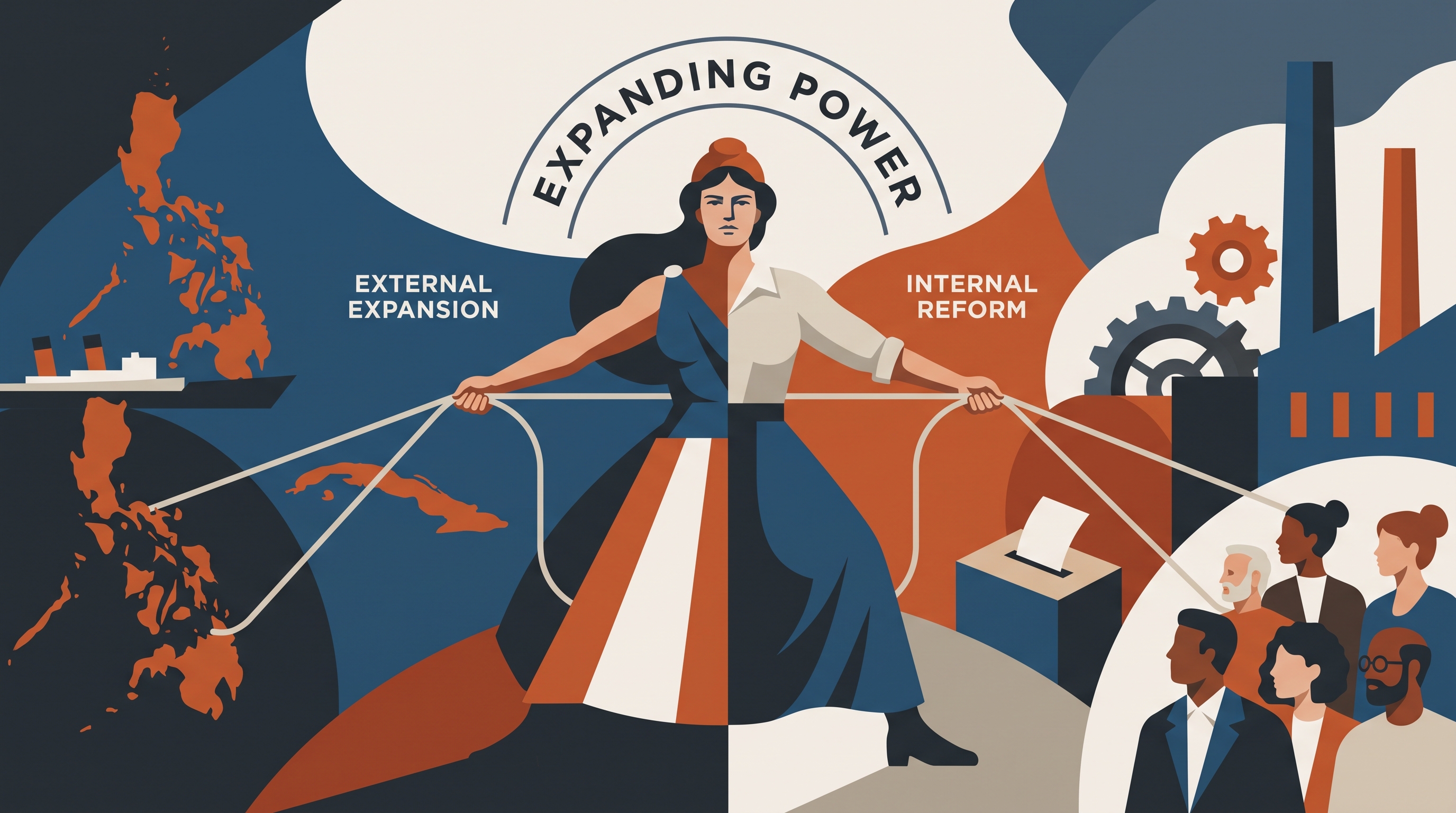
The Spanish–American War of 1898 transformed the United States from a nation mainly focused on continental expansion into an overseas power, while Progressivism tried to control the social and political consequences of rapid industrialization. The two developments were connected by a shared question: How should the United States use its growing power?
7.3 The Spanish–American War
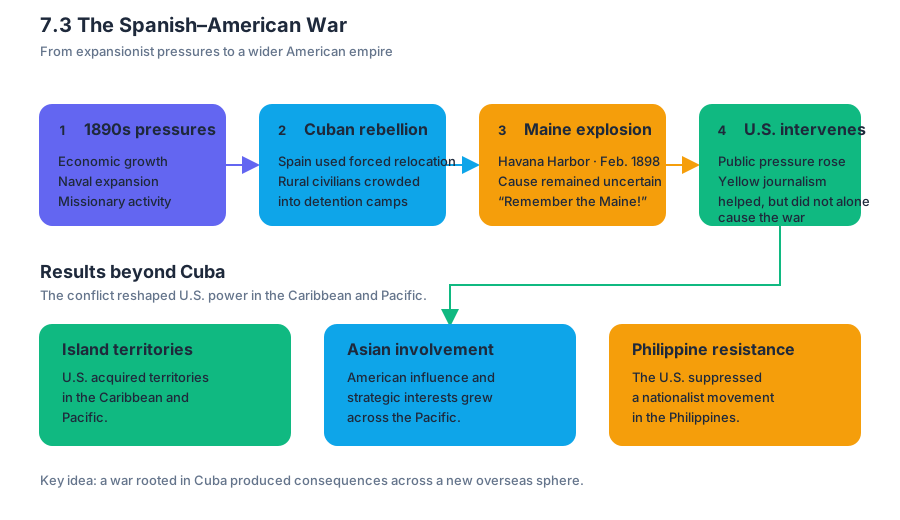
By the 1890s, economic growth, naval expansion, missionary activity, and nationalistic journalism encouraged many Americans to look beyond the continent. The war with Spain began in the context of a Cuban rebellion against Spanish rule, but its results reached far beyond Cuba: the United States acquired island territories in the Caribbean and Pacific, increased its involvement in Asia, and suppressed a nationalist movement in the Philippines.
The immediate crisis developed around Cuba. Spanish authorities attempted to defeat Cuban rebels through harsh policies, including the forced relocation of rural civilians into overcrowded camps. American newspapers used sensational stories and dramatic images to portray Spanish rule as cruel. This yellow journalism helped intensify public pressure for intervention, although newspaper coverage alone did not cause the war.
The explosion of the USS Maine in Havana Harbor in February 1898 became the decisive trigger. Although the cause of the explosion remained uncertain, the slogan “Remember the Maine!” encouraged Americans to blame Spain. President William McKinley initially resisted war, but Congress and public opinion pushed the administration toward intervention.
Key distinction: The war’s causes included Cuban resistance, Spanish repression, American economic interests, nationalism, and the Maine crisis. The war’s effects included an expanded American empire and a new conflict over whether the United States should govern other peoples.
The conflict was brief but geographically broad. Commodore George Dewey defeated the Spanish fleet at Manila Bay, while American forces and Filipino allies fought Spain in the Philippines. In the Caribbean, U.S. forces invaded Cuba. The Treaty of Paris ended the war: Spain relinquished Puerto Rico and Guam, transferred the Philippines to the United States, and recognized Cuban independence.
Cuba did not become fully independent in practice. Through the Platt Amendment, the United States claimed the right to intervene in Cuban affairs and gained control of Guantánamo Bay. In the Philippines, Emilio Aguinaldo and other nationalists expected independence after helping defeat Spain. Instead, the United States took possession of the islands, producing the Philippine–American War and suppressing Filipino independence fighters.
A useful sourcing example comes from a Filipino independence argument describing American rule as a “barbaric war” and contrasting “government by consent in America” with “government by force in the Philippine Islands.” Under Sourcing and Situation 2.B: Explain the point of view, purpose, historical situation, and/or audience of a source, a strong response does more than identify the author. It explains that a representative of Aguinaldo wrote from the perspective of a nationalist movement angered by the United States’ failure to honor its stated liberation ideals.
7.4 The Progressives
Progressivism was a broad reform movement that responded to the problems created by industrial capitalism, urbanization, immigration, and political corruption. Progressives were not a single unified party or ideology. They included journalists, settlement-house workers, clergy, middle-class reformers, labor advocates, and politicians who believed government could correct social and economic abuses.
Their methods reflected the problems they confronted:
| Problem | Progressive response |
|---|---|
| Unsafe food and medicine | Federal inspection and regulation |
| Political machines | Civil-service reform, direct primaries, and initiatives |
| Corporate power | Antitrust enforcement and government regulation |
| Urban poverty | Settlement houses and social-work programs |
| Workplace danger | Factory-safety laws and workers’ compensation |
| Political exclusion | Women’s suffrage and, more unevenly, restrictions on corruption |
Investigative journalists called muckrakers exposed abuses through photographs, articles, and books. Upton Sinclair’s The Jungle described unsanitary meatpacking conditions; public reaction helped produce the Meat Inspection Act and the Pure Food and Drug Act in 1906. The important historical connection is not that one book single-handedly created reform, but that investigative evidence strengthened existing demands for federal action.
Progressive reform also reshaped the presidency. Theodore Roosevelt used the federal government as a “steward” of the public interest, supported regulation of large corporations, and intervened in the 1902 coal strike. William Howard Taft continued some reforms, while Woodrow Wilson promoted the Federal Reserve, the Federal Trade Commission, and stronger antitrust legislation.
Progressivism contained major contradictions. Many reformers supported women’s suffrage and social welfare, yet some embraced racial segregation, eugenics, immigration restriction, or paternalistic control of poor and immigrant communities. Reform could therefore expand democracy for some Americans while limiting freedom for others.
Worked connection and misconception check
Worked example: To connect the two topics, ask why Progressive-era leaders might support both domestic regulation and overseas expansion. A defensible explanation is that many believed modern government should organize society scientifically and efficiently. At home, that logic encouraged regulation of corporations; abroad, it could justify controlling territories that Americans claimed were not yet prepared for self-government.
Named misconception — “The Spanish–American War liberated all the peoples involved.” The United States helped end Spanish rule in Cuba, but it retained substantial influence there and denied Philippine nationalists the independence they expected. Likewise, “Progressives all agreed on reform” is inaccurate: they shared concern about social problems but disagreed sharply over race, immigration, labor, gender, and the proper limits of federal power.
Retrieval check
- Name two causes and two effects of the Spanish–American War.
- Why did the Philippines become a test of American claims about self-government?
- How did muckraking contribute to Progressive reform?
- Identify one contradiction within Progressivism.
A strong final connection is this: the Spanish–American War expanded the nation’s external power, while Progressivism expanded—or attempted to expand—the government’s internal capacity. Both developments forced Americans to debate whether power should be used for liberation, order, reform, economic advantage, or control.
Source Materials
- AP U.S. History Course and Exam Description
- AP U.S. History Course and Exam Description Clarifications and Corrections
- AP U.S. History Course Overview
- AP U.S. History Course at a Glance
- AP United States History Course at a Glance Poster
- AP United States History
- AP United States History
- AP United States History Sample Syllabus 1