From the free course AP United States History on Lykke
2.7 Colonial Society and Culture · 2.8 Comparison in Period 2
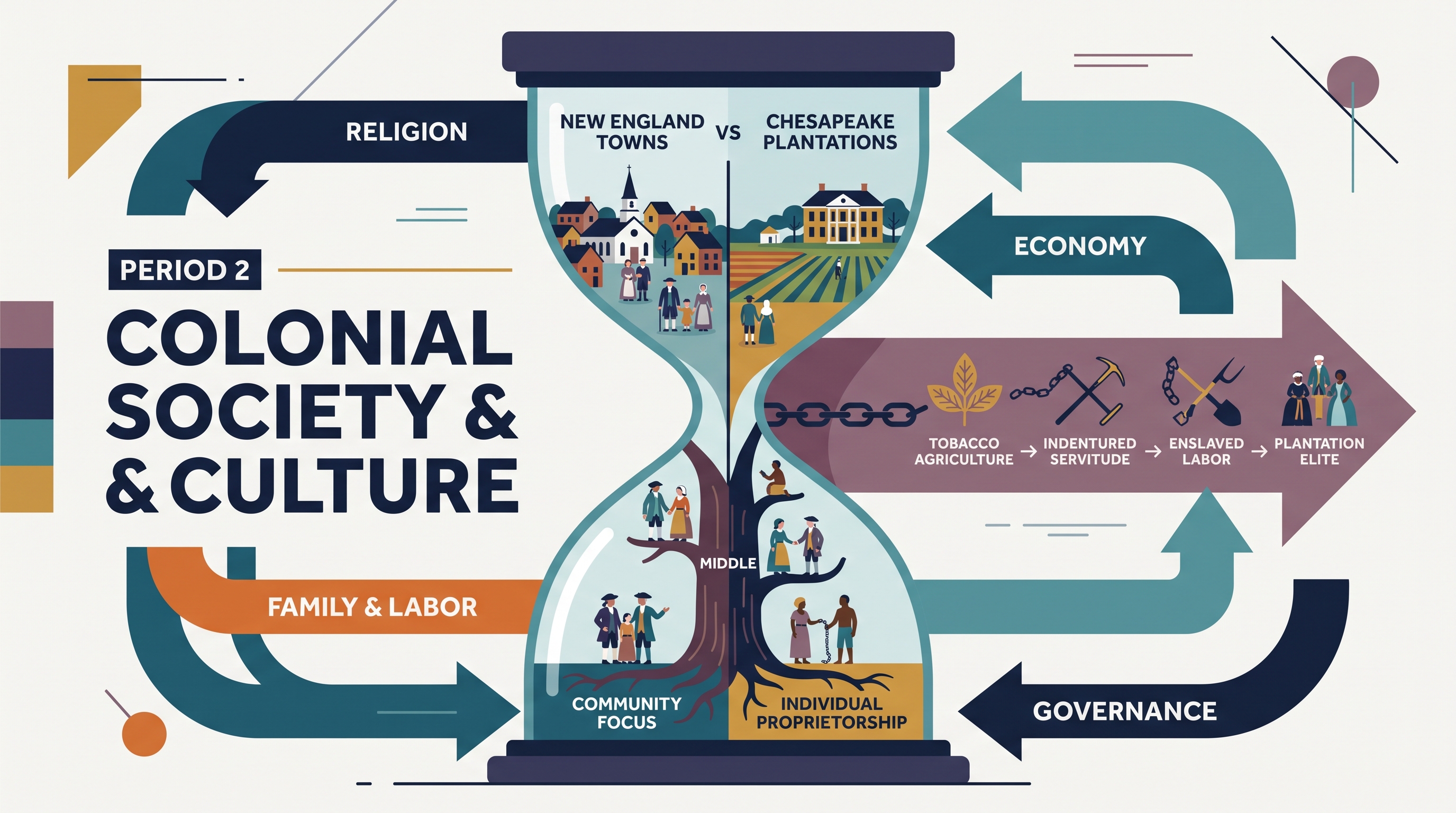
By 1754, Britain’s mainland colonies were not one society but a collection of regional societies connected by language, trade, Protestant Christianity, and political allegiance. The central question is therefore not simply what were the colonies like?
2.7 Colonial Society and Culture · 2.8 Comparison in Period 2
By 1754, Britain’s mainland colonies were not one society but a collection of regional societies connected by language, trade, Protestant Christianity, and political allegiance. The central question is therefore not simply what were the colonies like? but why did similar European colonies develop such different cultures—and why did those differences matter?
Learning Objective 2.G: Explain how and why the different goals and interests of European leaders and colonists affected how they viewed themselves and their relationship with Britain.
Learning Objective 2.H: Compare the effects of the development of colonial society in the various regions of North America.
A regional map of colonial development
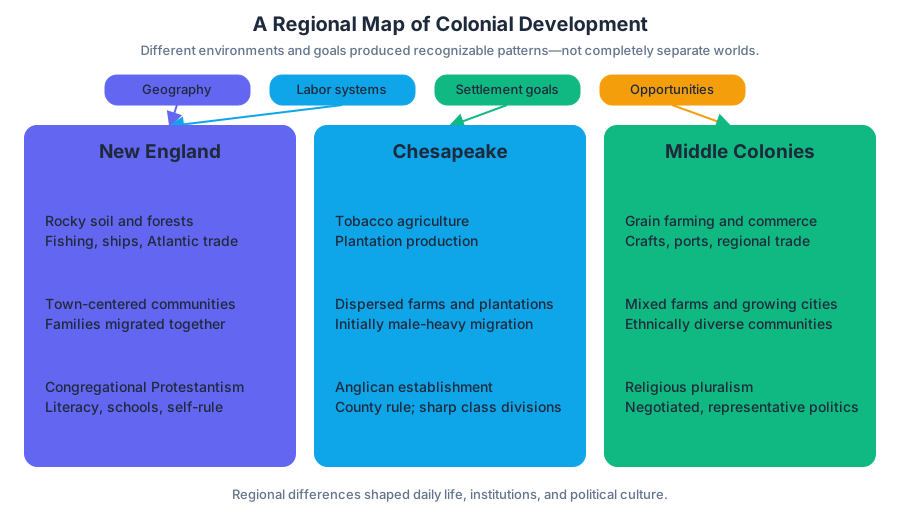
The three broad colonial regions developed from different combinations of geography, labor systems, settlement goals, and economic opportunities. These differences did not create completely separate worlds, but they produced recognizable patterns.
| Region | Environment and economy | Society and settlement | Culture and politics |
|---|---|---|---|
| New England | Rocky soil, forests, fishing, shipbuilding, and Atlantic trade | Town-centered communities; many families migrated together | Congregational Protestantism, literacy, schools, and local self-government |
| Chesapeake | Tobacco agriculture and plantation production | Dispersed farms and plantations; initially male-heavy migration | Anglican establishment, county government, and sharp class divisions |
| Middle Colonies | Grain farming, commerce, crafts, and port trade | Mixed farms, growing cities, and ethnically diverse communities | Religious pluralism, immigration, and comparatively broad cultural exchange |
New England: community, faith, and literacy
Puritan settlers in Massachusetts Bay sought to build a disciplined Protestant society rather than merely extract wealth. Their migration included substantial numbers of families, which encouraged stable communities, higher population growth, and settlements organized around towns and congregations.
Religion shaped public life, but Puritan society was not completely tolerant. Roger Williams challenged Massachusetts authorities by defending separation between church and government and insisting that colonists should not seize Native land without legitimate purchase. Anne Hutchinson challenged the authority of Puritan ministers by emphasizing individual religious faith. Both were expelled, demonstrating the tension between religious purpose and religious conformity.
Literacy became especially important because Puritans believed people should read the Bible. New England communities therefore supported schooling earlier and more systematically than many other colonies. This helped produce a culture of sermons, pamphlets, town meetings, and religious debate.
Misconception check: Puritans did not come to America to establish modern religious freedom. They wanted freedom to practice their own religion and often restricted competing beliefs within their communities.
The Chesapeake: tobacco, hierarchy, and dispersed settlement
Virginia developed around tobacco, a labor-intensive cash crop that tied the colony to Atlantic markets. Tobacco encouraged planters to seek more land and labor, while the plantation economy produced dispersed settlement rather than the compact towns common in New England.
Early Chesapeake society was unstable. Many immigrants were young men, mortality was high, and social divisions were severe. Over time, the expansion of slavery and the consolidation of plantation wealth created a rigid hierarchy: wealthy planters held the most land and political influence, while small farmers, indentured servants, enslaved Africans, and landless laborers occupied less powerful positions.
Virginia’s House of Burgesses gave some colonists experience with representative government, but “representative” did not mean democratic equality. Political participation was concentrated among propertied men, and colonial institutions often protected elite control.
The Middle Colonies: diversity and exchange
Pennsylvania, New York, New Jersey, and Delaware benefited from fertile farmland, navigable rivers, and commercial ports. Grain production supported export markets, while Philadelphia and New York became major centers of trade, printing, immigration, and political discussion.
The Middle Colonies contained English, Dutch, German, Scots-Irish, and other communities. Religious diversity was also pronounced: Quakers, Presbyterians, Lutherans, Dutch Reformed Christians, Jews, and others lived in the region. Pennsylvania’s Quaker leadership promoted comparatively broad religious toleration, although colonial societies still contained inequality and conflict.
This diversity made the Middle Colonies less culturally uniform than New England and less dominated by a single staple crop than the Chesapeake. It also encouraged negotiation among groups with different languages, customs, and religious commitments.
Colonial culture: shared institutions, unequal access
Across the colonies, people developed local political institutions such as assemblies, town meetings, church organizations, and county governments. These institutions gave colonists practical experience in managing local affairs and helped them form identities as Virginians, New Englanders, Pennsylvanians, or other colonials—not simply as distant subjects of Britain.
At the same time, colonial culture was profoundly unequal. Gender roles generally placed political authority and property control in men’s hands, while women performed essential agricultural, domestic, and commercial labor with limited legal independence. Enslaved Africans and their descendants created families, religious practices, music, and community networks despite laws designed to deny their autonomy.
The First Great Awakening in the 1730s and 1740s further connected the colonies through traveling preachers and emotional Protestant revivals. It also challenged established religious authority by encouraging ordinary people to evaluate ministers and religious experience for themselves.
Comparison as historical reasoning
AP Skill 5.A, Making Connections—Identify patterns and connections between and among historical developments and processes, is more than listing similarities and differences. A strong comparison explains a relationship: New England’s family migration and town structure encouraged communal institutions, whereas Chesapeake tobacco production and dispersed settlement encouraged plantation hierarchy and county-based politics.
AP Skill 1.A, Developments and Processes—Identify and describe a historical development or process, helps establish the evidence before comparison. For example, identifying the growth of tobacco agriculture, religious pluralism, or Atlantic commerce gives the comparison concrete historical content rather than vague regional stereotypes.
AP Skill 6, Argumentation—Develop an argument, requires a defensible claim supported by specific evidence. A workable thesis might argue that colonial regions became different primarily because environmental and economic conditions shaped settlement patterns, while shared Atlantic connections gradually produced cultural links among them.
Worked comparison
Prompt: Explain one major difference between New England and the Chesapeake colonies and explain one cause of that difference.
Reasoning: The difference was settlement structure. New England developed compact towns because many Puritan families migrated together and organized communities around churches and local institutions. The Chesapeake developed dispersed plantations because tobacco required extensive land and labor, encouraging planters to spread along waterways and producing greater dependence on hierarchical agricultural production.
Notice the complete chain: economic or religious goal → migration pattern → settlement structure → social and political consequences. That chain turns comparison into historical explanation.
Retrieval check
- Why did New England develop stronger town-centered institutions than the Chesapeake?
- Which region was most associated with religious and ethnic diversity?
- How could colonial assemblies exist alongside social inequality?
- Complete the causal chain: tobacco agriculture → __________ → plantation hierarchy.
Answers: 1. Family migration and Puritan community organization encouraged towns. 2. The Middle Colonies. 3. Political representation was generally limited to propertied men. 4. Expanded land and labor demands, producing dispersed plantations and sharp class divisions.
Source Materials
- AP U.S. History Course and Exam Description
- AP U.S. History Course and Exam Description Clarifications and Corrections
- AP U.S. History Course Overview
- AP U.S. History Course at a Glance
- AP United States History Course at a Glance Poster
- AP United States History
- AP United States History
- AP United States History Sample Syllabus 1