From the free course AP United States History on Lykke
3.13 Continuity and Change in Period 3
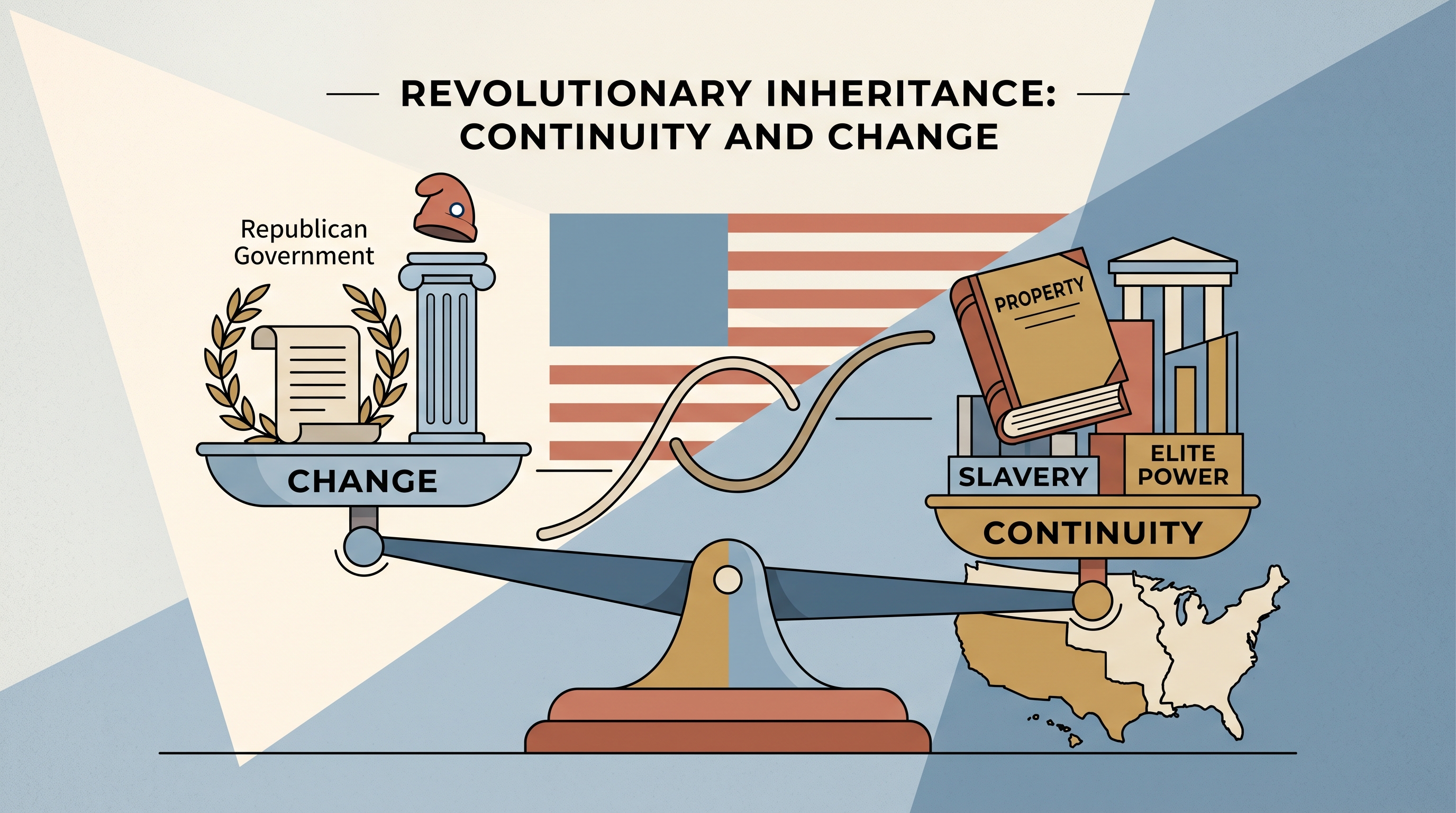
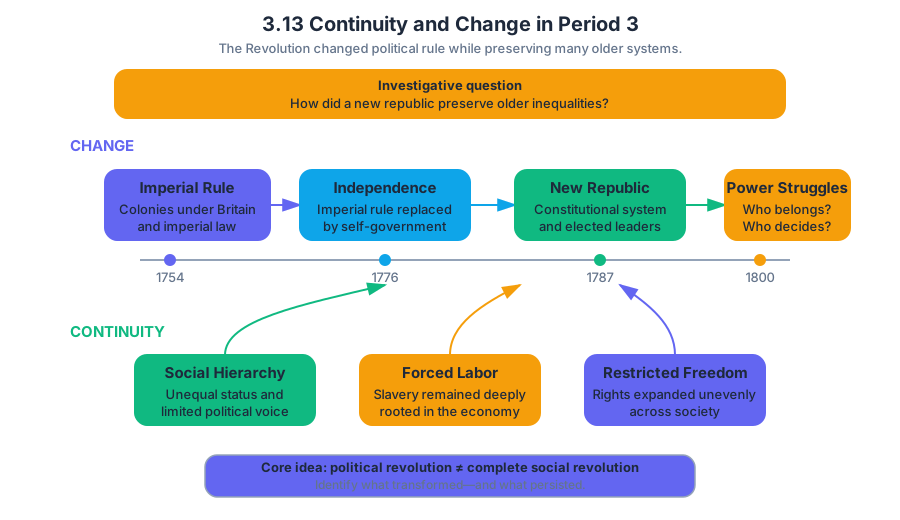
Between 1754 and 1800, the United States experienced a political revolution without a complete social revolution: independence replaced imperial rule, but inequality, forced labor, and struggles over power remained deeply rooted.
3.13 Continuity and Change in Period 3
Between 1754 and 1800, the United States experienced a political revolution without a complete social revolution: independence replaced imperial rule, but inequality, forced labor, and struggles over power remained deeply rooted.
Investigative question: How could the Revolution create a new republic while preserving so many older systems of inequality?
3.13 Continuity and Change in Period 3 asks you to identify both sides of that paradox. Change means a meaningful transformation over time; continuity means a pattern, institution, belief, or inequality that persisted despite major events.
The period at a glance
| Area | Major change, 1754–1800 | Important continuity |
|---|---|---|
| Government | Colonists moved from imperial rule to republican government under the Constitution | Political power remained concentrated among propertied white men |
| Political ideas | Natural rights, popular sovereignty, and republicanism became central public principles | Those principles were applied unevenly |
| Slavery | Revolutionary language encouraged some northern emancipation and antislavery criticism | Slavery expanded and remained protected, especially in the South |
| Native nations | The United States became independent from Britain | Native peoples continued resisting land loss and U.S. expansion |
| Economy and movement | Americans expanded westward and developed stronger national markets and institutions | Agriculture remained central, and regional differences persisted |
| Identity | A distinct American identity developed through symbols, republican language, and shared wartime experience | Americans continued to disagree over who belonged within “the people” |
Political transformation: from subjects to citizens
The clearest change was political. In 1754, most people living in Britain’s mainland colonies were imperial subjects who participated in local assemblies but accepted the authority of the British monarch and Parliament. By 1800, the United States had declared independence, written state constitutions, adopted the Articles of Confederation, replaced them with the Constitution, and developed competing national political parties.
The new system rested on republicanism, the belief that legitimate government derives from the people and should be directed by representatives rather than a hereditary monarch. Popular sovereignty, the principle that political authority ultimately comes from the people, also became more important. The Constitution strengthened the national government through taxation, regulation of interstate commerce, executive authority, and federal courts.
Yet political participation did not become broadly equal. Many states restricted voting or officeholding through property requirements, and women, enslaved people, most free Black people, and Native Americans were excluded from full political citizenship. The Revolution changed the source of political legitimacy more dramatically than it changed the distribution of political power.
Revolutionary ideals versus social reality
The language of liberty created new pressure against old institutions. The Declaration of Independence’s assertion that people possessed natural rights encouraged antislavery arguments, northern gradual-emancipation laws, and debates over women’s education and civic influence. Abigail Adams’s appeal to “remember the ladies” illustrates how revolutionary language could be used to challenge traditional authority, even though it did not produce women’s suffrage.
Named misconception — “The Revolution ended slavery.” It did not. Some northern states adopted gradual emancipation, but slavery continued throughout the early republic and remained economically powerful. The Constitution protected slaveholders through provisions involving representation, fugitive laborers, and the continuation of the transatlantic slave trade until 1808.
The contradiction was not accidental: revolutionary leaders faced pressure to defend liberty while preserving social order and economic interests. Thus, the period produced both an expanding vocabulary of rights and a durable racial hierarchy.
Native nations and western expansion
Independence also changed the balance of power in North America. The United States no longer had to operate through British imperial boundaries, and the Treaty of Paris of 1783 transferred British claims east of the Mississippi River to the new nation. However, Native nations had not surrendered their lands through that treaty, and many resisted U.S. settlement through diplomacy, military alliances, and warfare.
The continuity is crucial: European and American settlers continued the older pattern of treating Indigenous land as available for expansion. The change was that the United States now pursued that expansion as an independent republic. Conflicts in the Ohio Country and the defeat of Native forces at the Battle of Fallen Timbers in 1794 demonstrated that independence intensified, rather than ended, Indigenous dispossession.
Worked contextual example: the Constitution
Prompt: Explain one major change and one major continuity in American political life between the Seven Years’ War and 1800.
Step 1 — Establish the context. The Seven Years’ War increased Britain’s debt and led imperial officials to seek more revenue from the colonies. Resistance to taxation helped produce the Revolution and independence.
Step 2 — Identify the change. The United States replaced monarchy and parliamentary sovereignty with republican government. The Constitution created a stronger federal structure than the Articles of Confederation.
Step 3 — Identify the continuity. Political authority still remained largely in the hands of elite white men. The new republic rejected hereditary monarchy but did not create universal democracy.
Step 4 — Explain the relationship. The Revolution transformed governmental institutions and political language, but social hierarchies limited how fully those changes were applied.
This response demonstrates S.P.4 Contextualization by connecting developments to the Seven Years’ War, S.P.5 Making Connections through continuity-and-change reasoning, and S.P.6 Argumentation by making a defensible claim supported by specific evidence. It also applies the reasoning process Continuity and Change, which asks not merely what changed? but what persisted, and why did both occur together?
CED traceability and retrieval check
Learning Objective 3.13.A: Explain how and why the American Revolution and the early republic produced both continuities and changes in American society and government.
Essential Knowledge identifiers: KC-3.1.I.A, KC-3.1.I.B, KC-3.2.I.A, KC-3.2.I.B, and KC-3.3.I.A are especially useful for tracing revolutionary ideals, republican government, social hierarchy, slavery, Native dispossession, and the development of American identity across Period 3.
Retrieval check: Complete the sentence with two precise examples: “The Revolution changed ________, but it preserved ________ because ________.” A strong answer might identify the shift from imperial rule to republican government, the persistence of slavery or elite political power, and the economic or racial interests that limited revolutionary reform.
Source Materials
- AP U.S. History Course and Exam Description
- AP U.S. History Course and Exam Description Clarifications and Corrections
- AP U.S. History Course Overview
- AP U.S. History Course at a Glance
- AP United States History Course at a Glance Poster
- AP United States History
- AP United States History
- AP United States History Sample Syllabus 1