From the free course AP United States History on Lykke
2.1 Contextualizing Period 2 · 2.2 European Colonization
By 1607, European powers were no longer merely visiting North America: they were competing to control land, labor, trade, and strategic waterways. Between 1607 and 1754, that competition produced colonies with sharply different purposes and institutions.
2.1 Contextualizing Period 2 · 2.2 European Colonization
By 1607, European powers were no longer merely visiting North America: they were competing to control land, labor, trade, and strategic waterways. Between 1607 and 1754, that competition produced colonies with sharply different purposes and institutions. The central question is: Why did European colonies develop differently even though they occupied the same continent?
Learning Objective 2.1: Explain the context for the colonization of North America from 1607 to 1754.
Learning Objective 2.2: Explain how and why various European colonies developed and expanded from 1607 to 1754.
The larger Atlantic setting
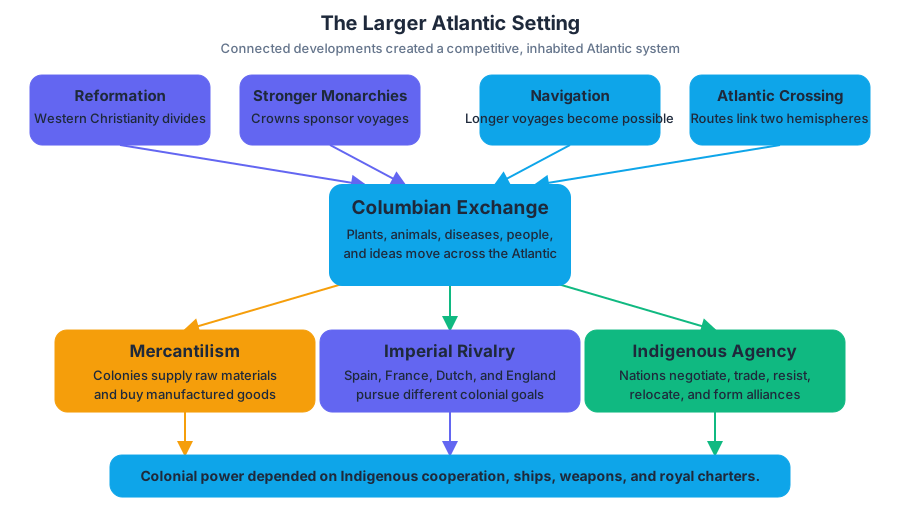
European colonization followed several connected developments: the Protestant Reformation divided western Christianity; stronger monarchies sponsored overseas exploration; improvements in navigation made longer voyages possible; and the Columbian Exchange, the movement of plants, animals, diseases, people, and ideas across the Atlantic, transformed both hemispheres.
European rulers also embraced mercantilism, an economic system in which colonies supplied raw materials and purchased manufactured goods from the imperial power. Colonies were valuable not only as places to settle but also as tools in European rivalry. Spain sought precious metals and religious influence, France pursued the fur trade and alliances, the Dutch emphasized commerce, and England promoted settlement, trade, and strategic expansion.
The Atlantic system worked like a competitive board game, but the “board” was already inhabited. European empires claimed territory, while Native nations negotiated, traded, resisted, relocated, and formed military alliances. European power therefore depended on Indigenous cooperation as well as on weapons, ships, and royal charters.
European colonial models
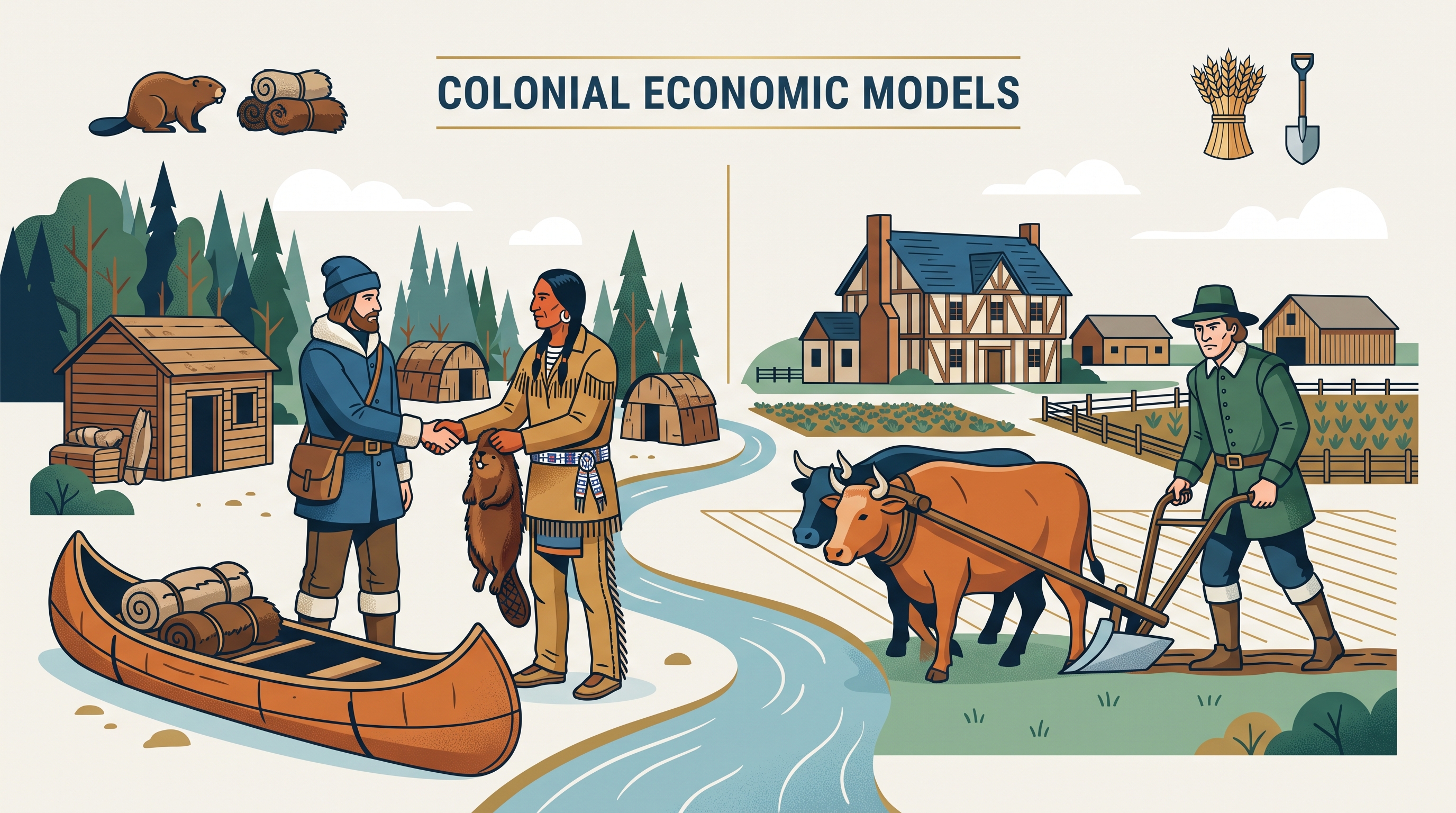
KC-2.1.I.A–C and KC-2.2.I.A–C require attention to both imperial rivalry and colonial difference. Spain created missions, presidios, and settlements across Florida, the Southwest, and California. French colonization centered more heavily on the St. Lawrence River valley, the Great Lakes, and the Mississippi system, where traders and missionaries depended on relationships with Native peoples.
The Dutch established New Netherland as a commercial colony organized around trade, especially in the Hudson River valley. England created the largest settler population along the Atlantic coast, including colonies founded for profit, religious purposes, and mixed economic goals.
| Imperial power | Major motive | Common colonial pattern | Important relationship with Native peoples |
|---|---|---|---|
| Spain | Wealth, strategic control, conversion | Missions, presidios, forced labor systems, settlements | Conquest, conversion, resistance, and accommodation |
| France | Fur trade, commerce, Catholic missions | Trading posts and river-based networks | Extensive diplomacy and military alliances |
| Netherlands | Commercial profit | Port-centered trade colony | Trade relationships and competition |
| England | Settlement, profit, religion, expansion | Large farming communities and towns | Trade, diplomacy, land conflict, and warfare |
A crucial distinction is between colonization and exploration. Exploration mapped routes and identified resources; colonization established permanent political and economic control. Jamestown, founded in 1607, marked England’s first permanent settlement in the Chesapeake, while Plymouth, founded in 1620, represented a separatist religious community. Massachusetts Bay, founded in 1630, combined religious purpose with a larger program of Puritan settlement.
Worked contextual example: Jamestown
Suppose a historian asks why Jamestown struggled during its first years. Begin with context: England was competing with Spain and France, investors expected profit, and the settlement was organized through the Virginia Company. That context explains why many settlers initially searched for marketable goods rather than developing reliable food production.
Next, connect environment and human choices. Jamestown’s swampy location created health problems, while insufficient preparation and strained relations with the Powhatan Confederacy made survival harder. The colony eventually stabilized through stronger leadership, expanded agriculture, and the cultivation of tobacco, which became an export crop and increased the demand for land and labor.
The reasoning chain is:
$$ \text{Imperial rivalry and investment} \rightarrow \text{profit-oriented settlement} \rightarrow \text{early instability} \rightarrow \text{tobacco expansion} \rightarrow \text{greater demand for land and labor} $$
This example demonstrates Historical Reasoning Process: Causation: the colony’s difficulties had multiple causes, and tobacco did not simply “save” Jamestown. It also transformed Virginia by intensifying land disputes, political conflict, and labor exploitation.
Native diplomacy was central, not incidental
Native nations were active political powers. The Powhatan Confederacy managed relations with Jamestown through trade, diplomacy, and calculated resistance. In New England, English settlers relied on Indigenous knowledge and alliances but also entered conflicts over land and sovereignty, including the Pequot War and King Philip’s War.
Common misconception — “Europeans conquered an empty wilderness.” North America was neither empty nor politically unorganized. Native societies had established economies, territorial systems, diplomatic traditions, and military capabilities. European settlement altered those systems through disease, warfare, trade, land seizure, and demographic pressure, but Indigenous peoples continued to shape colonial outcomes.
AP skills in action
This topic most directly develops Skill 3.A: Identify and describe a historical concept, development, or process and Skill 3.B: Explain and analyze the significance of a historical concept, development, or process when distinguishing exploration, colonization, mercantilism, and the Columbian Exchange.
It also uses Skill 4.A: Identify and describe patterns and trends and Skill 4.B: Explain and analyze patterns and trends to compare Spanish missions, French trading networks, Dutch commercial settlement, and English settler colonies. For source-based questions, apply Skill 2.A: Identify a source’s point of view, purpose, historical situation, and/or audience before deciding what the source proves. A strong response uses Skill 6.A: Make a historically defensible claim and Skill 6.B: Support an argument using specific and relevant evidence.
Retrieval and interpretation check
Check: Why did French colonization generally depend more on diplomacy with Native peoples than English colonization did?
Answer: French settlement concentrated on trade networks and waterways, especially the fur trade, so French colonists needed Indigenous partners. English colonies attracted larger numbers of permanent farmers who sought land, making sustained territorial conflict more likely. The difference arose from contrasting economic goals, settlement patterns, and relationships with Native nations—not from a simple difference in “friendliness.”
Source Materials
- AP U.S. History Course and Exam Description
- AP U.S. History Course and Exam Description Clarifications and Corrections
- AP U.S. History Course Overview
- AP U.S. History Course at a Glance
- AP United States History Course at a Glance Poster
- AP United States History
- AP United States History
- AP United States History Sample Syllabus 1
- AP US History Past Exam Questions — AP Central
- Khan Academy — AP US History
- Gilder Lehrman Institute — AP US History Study Guide
- AP US History Units — Save My Exams