From the free course AP United States History on Lykke
4.5 Market Revolution: Industrialization · 4.6 Market Revolution: Society and Culture
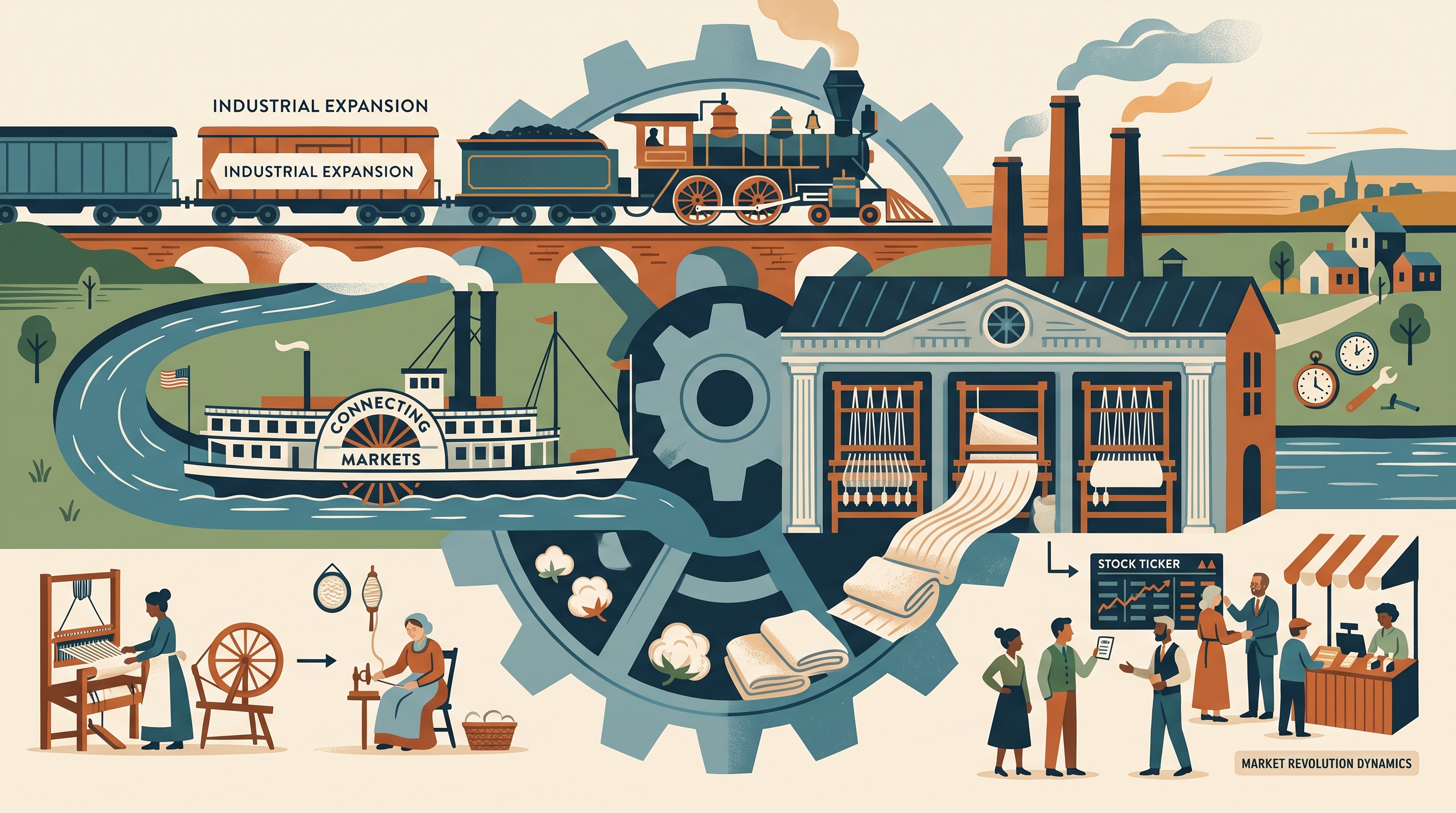
Between 1800 and 1848, the United States began shifting from a mostly local, household-based economy toward a national market economy linked by factories, canals, roads, railroads, banks, and commercial farming.
4.5 Market Revolution: Industrialization · 4.6 Market Revolution: Society and Culture
Between 1800 and 1848, the United States began shifting from a mostly local, household-based economy toward a national market economy linked by factories, canals, roads, railroads, banks, and commercial farming. The Market Revolution was this transformation: goods, labor, information, and investment moved across much greater distances, changing not only how Americans worked but also where—and how—they lived.
Investigative question: How did new systems of transportation and production reshape American society, and why did the benefits of economic growth remain unevenly distributed?
The industrial network: from local exchange to national markets
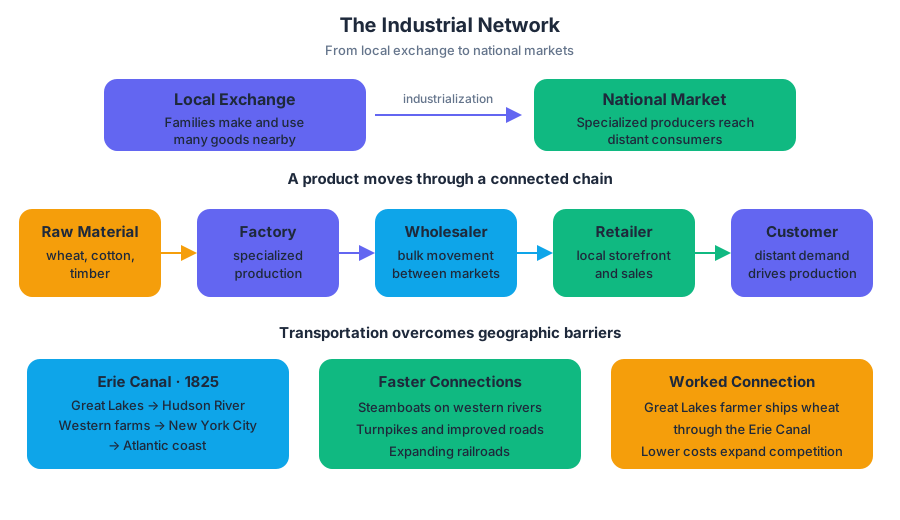
Before the Market Revolution, many families produced much of what they consumed. A farmer might grow food, spin thread, make clothing, and trade surplus goods within a nearby community. Industrialization changed that pattern by connecting specialized producers to distant consumers. A product could now pass through a chain: raw material, factory, wholesaler, retailer, and customer.
Transportation made this network practical. The Erie Canal, completed in 1825, connected the Great Lakes to the Hudson River and therefore linked western farmers to New York City and the Atlantic coast. Steamboats reduced travel time on western rivers, while turnpikes, improved roads, and expanding railroads connected farms, towns, and cities. Geography still mattered, but infrastructure increasingly allowed people and goods to overcome geographic barriers.
Worked connection: A farmer near the Great Lakes could ship wheat through the Erie Canal to New York City. Lower transportation costs made western grain more competitive, encouraged settlement in the Old Northwest, strengthened New York’s commercial importance, and increased the nation’s regional specialization. One canal therefore connected technology, economic development, migration, and urban growth.
Factories, technology, and wage labor
The factory system concentrated workers and machines in one location, allowing owners to supervise production and manufacture goods in larger quantities. In textile production, inventions such as the power loom accelerated cloth-making. The Waltham-Lowell system in Massachusetts recruited young women—often called “mill girls”—to work for wages in textile factories while living in supervised boardinghouses.
Industrialization did not eliminate older forms of production immediately. The putting-out system, in which merchants supplied raw materials to dispersed household workers, continued in some areas. The important change was the growing coexistence of household labor, workshops, factories, and commercial agriculture within one expanding market.
Misconception check: Industrialization did not mean that every American became a factory worker. Most people still lived in rural areas, but factories and markets increasingly influenced prices, employment, family choices, and regional development.
Society and culture under the Market Revolution
The Market Revolution encouraged urbanization, or the growth of towns and cities, because factories, warehouses, banks, and transportation hubs needed concentrated labor. Immigration added to this growth, especially in northeastern cities. Cities offered jobs and commercial opportunities, but they also produced crowded housing, disease, dangerous workplaces, and sharp inequalities between wealthy merchants and wage workers.
The transformation also changed gender expectations. The emerging separate-spheres ideology associated men with paid work, politics, and the public world, while it associated middle-class women with the household, child-rearing, and moral influence. Yet this ideal described only some families: working-class women, enslaved women, immigrant women, and many rural women continued to perform income-producing labor.
Commercial growth also created new consumer habits and social identities. Middle-class Americans increasingly measured status through education, fashionable goods, respectable homes, and participation in reform or religious communities. At the same time, wage workers developed shared interests, sometimes organizing strikes and early labor movements in response to long hours, low wages, and limited workplace control.
Regional specialization and uneven change
The Market Revolution connected the regions while making their economic differences more pronounced. The Northeast developed manufacturing, shipping, finance, and commercial cities. The Old Northwest expanded grain and livestock production. The South became increasingly dependent on cotton and enslaved labor as textile demand grew in Britain and the northern United States.
These developments were connected rather than separate. Northern factories created demand for cotton; southern plantations supplied it; western farms fed growing cities; canals and railroads moved products between regions. Economic interdependence increased, but it also helped make slavery more profitable and intensified sectional conflict—a connection that later political developments would build upon.
AP skill focus: Making Connections (5.B)
Skill 5.B — Making Connections: Explain how a historical development or process relates to another historical development or process. A strong response does more than name two related developments. It explains the mechanism connecting them: “The Erie Canal lowered shipping costs, which allowed western farmers to reach eastern markets and encouraged both commercial agriculture and urban expansion.”
For a document about an immigrant traveling on the Mississippi River, connect specific evidence to the Market Revolution: transportation enabled migration; migration supplied labor and created new communities; new communities expanded commercial exchange. Relevance alone is insufficient—the evidence must support the argument’s causal link.
Retrieval check
- Why did the Erie Canal matter beyond transportation?
- How did the factory system differ from household production?
- Name one way the Market Revolution expanded opportunity and one way it deepened inequality.
- Complete the connection: cotton textile demand → ________ → expansion of slavery.
Answers: The canal connected western producers to eastern markets and encouraged migration and urban growth. The factory system centralized workers and machines, while household production dispersed labor. Economic growth created jobs and markets but also produced exploitation, inequality, and dependence on slavery. The final chain is cotton textile demand → increased cotton cultivation and production → expansion of slavery.
Source Materials
- AP U.S. History Course and Exam Description
- AP U.S. History Course and Exam Description Clarifications and Corrections
- AP U.S. History Course Overview
- AP U.S. History Course at a Glance
- AP United States History Course at a Glance Poster
- AP United States History
- AP United States History
- AP United States History Sample Syllabus 1