From the free course AP United States History on Lykke
9.3 The End of the Cold War · 9.4 A Changing Economy
Key concepts: The end of the Cold War · Containment of communism · U.S.-Soviet ideological conflict between democracy and authoritarianism · Military intervention and diplomacy · Nuclear and conventional arms buildup · Strategic Defense Initiative · Reagan administration’s role in ending the Cold War · Economic transformation and globalization · The dot-com boom and its social effects · Historical analysis of primary sources
The Cold War ended not through a single battlefield victory, but through the interaction of ideological pressure, military competition, diplomacy, and deep problems within the Soviet system.
9.3 The End of the Cold War · 9.4 A Changing Economy
The Cold War ended not through a single battlefield victory, but through the interaction of ideological pressure, military competition, diplomacy, and deep problems within the Soviet system.
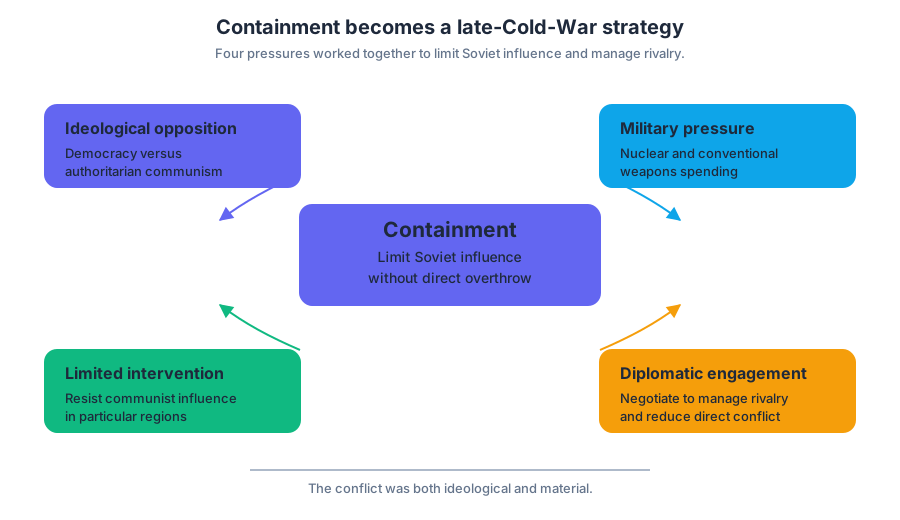
Containment becomes a late-Cold-War strategy
Containment was the effort to limit the spread of Soviet influence and communism rather than immediately overthrow every communist government. By the 1980s, U.S. policymakers used several tools at once: speeches that portrayed the Soviet Union as an authoritarian threat to democracy, diplomatic negotiations, limited military interventions, and expanded spending on nuclear and conventional weapons.
The conflict was therefore both ideological and material. The United States presented democracy as a system based on political choice, while characterizing the Soviet Union as an authoritarian rival whose government restricted opposition and controlled its sphere of influence. At the same time, each superpower measured security through military capacity, including nuclear weapons and conventional forces.
A useful way to organize the evidence is as a four-part pressure system:
- Ideological opposition: speeches and arguments contrasting democracy with authoritarian communism.
- Military pressure: increased nuclear and conventional weapons spending.
- Limited intervention: efforts to resist communist influence in particular regions.
- Diplomatic engagement: negotiations intended to manage rivalry and reduce the danger of direct conflict.
Strategic Defense Initiative: technology as strategy
The Strategic Defense Initiative (SDI) was a major example of increased U.S. military spending during the Cold War. Often called “Star Wars,” the program funded research into possible defenses against nuclear missiles, including laser and particle-beam technologies.
SDI mattered even though its proposed systems were technologically difficult and did not simply create an operational shield over the United States. Its strategic significance lay in the competition it represented: the United States was signaling that it could force the Soviet Union to respond to expensive and technically demanding military developments.
Key distinction: SDI was not the same thing as a conventional battlefield weapon. It was a research and defense program whose importance came partly from how it intensified the arms competition.
Diplomacy did not replace rivalry
Military pressure existed alongside negotiation. At the Geneva Summit in November 1985, President Ronald Reagan and Soviet Premier Mikhail Gorbachev met for the first time. Their discussions encountered serious disagreements, but the joint Soviet-United States statement showed that both governments were willing to continue diplomatic contact and agreed to hold two additional summits.
This is a valuable primary-source lesson: a diplomatic statement can reveal cooperation without proving that the underlying conflict has disappeared. The Geneva statement represented an opening for further negotiations, not an immediate end to the Cold War.
Worked source analysis — Geneva, 1985
- Claim: The summit demonstrated diplomatic movement.
- Evidence: Reagan and Gorbachev met directly, acknowledged unresolved problems, and committed to future summits.
- Interpretation: The commitment mattered because continued contact created opportunities to manage the arms race and address disputes.
- Limit: The statement alone cannot prove that diplomacy caused the Cold War’s end; it must be combined with evidence about Soviet political and economic weakness and the changing relationship between the superpowers.
This reasoning practices Skill 1.B: Developments and Processes — Explain a historical concept, development, or process. It also requires reading a source as evidence rather than automatically accepting its political language. Students should analyze what a document says, who produced it, and what the document can—and cannot—demonstrate.
How much did Reagan contribute?
A strong historical judgment evaluates Reagan’s policies as one cause among several. His opposition to communism, military buildup, and willingness to negotiate increased pressure on the Soviet Union while diplomacy created channels for cooperation. However, attributing the entire outcome to Reagan oversimplifies the evidence: political problems inside the Soviet Union weakened its ability to maintain control over its sphere of influence, and Gorbachev’s decisions also reshaped the confrontation.
Misconception check — “The Cold War ended because one president defeated the Soviet Union.” This explanation is too simple. A more defensible argument is that Reagan’s policies contributed to the end by combining pressure and negotiation, but the result depended on Soviet internal weaknesses, leadership choices, and the inability of the Soviet government to preserve its influence.
A changing American economy
The late twentieth-century economy changed as dramatically as foreign policy. Sources on Grace Lee Boggs, the dot-com boom, and globalization point to a common historical problem: economic growth can produce new opportunities while also disrupting workers, neighborhoods, and established industries.
The dot-com boom transformed the San Francisco Bay Area by concentrating technology firms, investment, and highly paid employment. That growth affected more than entrepreneurs: it reshaped local communities and placed pressure on workers and residents who did not benefit equally from the new economy.
Globalization means the increasing integration of national economies through trade, investment, production, technology, and communication. It could lower costs, expand markets, and connect American businesses to consumers and suppliers around the world. It could also disrupt communities when jobs moved, industries reorganized, or workers faced competition from a global labor market.
The key analytical distinction is between aggregate growth and distributed effects. An economy may become more productive overall while particular workers, industries, or regions lose stability. The experiences associated with Boggs, the Bay Area’s technology boom, and globalization help historians examine who gained, who struggled, and how economic change altered communities.
Retrieval check
Explain, in two sentences, why SDI and the Geneva Summit should be studied together. Then complete the argument: Reagan’s policies contributed to the end of the Cold War to the extent that... A strong answer should connect military pressure to diplomacy, then qualify the claim with Soviet internal problems and Gorbachev’s choices.

Source Materials
- AP U.S. History Course and Exam Description
- AP U.S. History Course and Exam Description Clarifications and Corrections
- AP U.S. History Course Overview
- AP U.S. History Course at a Glance
- AP United States History Course at a Glance Poster
- AP United States History
- AP United States History
- AP United States History Sample Syllabus 1
- [a] Briefly describe one major difference between Anderson’s and Brennan’s historical interpretations of social change in the 1960s.