From the free course AP United States History on Lykke
3.3 Taxation Without Representation · 3.4 Philosophical Foundations of the American Revolution
Key concepts: Taxation without representation · New taxes · Philosophical foundations of the American Revolution · Enlightenment ideas · American Revolution · Historical analysis of primary sources · Point of view · Purpose · Historical situation · Audience
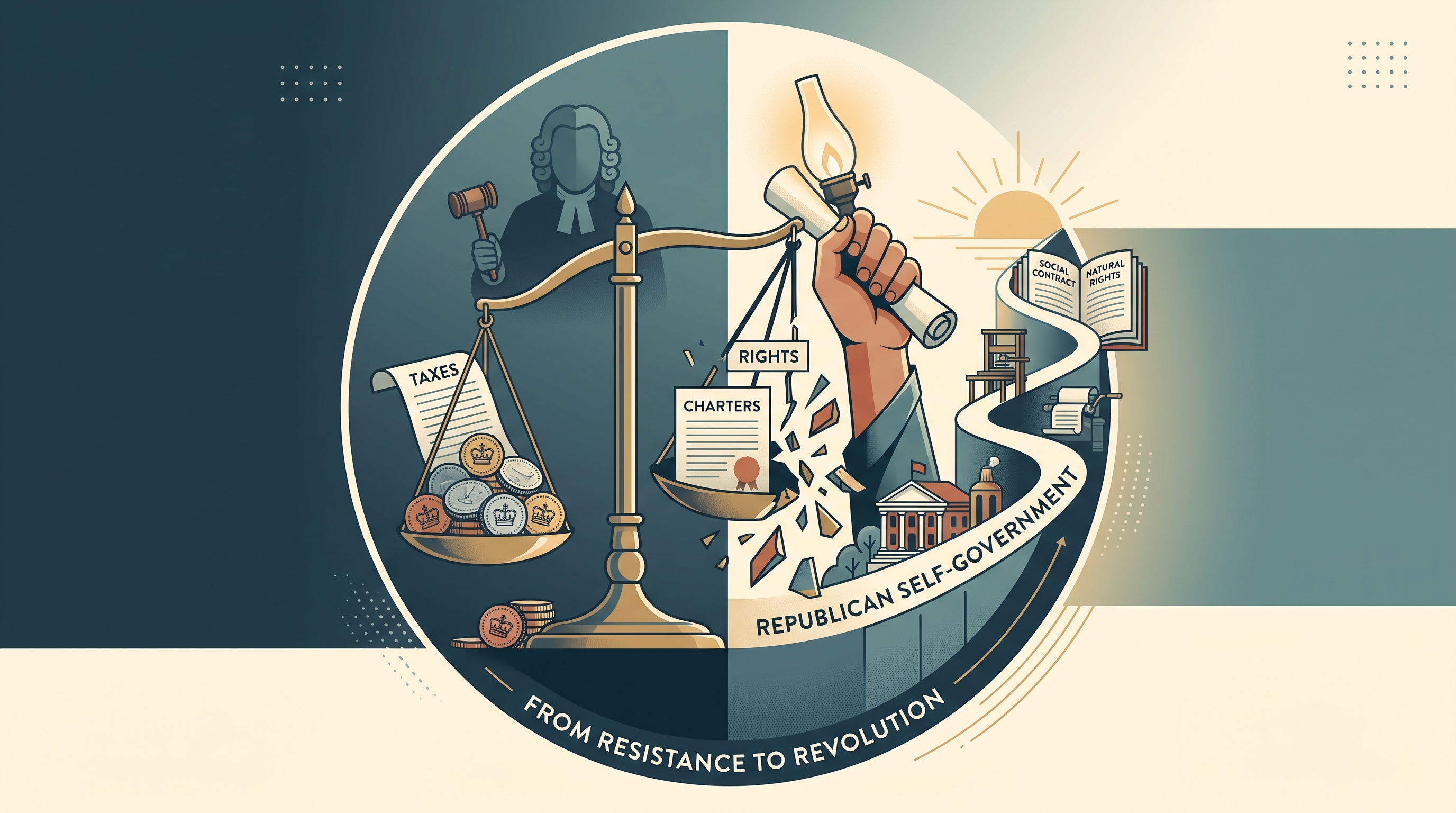
The American Revolution began as a dispute over a deceptively simple question: Who had the legitimate power to tax the colonies? After the Seven Years’ War, Great Britain claimed that the colonies should help pay the costs of imperial defense.
3.3 Taxation Without Representation · 3.4 Philosophical Foundations of the American Revolution
The American Revolution began as a dispute over a deceptively simple question: Who had the legitimate power to tax the colonies? After the Seven Years’ War, Great Britain claimed that the colonies should help pay the costs of imperial defense. Many colonists answered that taxation required the consent of their elected representatives—and that Parliament did not represent them.
Taxation without representation means imposing taxes on people who have no elected representatives with a meaningful voice in the legislature that creates those taxes.
From imperial victory to imperial crisis
Britain’s victory in the Seven Years’ War expanded its territory but also left the empire deeply in debt. British leaders therefore tried to make colonial administration more orderly and to require colonists to contribute more directly to imperial expenses. The Proclamation of 1763 restricted colonial settlement west of the Appalachian Mountains, while the Sugar Act of 1764 strengthened customs enforcement and placed duties on imported molasses and other goods.
The Stamp Act of 1765 went further: it required printed materials—including newspapers, legal documents, and licenses—to carry a tax stamp. Colonists objected not simply because the tax was expensive, but because Parliament had enacted it without the approval of colonial assemblies. Resistance included petitions, public demonstrations, intimidation of stamp distributors, and the formation of the Sons of Liberty.
The argument over representation
British officials argued that Parliament represented the interests of the entire empire through virtual representation, the idea that members of Parliament represented all British subjects, even those who did not vote for them. Colonial critics rejected this theory. They claimed that only their own elected assemblies could tax them because those assemblies represented the communities that paid the taxes.
The slogan “No taxation without representation” therefore expressed a constitutional argument, not merely opposition to high prices. Colonists generally did not begin by demanding independence. They demanded the rights they believed belonged to them as English subjects, including consent in taxation and protection from arbitrary government.
Key distinction: Colonial resistance initially challenged Parliament’s authority over internal taxation; it did not automatically reject the entire British Empire.
The Stamp Act Congress of 1765 asserted that colonists possessed the rights of Englishmen and that taxes could not be imposed without their consent. Although Parliament repealed the Stamp Act in 1766, it simultaneously passed the Declaratory Act, announcing its authority to legislate for the colonies “in all cases whatsoever.” The Townshend Acts of 1767 then placed duties on imported glass, lead, paint, paper, and tea, producing renewed boycotts and confrontation.
A worked primary-source analysis: sourcing before interpretation
Imagine a visual source published in the 1760s showing a colonial tax collector surrounded by angry colonists. Do not begin by treating the image as a neutral photograph. Apply Skill 2.A: Sourcing and Situation — Identify a source’s point of view, purpose, historical situation, and/or audience.
Step 1 — Historical situation: The image appeared during disputes over the Stamp Act or Townshend duties, when imperial officials were enforcing new revenue measures. Step 2 — Purpose: If the image exaggerates the tax collector’s humiliation, its purpose may be to mobilize resistance by portraying British policy as oppressive. Step 3 — Audience: A colonial newspaper audience would already understand local grievances and might be encouraged to boycott British goods. Step 4 — Point of view: The image likely reflects the perspective of colonial opponents rather than that of Parliament or royal officials.
The interpretation becomes stronger when the source is connected to its context: the image is evidence of colonial political mobilization, not proof that every colonist opposed every British policy. This is the difference between using a source and merely repeating what it depicts.
Enlightenment ideas and revolutionary political thought
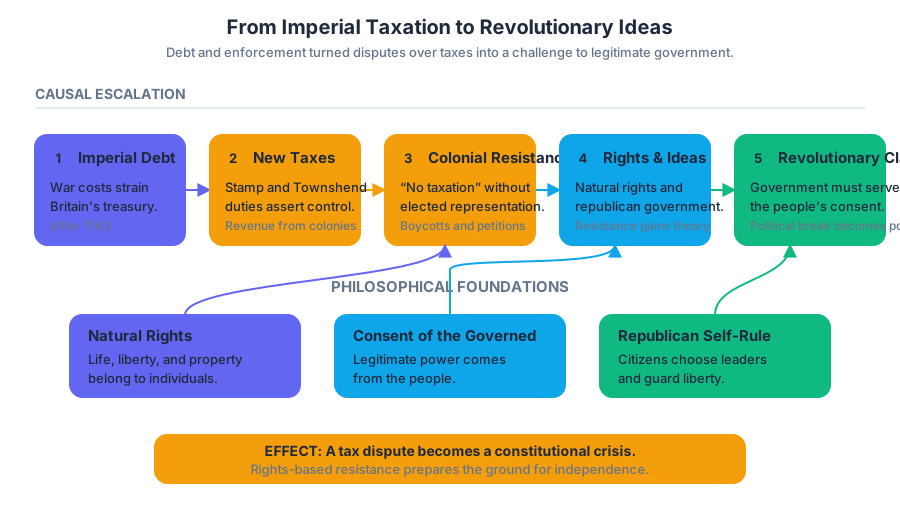
The conflict became more radical because colonists drew on Enlightenment ideas, an intellectual movement that emphasized reason, natural rights, and the examination of government through rational principles. John Locke argued that people possessed natural rights—including life, liberty, and property—and that governments existed through a social contract to protect those rights.
Locke’s reasoning created a powerful chain:
$$ \text{Natural rights} \rightarrow \text{social contract} \rightarrow \text{limited government} \rightarrow \text{right of resistance} $$
Colonial writers adapted these ideas to arguments about representation and liberty. Republican political thought also warned that concentrated power produced corruption and threatened freedom. These ideas did not mechanically cause revolution; they supplied a language through which colonists interpreted taxes, military enforcement, and imperial authority.
Misconception check
Misconception: “The Enlightenment directly caused all colonists to become revolutionaries.” In reality, revolutionary ideology interacted with concrete events: taxation, enforcement, troop presence, economic boycotts, and clashes such as the Boston Massacre. Ideas helped colonists explain why those events violated liberty; events made the ideas politically urgent.
Retrieval check: Why did colonists object to the Stamp Act even though some taxes were relatively modest? Identify one British argument, one colonial counterargument, and one Enlightenment idea that strengthened colonial resistance. A complete answer should connect parliamentary authority, consent, and natural rights rather than treating the conflict as a simple complaint about money.
CED traceability
This topic develops Learning Objective 3.C: Explain the causes and effects of the growing tensions between England and the American colonies and Learning Objective 3.D: Explain how and why different intellectual and ideological beliefs influenced the political, economic, and social development of the colonies and the United States. It connects especially to Key Concept 3.1.II.B, concerning Britain’s efforts to consolidate imperial control and impose new taxes, and Key Concept 3.1.II.C, concerning colonial resistance, rights as Englishmen, and republican self-government.
The central historical relationship is causal but not single-factor: imperial debt encouraged taxation; taxation provoked constitutional resistance; enforcement intensified distrust; and Enlightenment and republican ideas transformed resistance to particular policies into a broader argument about legitimate government. That combination prepared the political ground for the American Revolution.
Source Materials
- AP U.S. History Course and Exam Description
- AP U.S. History Course and Exam Description Clarifications and Corrections
- AP U.S. History Course Overview
- AP U.S. History Course at a Glance
- AP United States History Course at a Glance Poster
- AP United States History
- AP United States History
- AP United States History Sample Syllabus 1
- (A) Briefly describe one major difference between Cohen’s and Katznelson’s historical interpretations of the New Deal.
- (A) Briefly describe one point of view suggested in the excerpt.
- (A) Briefly describe one major difference between Cohen’s and Katznelson’s historical interpretations of the New Deal.
- (A) Briefly describe one point of view suggested in the excerpt.