From the free course AP United States History on Lykke
2.3 The Regions of British Colonies · 2.4 Transatlantic Trade
By the mid-1700s, Britain’s mainland colonies were not one unified society. Geography, climate, labor systems, and Atlantic commerce produced three recognizable regions: New England, the Middle Colonies, and the Southern Colonies.
2.3 The Regions of British Colonies · 2.4 Transatlantic Trade
By the mid-1700s, Britain’s mainland colonies were not one unified society. Geography, climate, labor systems, and Atlantic commerce produced three recognizable regions: New England, the Middle Colonies, and the Southern Colonies. The same ocean connected them, but local conditions made them economically and socially distinct.
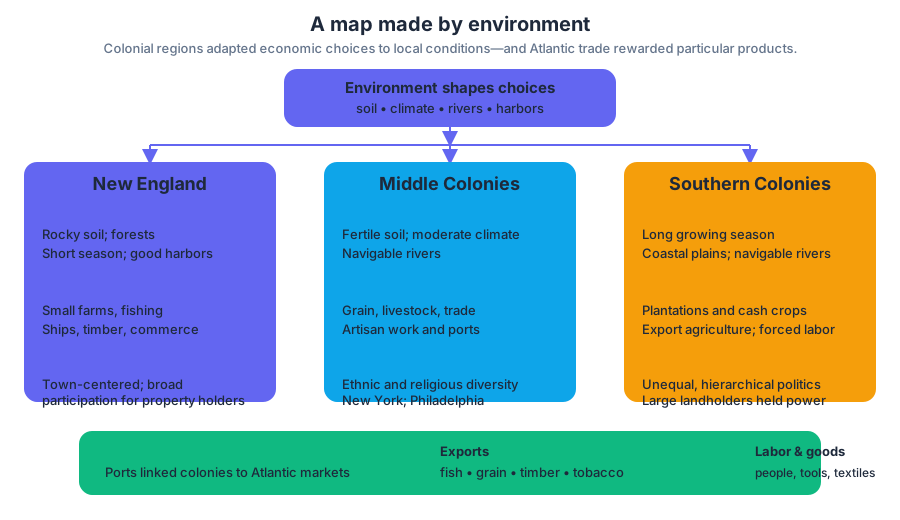
A map made by environment
Key idea: Colonial regions developed differently because people adapted economic choices to local environments—and because Atlantic trade rewarded particular products and labor systems.
| Region | Environment | Major economic pattern | Social and political tendencies |
|---|---|---|---|
| New England | Rocky soil, forests, shorter growing season, excellent harbors | Small farms, fishing, shipbuilding, timber, and commerce | Town-centered communities, congregational religious influence, relatively broad participation among property-holding men |
| Middle Colonies | Fertile soil, moderate climate, navigable rivers | Grain production, livestock, trade, and artisan work | Ethnic and religious diversity; important port cities such as New York and Philadelphia |
| Southern Colonies | Long growing season, fertile coastal plains, navigable rivers | Export agriculture, especially tobacco, rice, and indigo | Large plantations, dispersed settlements, and increasing dependence on enslaved labor |
In New England, rocky terrain and a short growing season discouraged plantation agriculture. Colonists therefore combined modest farming with maritime activities. Ports such as Boston connected local merchants to England and the Caribbean, while forests supported shipbuilding and timber exports.
The Middle Colonies occupied a productive middle ground. Their fertile land supported wheat and other grains, earning them the nickname “bread colonies.” Their ports attracted merchants, artisans, immigrants, and religious groups, making the region more diverse than either New England or the plantation South.
The Southern Colonies had conditions favorable to cash crops—agricultural products grown primarily for sale rather than local use. Tobacco became central in the Chesapeake, while rice and indigo flourished farther south. Because these crops required substantial labor, wealthy planters increasingly built plantation economies around enslaved labor.
Worked example: explaining regional difference
Suppose an exam prompt asks why New England and the Southern Colonies developed different economies. A strong causal chain would be:
$$ \text{environment} \rightarrow \text{crop possibilities} \rightarrow \text{labor demand} \rightarrow \text{social structure} $$
New England’s rocky soil and short growing season limited large-scale cash-crop agriculture, encouraging mixed farming, fishing, shipbuilding, and commerce. The South’s longer growing season supported tobacco, rice, and indigo exports; these crops generated demand for intensive labor, helping produce plantations and a society sharply divided between wealthy planters, small farmers, and enslaved Africans.
This explanation demonstrates Historical Reasoning Process: Causation and AP Historical Thinking Skill 1: Developments and Processes: it identifies a development, explains why it occurred, and traces consequences rather than merely listing regional facts.
Transatlantic trade: the colonies inside an Atlantic system
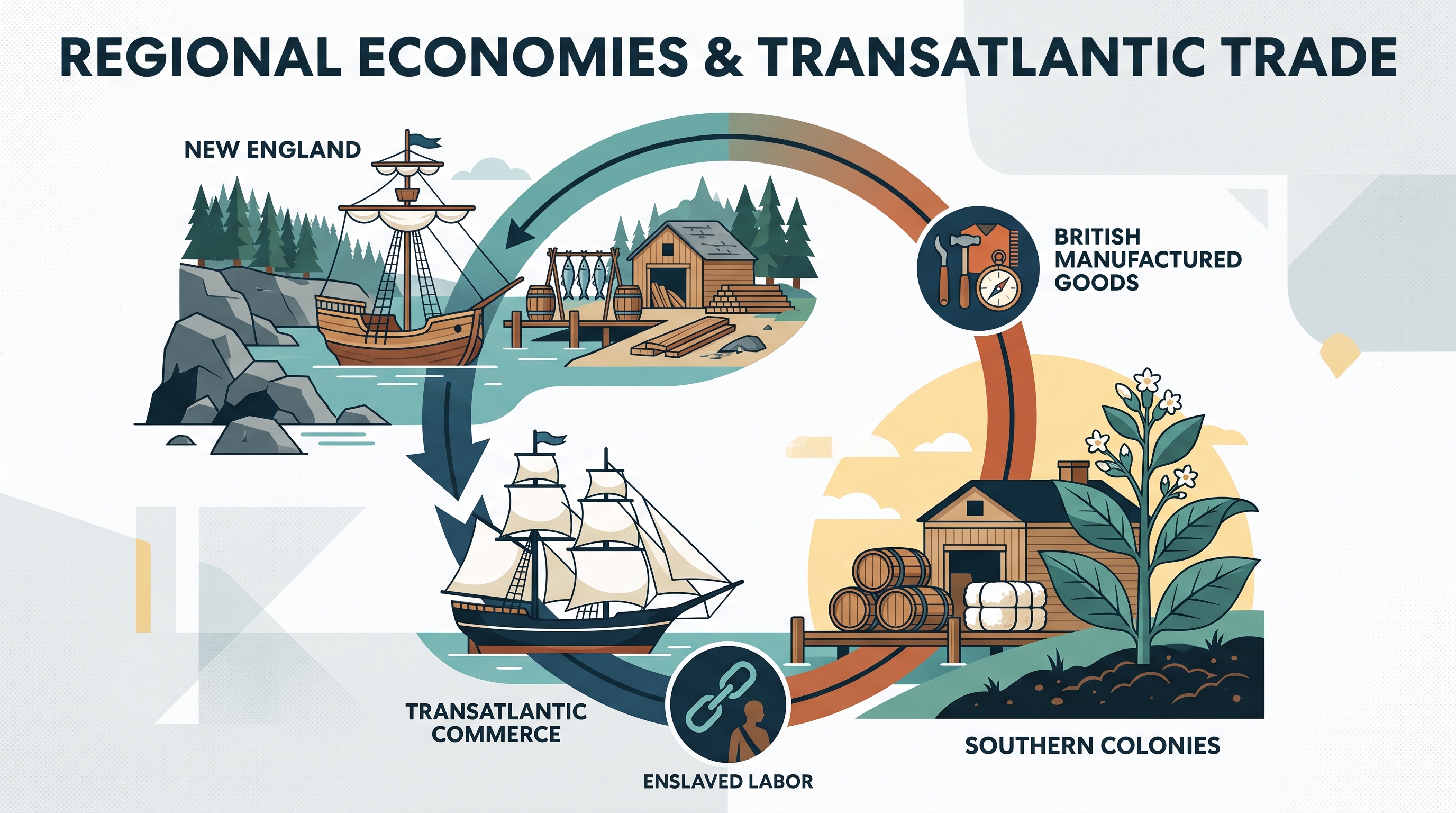
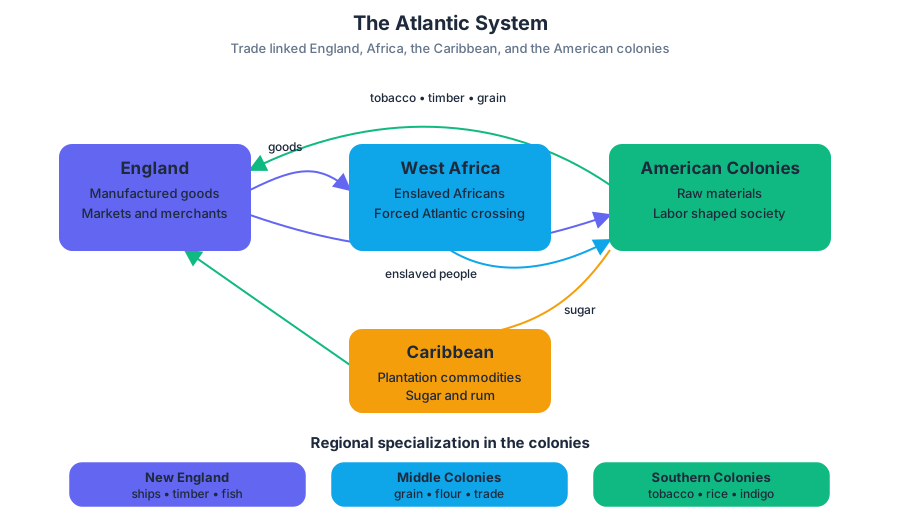
Transatlantic trade was the movement of people, commodities, and manufactured goods across the Atlantic Ocean among Europe, Africa, the Caribbean, and the Americas. It tied the British colonies to England, but it also transformed colonial society by encouraging regional specialization and expanding slavery.
A simplified trade pattern looked like this:
$$ \text{British manufactured goods} \rightarrow \text{Africa and the Americas} $$
$$ \text{Enslaved Africans} \rightarrow \text{the Americas} $$
$$ \text{Colonial raw materials} \rightarrow \text{England} $$
Colonial producers sold raw materials—such as tobacco, timber, grain, and other agricultural goods—to English consumers and manufacturers. Profits from these exchanges supported much of the colonial economy, while English merchants supplied manufactured goods that colonists often could not produce locally.
The triangular trade was not a single, universally fixed route. It describes recurring commercial connections among several Atlantic regions. Ships and merchants could follow different routes, but the larger system linked European capital and manufacturing, African societies and forced migration, Caribbean plantation production, and mainland colonial markets.
Slavery and the Southern economy
The transatlantic slave trade forcibly transported millions of Africans to the Americas. European traders often purchased captives from African political authorities and merchants involved in warfare, raiding, and the capture of prisoners; Europeans also used violence and coercion. Captives endured the Middle Passage—the deadly ocean voyage to the Americas—before sale into systems of forced labor.
In British North America, the greatest concentration of enslaved labor developed in the Southern Colonies, where plantation agriculture required a large workforce. The growth of slavery therefore did more than increase agricultural output: it shaped wealth, political power, settlement patterns, and racial hierarchy.
Misconception check — “The regions were completely separate.”
They were distinct, not isolated. New England merchants, Middle Colony farmers, Southern planters, English manufacturers, Caribbean producers, and African traders participated in interconnected Atlantic commerce. Regional specialization increased interdependence.
CED traceability and exam reasoning
Learning Objective 2.3: Explain how and why different European colonies developed differently. Essential Knowledge 2.3.A–2.3.C: regional development reflected environmental conditions, economic specialization, population patterns, and labor systems.
Learning Objective 2.4: Explain how and why transatlantic trade affected the development of British colonies. Essential Knowledge 2.4.A–2.4.C: Atlantic commerce connected the colonies to England, encouraged export economies, and expanded the forced migration and exploitation of Africans.
For document-based or short-answer work, apply AP Historical Thinking Skill 2: Sourcing and Situation by asking who benefited from a trade description, Skill 3: Claims and Evidence in Sources by linking evidence to a regional argument, and Skill 5: Making Connections by connecting Atlantic trade to regional economic development.
Retrieval check
- Why did geography encourage commerce and maritime work in New England?
- Which regional conditions supported plantation agriculture?
- How did transatlantic trade simultaneously connect the colonies to England and make Southern society increasingly dependent on enslaved labor?
Answer: New England’s rocky land, forests, and harbors favored maritime commerce; the South’s long growing season and fertile land supported export crops; Atlantic trade created markets for colonial goods and supplied manufactured goods and enslaved labor, strengthening both imperial dependence and plantation slavery.
Source Materials
- AP U.S. History Course and Exam Description
- AP U.S. History Course and Exam Description Clarifications and Corrections
- AP U.S. History Course Overview
- AP U.S. History Course at a Glance
- AP United States History Course at a Glance Poster
- AP United States History
- AP United States History
- AP United States History Sample Syllabus 1
- Figure — Sample Responses - LEQ 2 - Set 1 (p. 4)