From the free course AP United States History on Lykke
5.9 Government Policies During the Civil War · 5.10 Reconstruction
Key concepts: Emancipation Proclamation · African American flight from plantations and enlistment in the Union Army · Union victory over the Confederacy · 13th Amendment · 14th Amendment · 15th Amendment · African American citizenship and civil rights · Equal protection under the law · Voting rights · Contested Reconstruction and unresolved questions about federal power and minority rights
The Civil War transformed emancipation from a moral demand into federal policy—and Reconstruction transformed that policy into a constitutional struggle over citizenship, equality, and political power.
5.9 Government Policies During the Civil War · 5.10 Reconstruction
The Civil War transformed emancipation from a moral demand into federal policy—and Reconstruction transformed that policy into a constitutional struggle over citizenship, equality, and political power. The central question is not simply when slavery ended, but how wartime decisions and postwar amendments attempted to remake American society.
From emancipation policy to Union victory
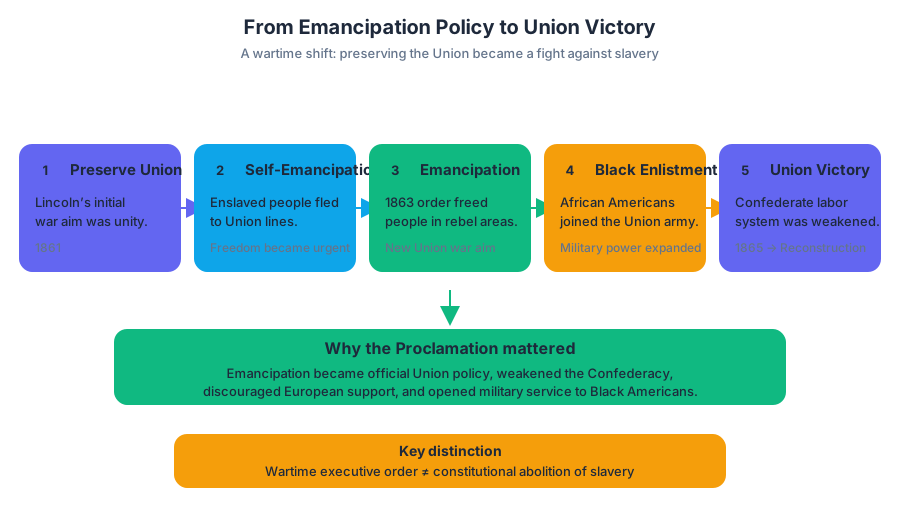
At the beginning of the Civil War, President Abraham Lincoln defined the conflict primarily as a fight to preserve the Union. As the war continued, however, enslaved people themselves made slavery impossible for the federal government to ignore. African Americans fled plantations, sought protection behind Union lines, and forced military commanders and policymakers to decide whether freedom would become part of the Union war effort.
The Emancipation Proclamation, issued by Lincoln in 1863, declared enslaved people in areas still rebelling against the United States to be free. Its immediate reach was limited: it did not free enslaved people in loyal slave states or in Confederate areas already controlled by the Union. Its importance was nevertheless enormous because it made emancipation an official Union war aim, weakened the Confederacy’s labor system, discouraged European support for the Confederacy, and authorized the enlistment of African American soldiers.
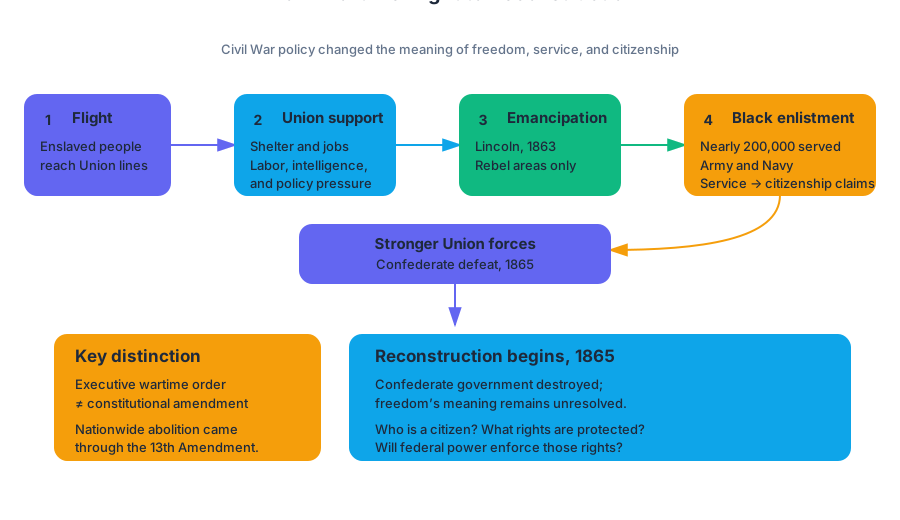
Key distinction: The Emancipation Proclamation was a wartime executive order, not a constitutional amendment abolishing slavery everywhere.
African American flight from plantations was therefore both an individual act of resistance and a form of wartime policy-making from below. People who reached Union lines became known as “contraband” in early federal policy; their presence supplied the Union with laborers, refugees, and eventually soldiers. Nearly 200,000 African American men served in the Union Army and Navy, strengthening Union military capacity while making emancipation inseparable from African American citizenship claims.
The chain of causation can be represented simply:
Enslaved people flee plantations → Union forces shelter and employ them → Federal policy moves toward emancipation → African American men enlist → Union military power increases → Confederate defeat becomes more likely.
This process helped produce Union victory over the Confederacy in 1865. Victory destroyed the Confederate government, but it did not automatically settle the meaning of freedom. The United States still had to determine who counted as a citizen, what rights citizenship protected, and whether the federal government would enforce those rights against resistant states.
Reconstruction and the constitutional reordering of citizenship
Reconstruction refers to the effort, from 1865 to 1877, to rebuild the former Confederate states and redefine the political and social consequences of emancipation. Under KC-5.3.II.ii, Reconstruction altered relationships between the states and the federal government and produced debates over new definitions of citizenship, especially for African Americans, women, and other minorities.
The constitutional amendments formed a sequence:
| Amendment | Core change | Why it mattered |
|---|---|---|
| 13th Amendment | Abolished slavery | Made emancipation permanent in the Constitution |
| 14th Amendment | Established African American citizenship and equal protection under the laws | Expanded federal responsibility for civil rights |
| 15th Amendment | Protected voting rights for African American men, with limits in its wording | Recognized political participation as central to freedom |
The 13th Amendment abolished slavery. This distinction matters because the Emancipation Proclamation depended on wartime conditions, while the amendment made slavery unconstitutional throughout the United States. The amendment also exposed a new conflict: if formerly enslaved people were free, could southern states force them into labor systems that reproduced slavery under another name?
The 14th Amendment granted African Americans citizenship, required states to provide equal protection under the laws, and strengthened the federal government’s ability to challenge state violations of rights. The 15th Amendment prohibited denying the vote on the basis of race, color, or previous condition of servitude. Together, these amendments attempted to move the nation from emancipation—the ending of legal slavery—to civil and political equality.
Misconception check: The 14th Amendment did not create complete equality for every group. Women remained excluded from national voting guarantees, and the 15th Amendment protected African American men rather than establishing universal suffrage.
Competing Republican approaches
Republicans disagreed over how far Reconstruction should go. Radical Republicans sought stronger federal protection for African American rights, punishment or restriction for former Confederate leaders, and a fundamental reordering of race relations in the South. Moderate Republicans also supported congressional action and constitutional change, but often favored more limited measures and worried about prolonged federal control.
Their conflict with President Andrew Johnson produced a struggle over the balance of power between Congress and the presidency. Congressional Republicans attempted to shape Reconstruction policy, protect the freedpeople, and reorganize southern governments, while Johnson favored a more lenient approach toward white southern leadership. The political cartoon Swing Around the Circle mocked Johnson’s 1866 speaking tour, portraying his attempt to win public support as politically disastrous.
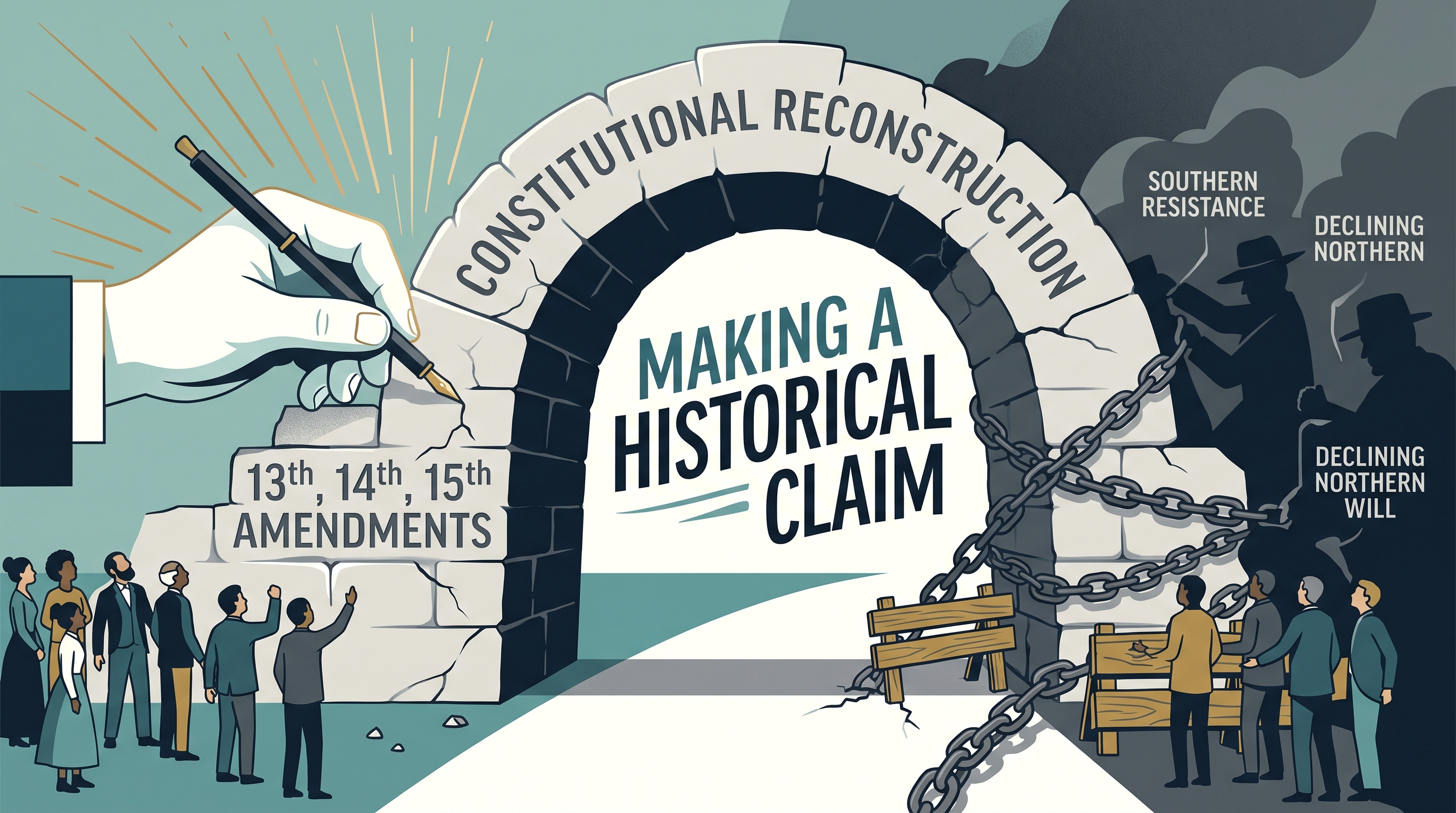
Reconstruction achieved short-term successes: formerly enslaved people gained constitutional rights, African American men voted and held political office, and the federal government briefly expanded its role as protector of civil rights. Yet Southern resistance—including organized violence, intimidation, and resistance to Black political participation—undermined those gains. Reconstruction ultimately failed because resistance combined with waning Northern resolve, allowing federal enforcement to recede by 1877.
Citizenship debates beyond African American rights
Reconstruction also reshaped other movements. The women’s rights movement was emboldened and divided by the 14th and 15th Amendments under KC-5.3.II.B. Some activists welcomed the amendments as steps toward equal citizenship; others criticized the decision to extend voting protections to African American men while women remained excluded.
Frederick Douglass’s argument in “The Composite Nation” expanded the meaning of American identity by defending a multiracial nation and advocating naturalization for Chinese Americans. His position shows that Reconstruction raised a broad question: whether citizenship should be defined narrowly by race or expanded as a national political principle.
Worked interpretation: making a historical claim
Suppose a source argues that Reconstruction was a complete success because the amendments transformed the Constitution. A strong response using Suggested Skill: Claims and Evidence in Sources and 3.D, Explain how claims or evidence support, modify, or refute a source’s argument, would both recognize and qualify the claim: the 13th, 14th, and 15th Amendments created revolutionary legal changes, but Southern resistance and declining Northern commitment limited their enforcement. The evidence therefore supports the argument about constitutional transformation while modifying any claim that legal change immediately produced secure equality.
Retrieval check: Which amendment abolished slavery, which established citizenship and equal protection, and which addressed voting rights? Why was the Emancipation Proclamation historically important even though it did not itself abolish slavery everywhere?
Source Materials
- AP U.S. History Course and Exam Description
- AP U.S. History Course and Exam Description Clarifications and Corrections
- AP U.S. History Course Overview
- AP U.S. History Course at a Glance
- AP United States History Course at a Glance Poster
- AP United States History
- AP United States History
- AP United States History Sample Syllabus 1
- Figure — Sample Responses - SAQ 2 - Set 2 (p. 4)
- Figure — Sample Responses - SAQ 2 - Set 2 (p. 5)
- Figure — Sample Responses - SAQ 2 - Set 2 (p. 6)