From the free course AP United States History on Lykke
4.3 Politics and Regional Interests · 4.4 America on the World Stage
The early republic faced a problem that no constitutional clause could solve by itself: How could one nation reconcile regions with different economies, priorities, and visions of American power?
4.3 Politics and Regional Interests · 4.4 America on the World Stage
The early republic faced a problem that no constitutional clause could solve by itself: How could one nation reconcile regions with different economies, priorities, and visions of American power? In the 1810s and 1820s, debates over tariffs, banks, slavery, western settlement, and foreign policy revealed that “national interest” often meant something different in New England, the South, and the West.
Investigative question: Why did national expansion and stronger federal policies unite Americans in some moments but deepen sectional conflict in others?
4.3 Politics and Regional Interests
CED traceability: Topic 4.3 Politics and Regional Interests develops Skill 2: Sourcing and Situation and Theme PCE: Politics and Power. Its central learning objective is PCE-2.A: Explain how different regional interests affected debates about the role of the federal government during the early republic. The associated essential-knowledge identifiers are PCE-2.A.1 and PCE-2.A.2.
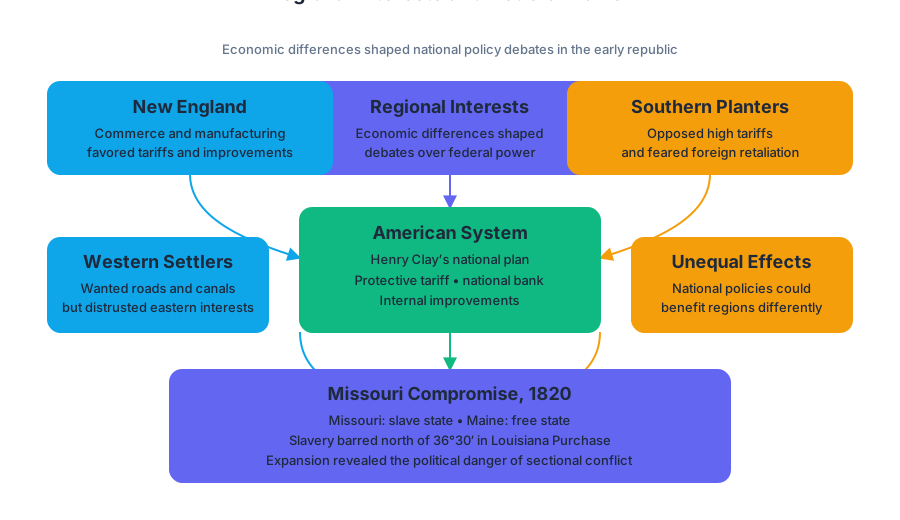
Regional interests grew from economic differences. New England merchants and manufacturers generally favored protective tariffs and federally funded transportation because these policies supported commerce and industry. Southern planters often opposed high tariffs, which made imported goods more expensive and seemed to invite foreign retaliation against cotton exports. Western settlers wanted roads, canals, and military protection, but they also resisted policies that appeared to favor eastern financial interests.
The American System, associated with Henry Clay, attempted to connect these interests through three policies: a protective tariff, a national bank, and federally funded internal improvements. The plan illustrates a crucial AP historical pattern: a policy can be nationally framed while producing sharply unequal regional effects.
The Missouri Compromise of 1820 exposed the political danger of western expansion. Missouri entered the Union as a slave state, Maine entered as a free state, and slavery was prohibited in the rest of the Louisiana Purchase north of latitude $36^\circ 30'$, except in Missouri. The compromise temporarily preserved the balance between free and slave states, but it also confirmed that every new territory could trigger a national argument over slavery.
The conflict over the Tariff of Abominations and the Nullification Crisis showed how regional interests could challenge federal authority directly. South Carolina claimed that a state could reject an unconstitutional federal law; President Andrew Jackson insisted that federal law remained supreme. The Compromise Tariff of 1833 reduced tensions, but the underlying disagreement—whether the Union was a permanent nation or a voluntary compact of states—remained unresolved.
Worked contextual example: from policy to sectional conflict
Suppose a historian asks why a protective tariff produced political conflict rather than national unity. Begin with context: the postwar economy was becoming more interconnected, but regional economies remained distinct. Then connect policy to interest: manufacturers benefited from protection, while the plantation South feared higher costs and foreign retaliation. Finally, explain the political consequence: South Carolina transformed an economic objection into a constitutional challenge through nullification.
Strong historical reasoning: Regional economic differences shaped political beliefs about federal power; those beliefs then determined whether citizens viewed national policies as cooperation or coercion.
Misconception check
Misconception: “The Missouri Compromise solved the slavery issue.” It did not. It postponed a crisis by creating a temporary geographic rule and maintaining sectional balance. Its importance lies partly in showing that westward expansion made slavery impossible to contain as a merely local or regional institution.
4.4 America on the World Stage
CED traceability: Topic 4.4 America on the World Stage develops Skill 2: Sourcing and Situation and Theme WOR: America in the World. Its central learning objective is WOR-2.A: Explain how U.S. foreign policy in the early republic affected political debates. The associated essential-knowledge identifiers are WOR-2.A.1 and WOR-2.A.2.
The United States sought security and recognition while avoiding domination by European empires. The War of 1812 strengthened American nationalism despite its mixed military results, and the postwar period encouraged leaders to defend national independence through diplomacy, military preparedness, and control of North American borders.
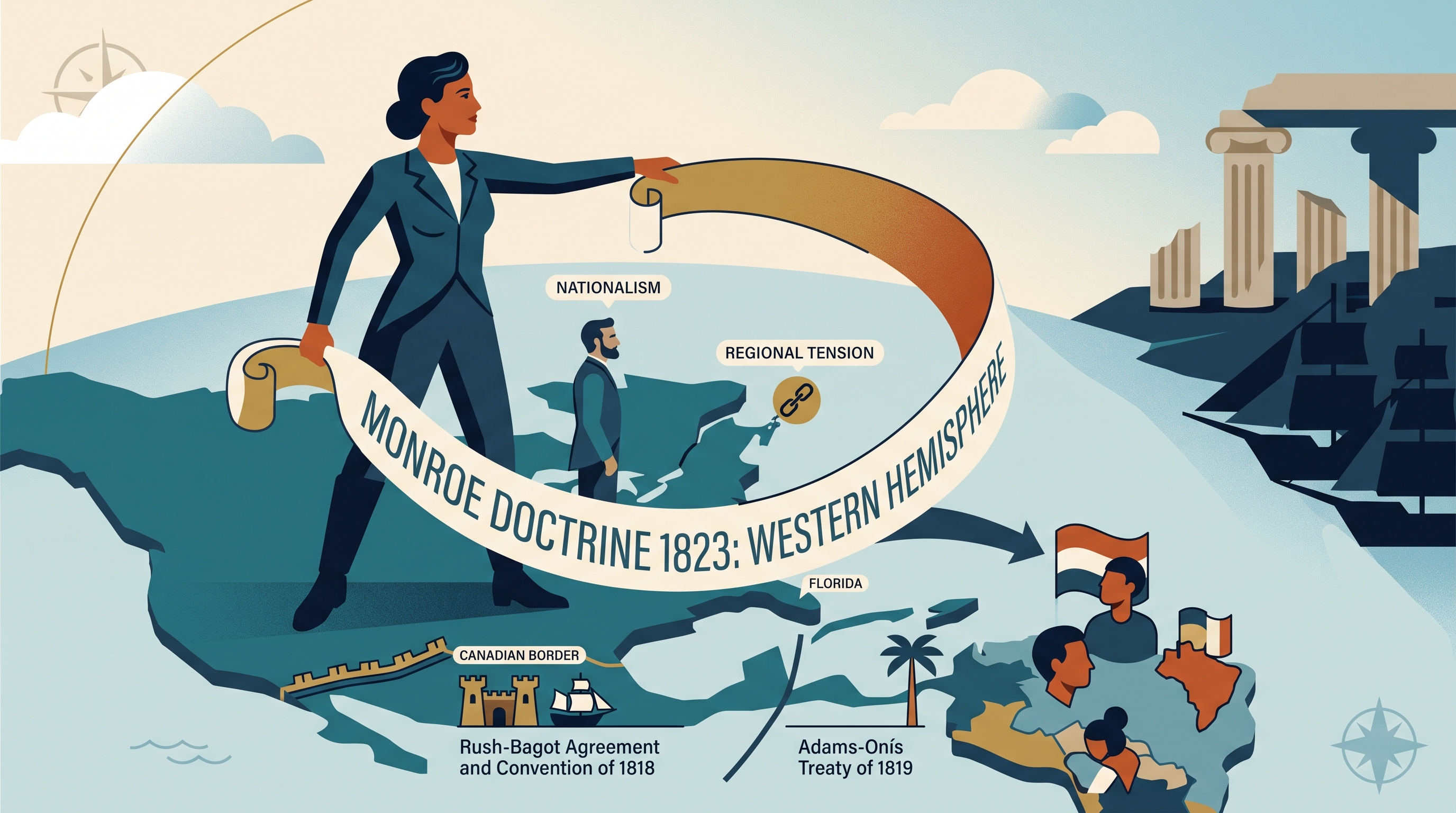
Several agreements reduced tensions with Britain. The Rush-Bagot Agreement limited naval forces on the Great Lakes, while the Convention of 1818 established part of the U.S.-Canadian boundary and created joint occupation of the Oregon Country. The Adams–Onís Treaty of 1819 transferred Florida to the United States and clarified boundaries with Spanish territory.
The Monroe Doctrine of 1823 announced that European powers should not establish new colonies or interfere in independent nations of the Western Hemisphere. Although the United States lacked the military strength to enforce the policy alone, British naval power made European intervention less likely. The doctrine therefore expressed both ambition and limitation: the United States claimed a special regional role but still depended on international circumstances.
Foreign policy also produced domestic disagreement. Nationalists supported a more assertive United States, while critics worried that military expansion, commercial commitments, or sympathy for revolutions abroad could endanger republican government. The same nationalism that encouraged continental expansion could therefore intensify sectional disputes over slavery and the political future of new territories.
Sourcing and situation in practice
When analyzing a speech defending the Monroe Doctrine, identify who spoke, when, and what audience or crisis shaped the statement. A president addressing Congress in 1823 had reason to present U.S. policy as confident and principled; that purpose does not prove the United States possessed the power to enforce every claim independently.
Retrieval and interpretation check
- Why did the Missouri Compromise temporarily reduce conflict but fail to eliminate it?
- How did the Nullification Crisis challenge the meaning of federal supremacy?
- Why was the Monroe Doctrine more than a foreign-policy statement?
Answer check: The Missouri Compromise preserved sectional balance while leaving slavery’s expansion unresolved; nullification challenged whether states could reject federal law; and the Monroe Doctrine asserted a U.S. sphere of influence in the Western Hemisphere while reflecting the nation’s continuing dependence on broader international power relationships.
Source Materials
- AP U.S. History Course and Exam Description
- AP U.S. History Course and Exam Description Clarifications and Corrections
- AP U.S. History Course Overview
- AP U.S. History Course at a Glance
- AP United States History Course at a Glance Poster
- AP United States History
- AP United States History
- AP United States History Sample Syllabus 1