From the free course AP United States History on Lykke
3.5 The American Revolution · 3.6 The Influence of Revolutionary Ideals
Key concepts: American Revolution · American independence and national identity · Democratic and republican ideals · Thomas Paine’s Common Sense · Declaration of Independence · State and federal government · Individual liberties · Limits on centralized power · New constitutions and declarations · Global influence of the American Revolution
The American Revolution did more than separate thirteen colonies from Britain: it created a political laboratory in which Americans tested how a nation could protect liberty without reproducing the concentrated power they had just resisted.
3.5 The American Revolution · 3.6 The Influence of Revolutionary Ideals
The American Revolution did more than separate thirteen colonies from Britain: it created a political laboratory in which Americans tested how a nation could protect liberty without reproducing the concentrated power they had just resisted. Independence made the United States possible; revolutionary ideals made its government a continuing experiment.
Investigative question: How did the Revolution transform a colonial rebellion into a new national identity and a debate over the proper limits of government?
From independence to national identity
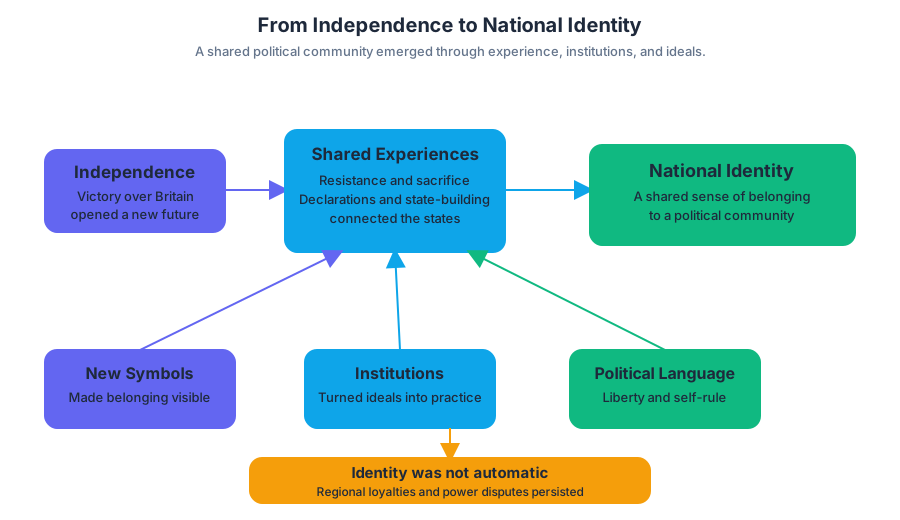
Victory over Britain enabled the former colonies to claim independence and begin imagining themselves as one people. That identity was not automatic. Regional differences, local loyalties, economic interests, and disagreements over political power continued, but new national symbols, institutions, and political language gradually connected the states.
National identity means a shared sense of belonging to a political community. During and after the Revolution, Americans developed that identity through common experiences: resistance to British authority, wartime sacrifice, independence declarations, state-building, and the belief that their political experiment had significance beyond North America.
Paine and the argument for independence
Thomas Paine’s Common Sense, published in 1776, translated revolutionary arguments into direct language for a broad audience. Paine attacked monarchy and hereditary rule, challenged the idea that a distant island should govern a continent, and argued that independence would allow Americans to build a new political order rather than merely repair the old one.
Paine’s importance was not that he single-handedly caused independence. His pamphlet mattered because it helped shift the debate from resistance within the British Empire toward complete separation. It connected political theory to practical claims about geography, monarchy, military security, and the future of American society.
Misconception check: Common Sense did not itself declare independence or create the Revolution. The pamphlet influenced public opinion; the Continental Congress formally declared independence.
The Declaration of Independence
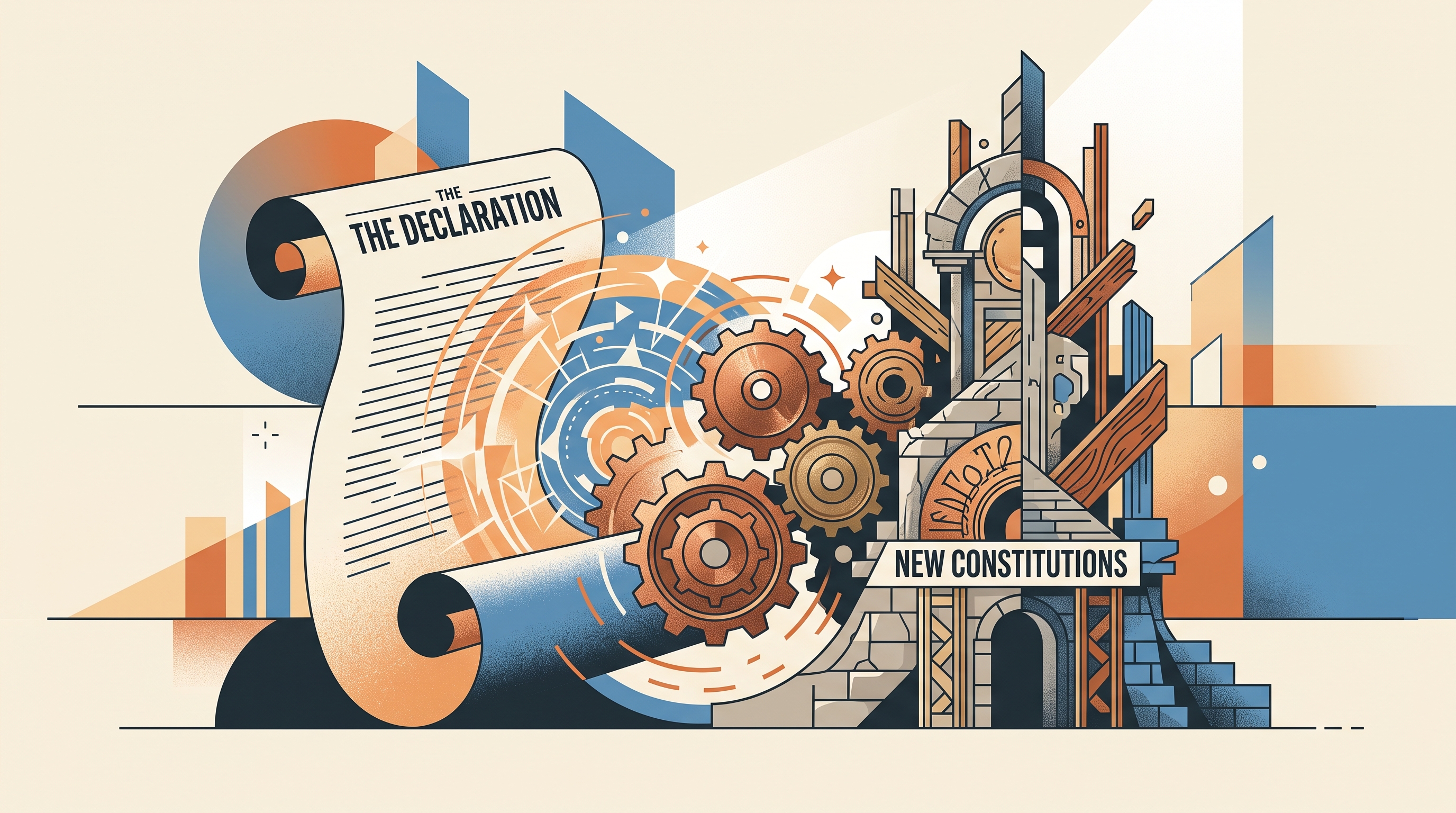
The Declaration of Independence performed two jobs at once. Internationally, it announced that the colonies were no longer British subjects. Politically, it justified separation by asserting that legitimate government rests on the rights and consent of the governed.
Its democratic ideals emphasized political legitimacy through the people rather than through inherited privilege. Its republican ideals emphasized representative government, civic responsibility, and resistance to arbitrary power. The Declaration therefore presented independence as a defense of rights and as an argument for a new form of government.
The document’s universal language created a powerful tension. Its claims about equality and liberty could be used to challenge slavery, political exclusion, and unequal treatment, even though the Revolution did not immediately extend those principles to everyone. Revolutionary ideals became standards against which American institutions could be judged.
Constitutions, rights, and divided power
After independence, political leaders created new constitutions and declarations of rights. These documents did not merely replace British officials; they defined how authority should operate inside the new states and across the emerging nation.
The central problem was balance:
| Political goal | Danger leaders wanted to avoid | Institutional response |
|---|---|---|
| Protect individual liberties | Government could violate rights | Declarations of rights and written protections |
| Limit centralized power | A distant national authority could become oppressive | Stronger state authority and divided powers |
| Prevent excessive popular influence | Sudden majorities could threaten property or stability | Representation, elections, and constitutional limits |
| Create effective national action | States could act without coordination | Experiments with federal institutions |
State government governed a particular former colony, while federal government referred to authority operating across the states. Revolutionary political systems tried to make both useful: states would preserve local control, while national institutions would address shared concerns. The unresolved balance between liberty, order, state power, federal power, and popular influence became a defining problem of the early republic.
Worked contextual example: tracing an ideal
Suppose a historian asks how the Revolution influenced American government. A strong chain of reasoning would look like this:
- British rule encouraged resistance to concentrated and arbitrary authority.
- Common Sense popularized the argument that monarchy and hereditary power were illegitimate.
- The Declaration of Independence expressed consent, rights, and resistance to tyranny.
- New state constitutions and rights declarations converted those ideals into political rules.
- Americans then debated how much authority a national government should possess.
The key is causation: revolutionary ideals did not produce one settled system. They produced experiments—different forms of government designed to protect liberty while limiting centralized power and excessive popular influence.
Revolutionary ideals beyond the United States
The Revolution and the Declaration influenced France, Haiti, and Latin America by demonstrating that inherited political authority could be challenged and that independence could be justified through rights-based language. Future independence movements around the world drew on the idea that a people could claim sovereignty and construct a new political order.
These influences were selective and contested. Different movements adapted revolutionary language to local conditions, and the United States itself continued to struggle over whose liberty, citizenship, and political voice the ideals protected.
AP skill focus
Skill 1: Developments and Processes asks you to explain how independence, national identity, constitutions, and revolutionary ideals developed over time. Skill 5: Making Connections links the Declaration’s political language to later movements in France, Haiti, Latin America, and the United States. Skill 6: Argumentation requires a defensible claim that connects evidence—such as Common Sense, the Declaration, and new constitutions—to the broader transformation in government.
Retrieval check: Why did the Revolution produce both stronger ideas about popular liberty and continued concern about excessive popular influence? Name one document or political development that demonstrates this tension.
Source Materials
- AP U.S. History Course and Exam Description
- AP U.S. History Course and Exam Description Clarifications and Corrections
- AP U.S. History Course Overview
- AP U.S. History Course at a Glance
- AP United States History Course at a Glance Poster
- AP United States History
- AP United States History
- AP United States History Sample Syllabus 1