From the free course AP United States History on Lykke
8.7 America as a World Power · 8.8 The Vietnam War
Key concepts: America’s increasingly important role in world affairs · Debates over U.S. internationalism and isolationism · Intervention to promote a vision of international order · Cold War competition · Diplomatic, economic, cultural, and military interactions among nations · U.S. strategic and economic interests in the Pacific Rim, Asia, and Latin America · The Vietnam War · Richard Nixon’s “Address to the Nation on the Vietnam War” · The relationship between U.S. policies toward Iran’s Mosaddegh and broader Cold War strategy
By the middle of the twentieth century, the United States had become a global power whose choices could reshape governments, economies, and wars far beyond North America.
8.7 America as a World Power · 8.8 The Vietnam War
By the middle of the twentieth century, the United States had become a global power whose choices could reshape governments, economies, and wars far beyond North America. The central question was no longer whether the United States could intervene abroad, but whether intervention, restraint, or withdrawal would best protect American security and define a stable international order.
From isolationist debate to global leadership
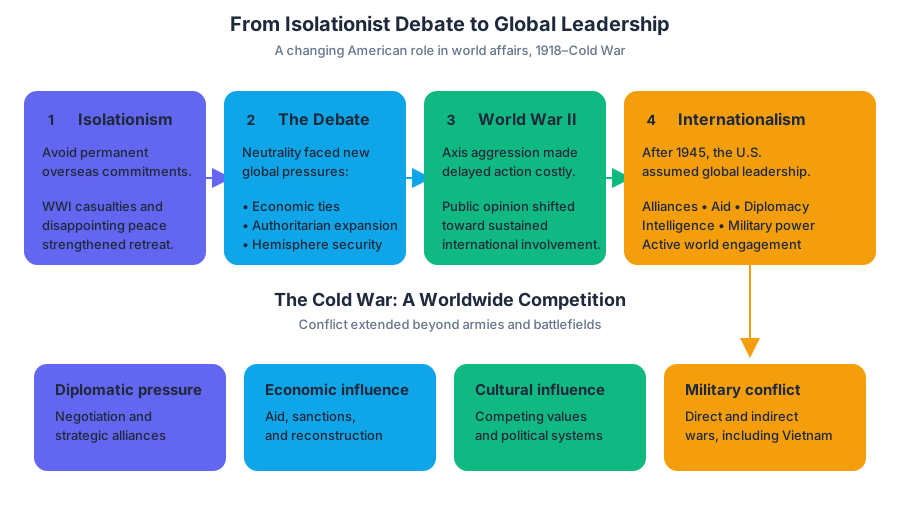
Isolationism means avoiding permanent political and military commitments overseas. During the 1930s, many Americans favored this approach after the enormous casualties and disappointing peace settlement that followed World War I. Policymakers nevertheless debated whether modern threats made neutrality unrealistic: economic interdependence, authoritarian expansion, and the security of the Western Hemisphere increasingly connected American interests to events abroad.
World War I and its aftermath intensified this argument. The United States participated in the war but rejected membership in the League of Nations, illustrating a lasting tension: Americans might support military action in an emergency while resisting institutions that seemed to limit national independence. By World War II, however, the combination of Axis aggression and the consequences of delayed action helped shift public and governmental opinion toward sustained international involvement.
After 1945, victory over the Axis powers placed the United States in a position of global political and military leadership. Internationalism—active participation in world affairs—now shaped policy through alliances, economic programs, diplomacy, intelligence operations, and military power. The Cold War was therefore not merely a contest of armies. It was a worldwide competition involving diplomatic pressure, economic assistance and sanctions, cultural influence, competing political systems, and direct or indirect military conflict.
Interests and intervention
U.S. leaders often justified intervention as containment, the effort to prevent the spread of communism rather than immediately overthrow every communist government. Yet containment was applied flexibly. American interests included the security of the Pacific Rim, access to Asian and Latin American markets, and the protection of natural resources and trade routes. In Latin America, the United States supported non-Communist regimes with varying commitments to democracy, revealing a recurring contradiction between defending “the free world” and cooperating with authoritarian governments.
A useful comparison is the U.S. response to Iranian prime minister Mohammad Mosaddegh in 1953. Fearing communist influence and concerned about oil interests, the United States supported covert efforts that helped remove Mosaddegh and strengthened the shah. This approach relied on secret intervention and regime change; Vietnam eventually involved a much larger, prolonged American military commitment. In both cases, officials interpreted local political conflict through the Cold War, but the scale, visibility, and consequences of the interventions differed sharply.
Key insight: Cold War policy was not driven by ideology alone. Security fears, economic interests, resource concerns, regional alliances, domestic politics, and assumptions about American credibility interacted.
Vietnam: containment becomes escalation
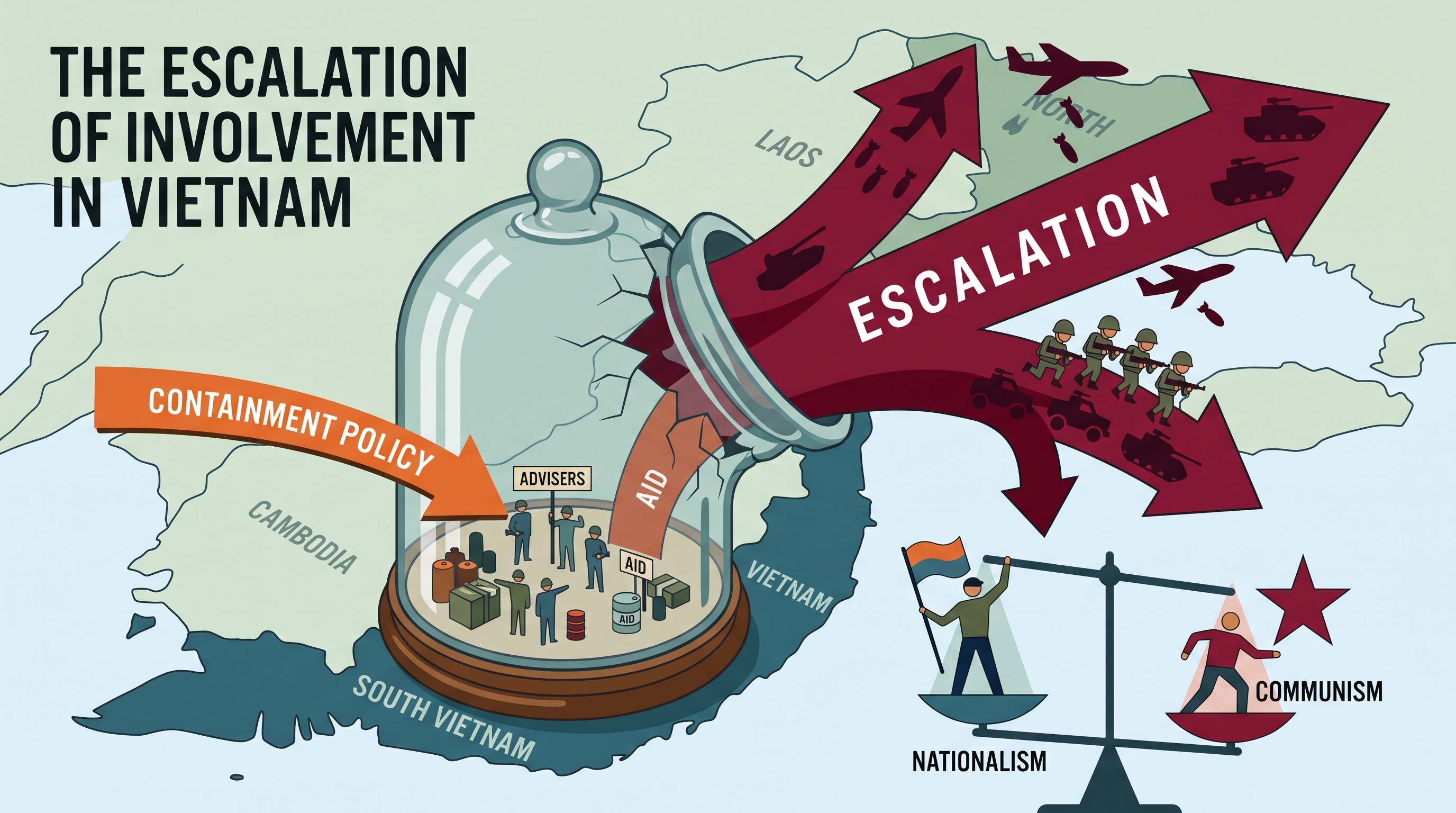
Vietnam exposed the dangers of treating every nationalist or revolutionary movement as part of a single Soviet-led conspiracy. After the division of Vietnam, the United States supported South Vietnam against communist North Vietnam and the Viet Cong. American presidents increased aid and advisers before committing large combat forces under Lyndon Johnson. The Gulf of Tonkin incident in 1964 provided political justification for expanded military action, and bombing and troop escalation followed.
The war became a test of competing claims about international order. U.S. officials argued that abandoning South Vietnam might encourage further communist expansion and weaken American credibility with allies. Opponents argued that Vietnamese nationalism, colonial history, civil war, and local political conditions could not be solved by overwhelming American force. The Tet Offensive of 1968, although costly for communist forces, undermined public confidence by showing that military strength had not produced a clear victory.
Richard Nixon’s “Address to the Nation on the Vietnam War” reflected an attempt to manage this crisis rather than simply intensify it. His policy of Vietnamization shifted increasing responsibility for combat to South Vietnamese forces while the United States reduced its ground presence, combined with continued diplomacy and military pressure. The approach sought to balance withdrawal, preservation of American credibility, and the goal of an acceptable settlement.
Skill application: Skill 1 and Skill 6
Skill 1: Developments and Processes asks students to explain how American foreign policy developed over time. A strong explanation traces a process: 1930s isolationist debate → World War II global leadership → Cold War containment → intervention in regional conflicts → reassessment after Vietnam.
Skill 6: Argumentation requires a defensible claim supported by evidence and reasoning. For example: Although Cold War intervention was presented as a defense of international order, U.S. actions in Iran and Vietnam also reflected economic interests, credibility concerns, and assumptions that local conflicts were extensions of global communism.
Misconception check
Misconception: “The Vietnam War was simply a military failure.” Military outcomes mattered, but the deeper problem involved political legitimacy, inaccurate assumptions about Vietnamese nationalism, public distrust, domestic opposition, and the limits of American power. A complete explanation connects battlefield developments to diplomatic, cultural, economic, and political consequences.
Retrieval and interpretation check
- Why did World War I intensify debates over U.S. involvement overseas?
- Name two dimensions of Cold War competition besides military conflict.
- How did Vietnamization differ from the approach used against Mosaddegh?
- In one sentence, explain how the Vietnam War challenged the assumption that intervention could reliably produce a favorable international order.
Source Materials
- AP U.S. History Course and Exam Description
- AP U.S. History Course and Exam Description Clarifications and Corrections
- AP U.S. History Course Overview
- AP U.S. History Course at a Glance
- AP United States History Course at a Glance Poster
- AP United States History
- AP United States History
- AP United States History Sample Syllabus 1