From the free course AP United States History on Lykke
6.7 Labor in the Gilded Age · 6.8 Immigration and Migration in the Gilded Age
Key concepts: International and internal migration · Urbanization in the Gilded Age · Growth of urban culture · Labor unions · African American labor organization · National Colored Labor Convention · Colored National Labor Union · Knights of Labor · Labor activism and radicalism · Immigration and migration in the Gilded Age
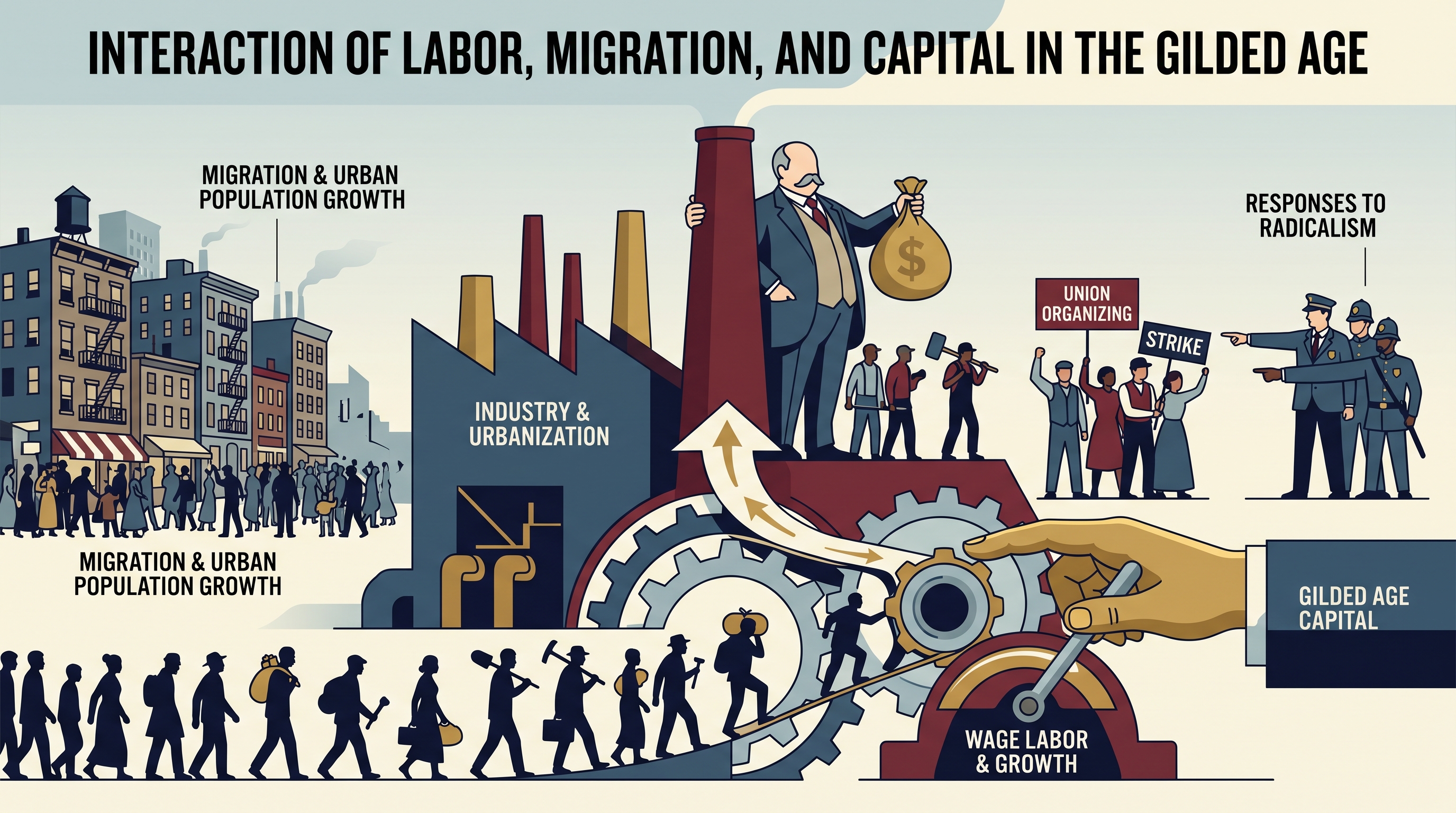
Industrial growth pulled people into cities while land hunger pushed others westward, but neither movement was peaceful or evenly shared. Migration reshaped where Americans lived; labor organizing tried to determine who would benefit from the new economy.
6.7 Labor in the Gilded Age · 6.8 Immigration and Migration in the Gilded Age
Industrial growth pulled people into cities while land hunger pushed others westward, but neither movement was peaceful or evenly shared. Migration reshaped where Americans lived; labor organizing tried to determine who would benefit from the new economy.
Investigative question: How did migration and urbanization create both new opportunities and new conflicts in the Gilded Age?
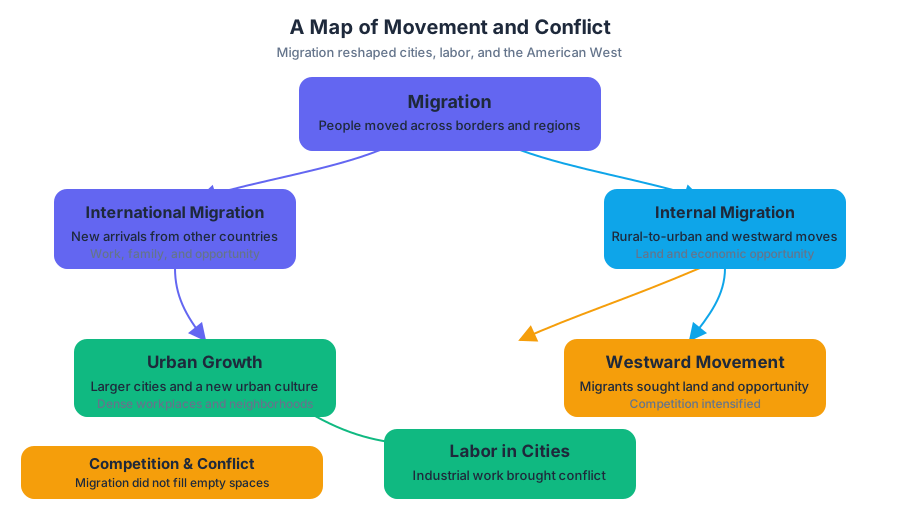
A map of movement and conflict
International migration brought people from other countries into the United States. Internal migration moved people within the country, including movement from rural areas to cities and movement westward in search of land and economic opportunity. Together, these migrations increased urban populations and fostered the growth of a new urban culture (KC-6.2.I).
Westward migration also intensified competition. Larger numbers of migrants moved west seeking land and economic opportunity, frequently provoking competition and violent conflict (KC-6.2.II). The key point is causation: migration did not simply fill empty spaces. It brought migrants into conflict with Native peoples, earlier settlers, landholders, railroads, and one another over access to land and resources.
Retrieval check: If a historian connects immigration, rural-to-urban movement, and western settlement to population change, which two migration categories should appear in the explanation? International and internal migration.
Urbanization and a new culture
Urbanization is the growth of cities as a share of the population and economy. Cities became meeting points for migrants, wage workers, employers, political organizations, newspapers, entertainment, and reform efforts. The result was not merely crowded streets; it was a new urban culture shaped by diverse languages, neighborhoods, religious institutions, labor associations, and commercial spaces.
Industrialization and urbanization therefore worked together. Factories, railroads, construction, and service industries attracted workers; the growing population supplied employers with labor and created markets for new goods. At the same time, crowded housing, dangerous workplaces, and unequal wages made urban life a setting for labor conflict and public anxiety.
The Gilded Age also produced new cultural and intellectual movements and public reform efforts (KC-6.3). These developments should not be treated as separate from migration and labor: changing cities created the social problems, organizations, and political debates that reformers addressed.
Labor unions and exclusion
A labor union is an organization through which workers act collectively to seek higher wages, safer conditions, shorter hours, or greater control over employment. Collective action mattered because an individual worker usually had little bargaining power against a large business, whereas workers acting together could strike, negotiate, or publicize workplace abuses.
African American workers faced an additional barrier: exclusion from predominantly White labor organizations. In 1869, African Americans formed the Colored National Labor Union to organize their labor on a national level because they were denied membership in predecessor labor organizations. The National Colored Labor Convention was reported in The New York Tribune on December 7, 1869.
The name distinction matters. The convention was a meeting and public event; the Colored National Labor Union was the organization created to coordinate African American labor nationally. Both reveal that African American workers pursued organized economic power rather than merely waiting for existing unions to become inclusive.
Named misconception check — “Labor unions represented all workers.” They did not. Many unions excluded African Americans, women, immigrants, or particular categories of workers. A strong historical explanation asks who was included, who was excluded, and why that boundary mattered.
Herrera, land resistance, and competing interpretations
Juan José Herrera illustrates how labor activism could overlap with local struggles over land and economic power. Herrera was a leader of a land-grab resistance group and a local organizer for the Knights of Labor, a broad labor organization that sought to unite workers across some occupational and ethnic boundaries.
The land-grab resistance included cutting fences, burning haystacks, and sabotaging railroads. Through Herrera’s organizing, the Knights of Labor and the land-grab resistance organization became closely associated. This association shows why authorities and business leaders could portray labor activism as a threat to property and public order, while participants could portray resistance as defense against dispossession.
This conflict also requires source comparison. Sources from unions and business leaders can be used to compare interpretations of labor conflict and changing standards of living (KC-6.1.II.B.i). A business leader might emphasize property damage, disrupted transportation, or radicalism. A union source might emphasize low wages, dangerous work, exclusion, or declining control over land and labor. Neither source should be accepted automatically: its author, purpose, audience, and historical situation shape its interpretation.
AP historical thinking in action
Skill 1.A — Developments and Processes: Identify urbanization, migration, union formation, and land resistance as connected developments.
Skill 2.A — Sourcing and Situation: Ask how a union newspaper, business statement, or New York Tribune report shaped its account.
Skill 3.A — Claims and Evidence in Sources: Extract each source’s claim about labor conflict and identify the evidence used.
Skill 4.A — Contextualization: Place labor disputes within post–Civil War industrialization, migration, and urban growth.
Skill 5.A — Making Connections: Connect migration patterns to urban population growth, labor markets, and western conflict.
Skill 6.A — Argumentation: Make a defensible claim about whether migration expanded opportunity, intensified exploitation, or did both.
Increased anxiety about radicalism contributed to attacks on labor activism and immigrant culture. The crucial distinction is between cause and response: migration and industrial change helped produce labor conflict, while fear of radicalism shaped how employers, officials, and other Americans reacted to that conflict.
Final interpretation check: A historian argues that Gilded Age labor conflict resulted partly from the interaction of migration and industrial urbanization. What evidence would best support the argument? A defensible answer would connect growing migrant populations and crowded cities to wage labor, union organizing, exclusion from unions, and competing interpretations of strikes or land resistance.
Source Materials
- AP U.S. History Course and Exam Description
- AP U.S. History Course and Exam Description Clarifications and Corrections
- AP U.S. History Course Overview
- AP U.S. History Course at a Glance
- AP United States History Course at a Glance Poster
- AP United States History
- AP United States History
- AP United States History Sample Syllabus 1