From the free course AP United States History on Lykke
4.7 Expanding Democracy · 4.8 Jackson and Federal Power
Key concepts: Expanding democracy in the early republic · Jacksonian democracy and the "common people" · Federal power during Andrew Jackson’s presidency · The American System · Internal improvements and the Cumberland Road Bill · The rise of the Whig Party in opposition to Jackson · The Tariff of 1828 (Tariff of Abominations) · Gibbons v. Ogden and federal authority · Voting restrictions based on age and race · Indigenous resistance and federal policy, including the Black Hawk War
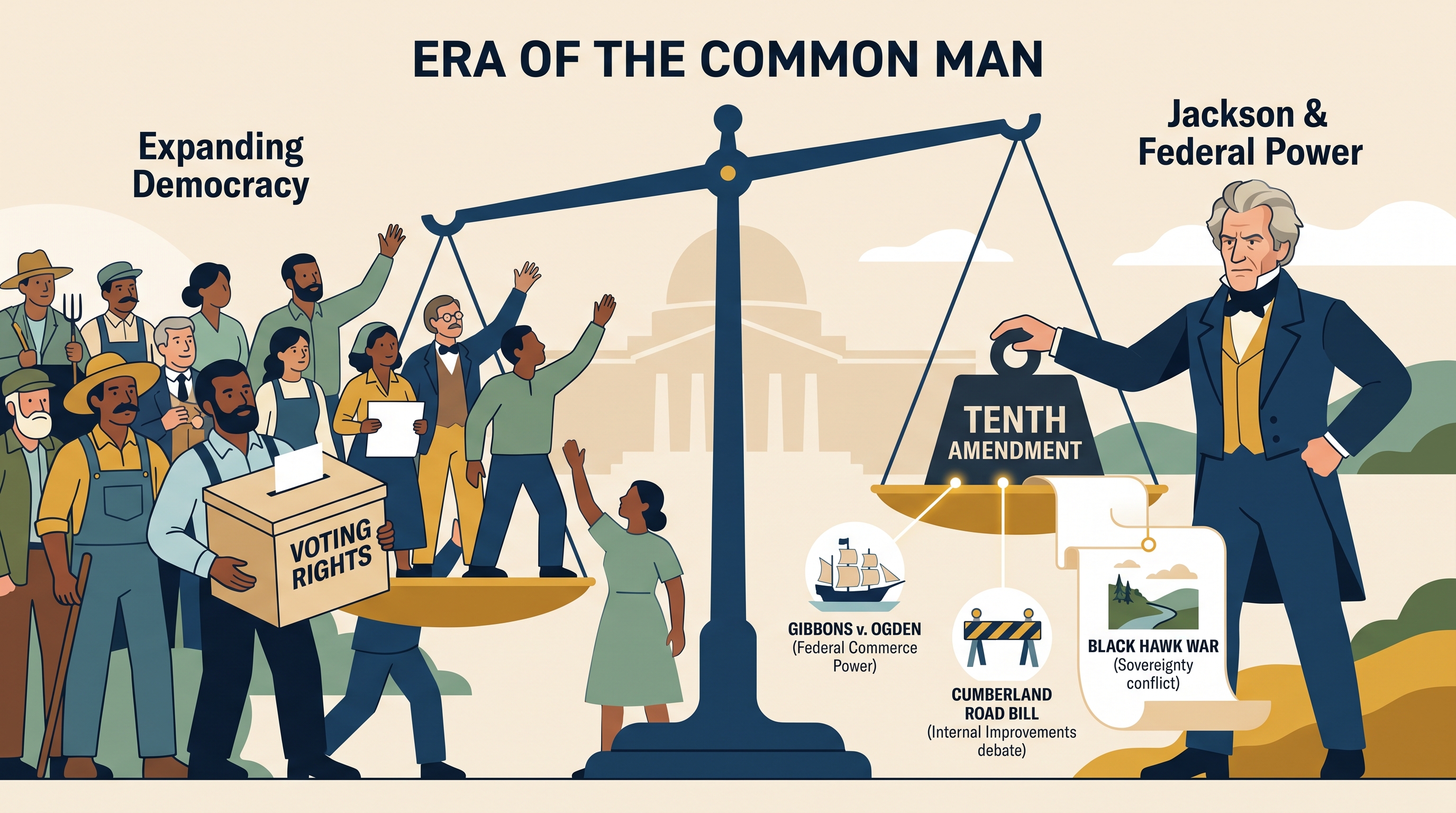
How could American democracy expand while political power remained restricted—and why did that expansion produce a new struggle over federal authority? Between the 1820s and 1830s, more states adopted universal White manhood suffrage, meaning that adult White men could vote without owning property.
4.7 Expanding Democracy · 4.8 Jackson and Federal Power
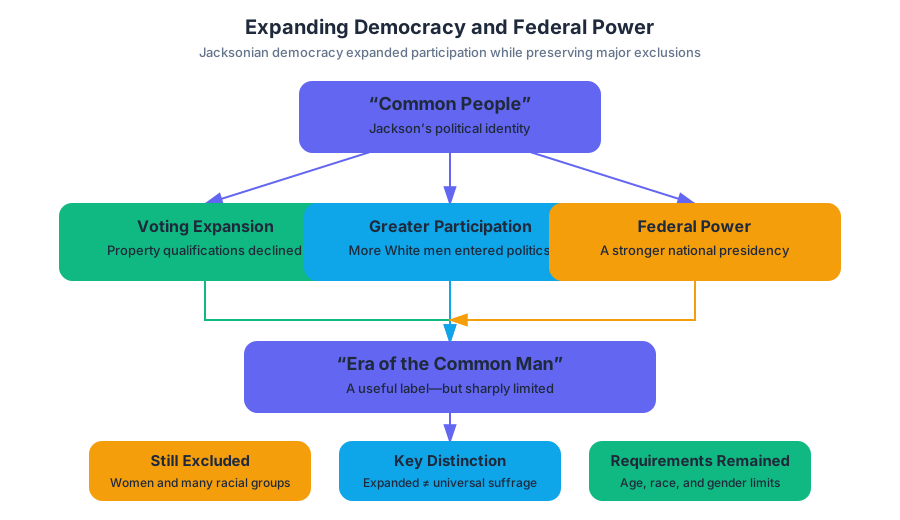
How could American democracy expand while political power remained restricted—and why did that expansion produce a new struggle over federal authority? Between the 1820s and 1830s, more states adopted universal White manhood suffrage, meaning that adult White men could vote without owning property. Yet women, most African Americans, Indigenous people, and minors remained excluded. Democracy widened, but it did not become universal.
Key distinction: Expanded participation is not the same as equal political power.
The “common people” and the expansion of democracy
The rise of Andrew Jackson reflected—and accelerated—a change in political culture. Jackson presented himself as the champion of the “common people”, contrasting ordinary White farmers and laborers with wealthy elites, inherited privilege, and concentrated national power. Increased voter participation and the removal of property qualifications helped create the period’s reputation as the “Era of the Common Man.”
The label is useful but incomplete. Voting restrictions still included age requirements, racial restrictions, and gender restrictions. “Universal White manhood suffrage” therefore described a major expansion within a sharply limited political community: the electorate became more broadly White and male, not broadly inclusive of all Americans.
Misconception check — “Jacksonian democracy gave everyone the vote.”
It did not. The change was democratic in comparison with earlier property-based systems, but it preserved racial and gender exclusions. A strong historical explanation must hold both facts together: participation expanded for many White men while political power remained restricted overall.
Jackson and the meaning of federal power
Jackson’s presidency exposed a central contradiction. He opposed federal actions that he believed favored privileged economic interests, yet he also used presidential and national authority forcefully. His response to the tariff controversy illustrates this conflict.
The Tariff of 1828, designed in part to protect Northern industry from foreign competition, raised the cost of imported goods. Many Southerners called it the Tariff of Abominations because they believed it harmed the export-oriented Southern economy while benefiting Northern manufacturers. South Carolina’s claim that a state could reject a federal law challenged national supremacy.
Jackson rejected the idea that a state could nullify federal law. Although he supported reducing the tariff through compromise, he also secured the Force Bill, authorizing federal action to enforce tariff collection. The episode demonstrates that Jackson’s populist appeal did not mean weak federal authority: he could oppose elite economic policy while defending the Union’s power to make and enforce national law.
The American System and internal improvements
Debates over the American System supplied the context for arguments about the Cumberland Road Bill. The American System promoted a stronger national economy through protective tariffs, a national bank, and federally supported internal improvements—roads, canals, and other transportation projects.
The Cumberland Road Bill concerned federal support for internal improvements. Supporters argued that national investment could connect frontier settlements to eastern markets, strengthen commerce, and bind distant regions together. Opponents objected that the Constitution did not clearly authorize Congress to fund local transportation projects and feared that federal spending would expand national power or favor particular regions.
This disagreement was not simply “North versus South.” It also involved constitutional interpretation, regional economic interests, and competing visions of development. A federal road could be understood simultaneously as a practical transportation project, an economic investment, and a test of how far national authority should reach.
Courts, territories, and Indigenous resistance
Federal power also operated through the courts and through policy toward western territories and frontier settlements. In Gibbons v. Ogden (1824), the Supreme Court strengthened federal authority over interstate commerce by ruling that federal law governed navigation crossing state boundaries. The decision limited state-created monopolies and reinforced the Constitution’s commerce power.
Federal-government actions likewise shaped territorial disputes and frontier settlement. Treaties, military campaigns, land policies, and transportation projects altered who could occupy land and whose claims the government recognized. The Black Hawk War revealed the violent consequences of these policies.
Black Hawk, a Sauk leader, resisted forced removal from ancestral lands. His 1832 surrender speech expressed Indigenous grievances after military defeat: surrender did not mean that removal had been just. The Treaty of Fort Jackson ending the Creek War similarly resulted in major Indigenous land cessions. These examples connect expanding American settlement to federal power and Indigenous resistance, a relationship identified in KC-4.3.I.B.
The Whigs emerge in opposition
Opposition to Jackson’s use of federal power helped produce the Whig Party. Whigs criticized what they regarded as executive overreach, especially Jackson’s opposition to the national bank and his willingness to use presidential authority against opponents. They generally favored congressional leadership, economic modernization, federally supported internal improvements, and policies associated with the American System.
The political conflict therefore involved more than personal dislike of Jackson. It was a dispute over whether democracy was best protected by a forceful president claiming to represent ordinary citizens or by institutions that restrained executive power and encouraged national economic planning.
AP historical reasoning in this topic
This topic develops Skill 1: Developments and Processes by tracing the expansion of White male suffrage and the growth of executive authority. It uses Skill 3: Claims and Evidence in Sources when interpreting Black Hawk’s surrender speech or a defense of the Cumberland Road Bill. Skill 4: Contextualization places the tariff and internal-improvement debates within the broader transformation of the early republic. Skill 5: Making Connections links democracy, sectionalism, economic policy, territorial expansion, and Indigenous resistance. Skill 6: Argumentation requires a defensible claim about whether Jackson expanded democracy, federal power, or both.
Retrieval and interpretation check
In two or three sentences, explain why the phrase “Era of the Common Man” is both accurate and misleading. Then connect one of these examples—the Tariff of 1828, Gibbons v. Ogden, the Cumberland Road Bill, or the Black Hawk War—to the larger question of federal authority. A complete response should identify the specific development, explain its historical significance, and acknowledge the limitation or conflict within it.
Source Materials
- AP U.S. History Course and Exam Description
- AP U.S. History Course and Exam Description Clarifications and Corrections
- AP U.S. History Course Overview
- AP U.S. History Course at a Glance
- AP United States History Course at a Glance Poster
- AP United States History
- AP United States History
- AP United States History Sample Syllabus 1