From the free course AP United States History on Lykke
AP Practice 4
A Long Essay Question (LEQ) asks you to construct a defensible historical argument without being given documents to analyze. Success depends less on recalling every fact than on making a clear claim, placing the issue in context, selecting specific evidence, and explaining relationships through causation,…
AP Practice 4
A Long Essay Question (LEQ) asks you to construct a defensible historical argument without being given documents to analyze. Success depends less on recalling every fact than on making a clear claim, placing the issue in context, selecting specific evidence, and explaining relationships through causation, comparison, or continuity and change over time.
Core task: Turn historical knowledge into an argument—not a list of events.
The original practice prompt
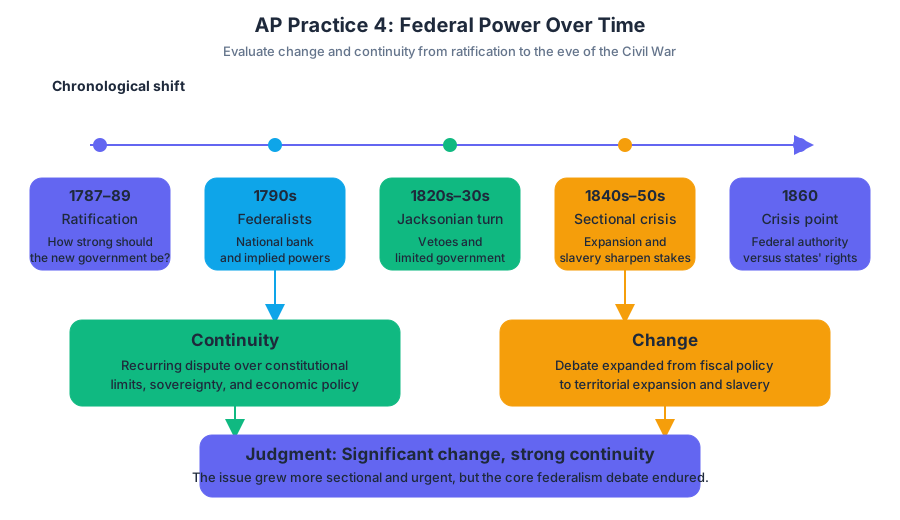
Evaluate the extent to which debates over the role of the federal government changed between the ratification of the Constitution and the eve of the Civil War.
This prompt spans roughly 1787–1860 and asks for continuity and change over time. The phrase “evaluate the extent” requires a judgment: the strongest response will argue that federal-power debates changed in some ways but retained important continuities.
Decode the prompt before writing
| Prompt feature | What it requires |
|---|---|
| Evaluate | Make and defend a judgment, not merely describe events. |
| The extent to which | Weigh the degree of change: limited, substantial, or significant but incomplete. |
| Debates over the role of the federal government | Focus on arguments about federal authority, not every political disagreement. |
| Changed | Organize around developments over time while identifying continuities. |
| Between ratification and the eve of the Civil War | Use evidence from approximately 1787–1860. |
Historical Thinking Skill 5. Making Connections is central here, especially the reasoning process of continuity and change. Strong responses also use Skill 1. Developments and Processes to identify major political developments, Skill 4. Contextualization to place those developments in broader circumstances, and Skill 3. Claims and Evidence in Sources only when interpreting evidence supplied by a source-based task; because an LEQ provides no documents, the evidence must come from your own historical knowledge.
A workable argument
A defensible thesis might argue:
Debates over federal power changed substantially between ratification and 1860 because the federal government expanded its authority through constitutional interpretation, economic policy, and territorial governance; however, the central conflict remained continuous, since Americans repeatedly disagreed over whether national power threatened local self-government and slavery.
This thesis earns its force by doing three jobs: it answers the question, identifies categories of change, and establishes a qualification. It does not claim that the entire meaning of federal power transformed; instead, it distinguishes new policy conflicts from a persistent argument about sovereignty.
Build the historical argument
| Period or development | Specific evidence | How it supports the argument |
|---|---|---|
| Ratification era | Federalists defended the Constitution; Anti-Federalists feared centralized authority. | The original debate established a lasting conflict over national power. |
| Early republic | The Bank of the United States and the Necessary and Proper Clause produced disagreement between Hamilton and Jefferson. | Federal-power debates moved from constitutional design to concrete economic policy. |
| 1810s–1830s | The American System, the Bank War, and nullification intensified disputes over federal economic and constitutional authority. | National power became more visible in banking, tariffs, and internal improvements. |
| 1840s–1850s | The Wilmot Proviso, the Compromise of 1850, the Kansas-Nebraska Act, and Dred Scott v. Sandford connected federal authority to slavery’s expansion. | The federal-power debate changed in content and became inseparable from sectional conflict. |
| Continuity | States’ rights arguments persisted from Anti-Federalist criticism through nullification and secessionist thought. | The language of local sovereignty continued even as the issues changed. |
The logical chain should be explicit: constitutional disagreement → economic-policy disagreement → sectional disagreement. The federal government did not simply become “stronger” in a straight line; its authority was repeatedly contested, and the meaning of that authority shifted as the nation expanded.
Worked paragraph
During the early republic, debates over federal power increasingly concerned economic development rather than only the structure of the new government. Alexander Hamilton’s proposal for a national bank relied on a broad interpretation of federal authority, while Thomas Jefferson argued that Congress possessed only powers specifically listed in the Constitution. Later conflicts over the Bank of the United States, protective tariffs, and federally supported transportation projects made this disagreement practical for citizens and states. These controversies therefore represented a change in the application of federal power, even though they preserved the earlier fear that national authority could overwhelm state or individual independence.
Notice the paragraph’s pattern: claim → evidence → explanation → connection to continuity and change. Naming an event is not enough; the final sentences explain why the evidence matters.
Rubric-targeted writing plan
| Rubric criterion | What an examiner must see |
|---|---|
| Thesis/claim | A defensible answer that establishes a line of reasoning. |
| Contextualization | Broader circumstances before, during, or surrounding the period, such as the weaknesses of the Articles of Confederation, westward expansion, or sectional tensions. |
| Evidence: description | At least two specific, relevant examples. |
| Evidence: argument support | Evidence must be used to prove the thesis, not dropped into a timeline. |
| Analysis and reasoning | A sustained use of continuity-and-change reasoning. |
| Complex understanding | Explain multiple causes, consequences, perspectives, or both change and continuity with meaningful qualification. |
Timing guidance
For a standard LEQ session, reserve approximately 40 minutes: spend 5 minutes unpacking the prompt and outlining, 30 minutes drafting, and 5 minutes checking for missing rubric elements. Before submitting, underline your thesis mentally, mark each specific example, and ask whether every body paragraph explains how the evidence answers the prompt.
Common failure: the chronological dump
A chronological dump says, “The Bank was created, Jackson vetoed it, nullification occurred, and the Compromise of 1850 followed.” That may demonstrate recall, but it does not evaluate change. Repair it by adding an analytical sentence: These events show that federal-power disputes expanded from constitutional interpretation into economic regulation and finally into the federal government’s authority over slavery in the territories.
Error-review routine
After writing, classify each weakness:
- Knowledge error: the event, date, person, or policy is inaccurate.
- Relevance error: the evidence is true but does not answer the prompt.
- Reasoning error: the response describes change without explaining its extent.
- Argument error: the thesis and body paragraphs point in different directions.
- Complexity gap: the response mentions continuity or an opposing perspective but does not explain its significance.
Rewrite only the weakest paragraph. Add one sentence that connects a specific piece of evidence to the thesis and one sentence that qualifies the argument.
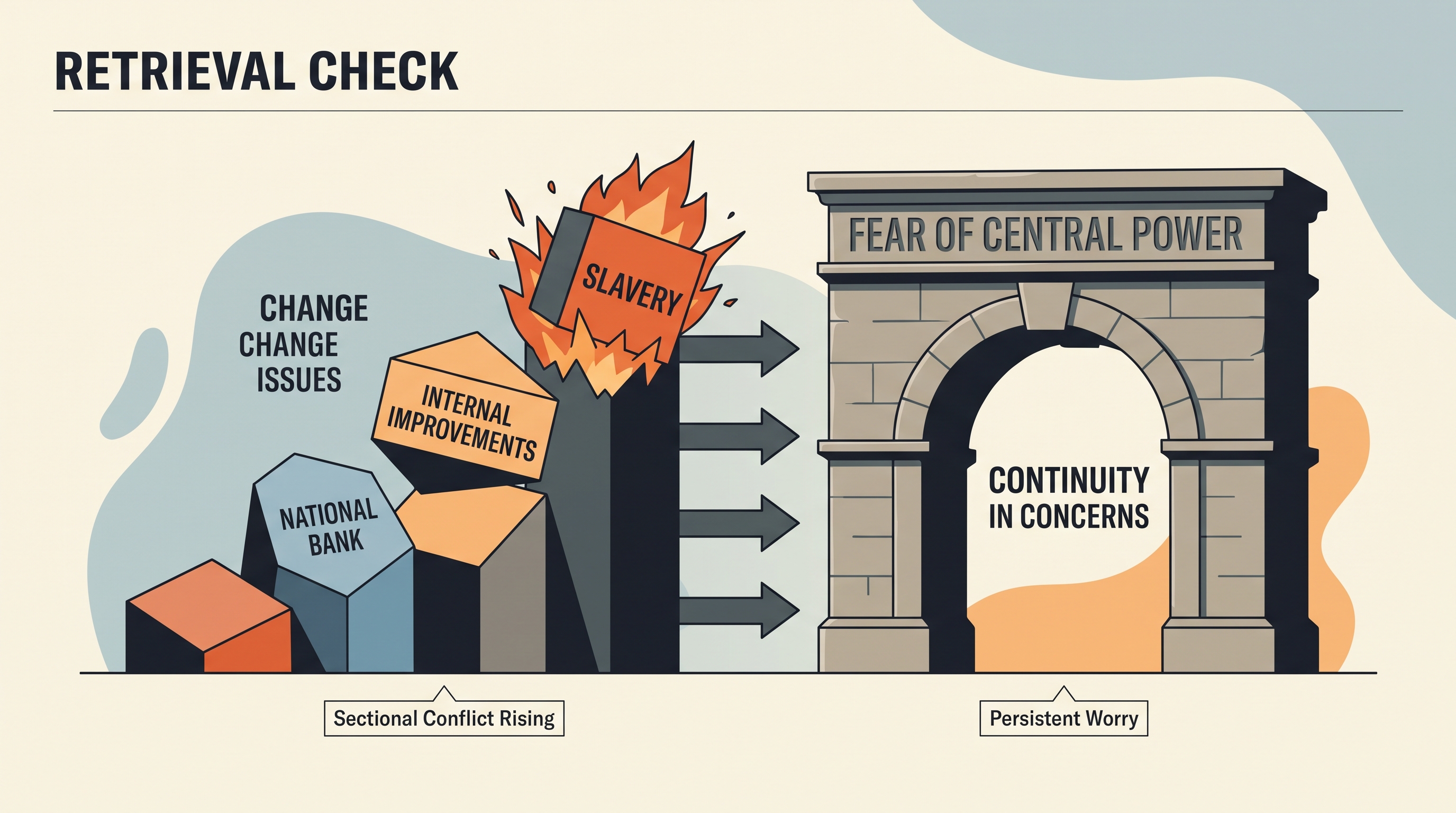
Retrieval check
In one sentence, explain the difference between a change in the issues surrounding federal power and a continuity in Americans’ concerns about federal power. A strong answer should distinguish the rise of slavery-related sectional conflict from the persistent fear that national authority threatened state or local autonomy.
Source Materials
- AP U.S. History Course and Exam Description
- AP U.S. History Course and Exam Description Clarifications and Corrections
- AP U.S. History Course Overview
- AP U.S. History Course at a Glance
- AP United States History Course at a Glance Poster
- AP United States History
- AP United States History
- AP United States History Sample Syllabus 1
- AP US History Past Exam Questions — AP Central
- Khan Academy — AP US History
- Gilder Lehrman Institute — AP US History Study Guide
- AP US History Units — Save My Exams