From the free course AP United States History on Lykke
6.13 Politics in the Gilded Age · 6.14 Continuity and Change in Period 6
Between 1865 and 1898, American politics became more democratic in participation yet less democratic in practice: party organizations mobilized millions of voters while employers, political machines, racial violence, and unequal access to the ballot narrowed who could exercise power.
Investigative question: How could political parties become stronger and elections become more competitive while many Americans lost meaningful political influence?
6.13 Politics in the Gilded Age
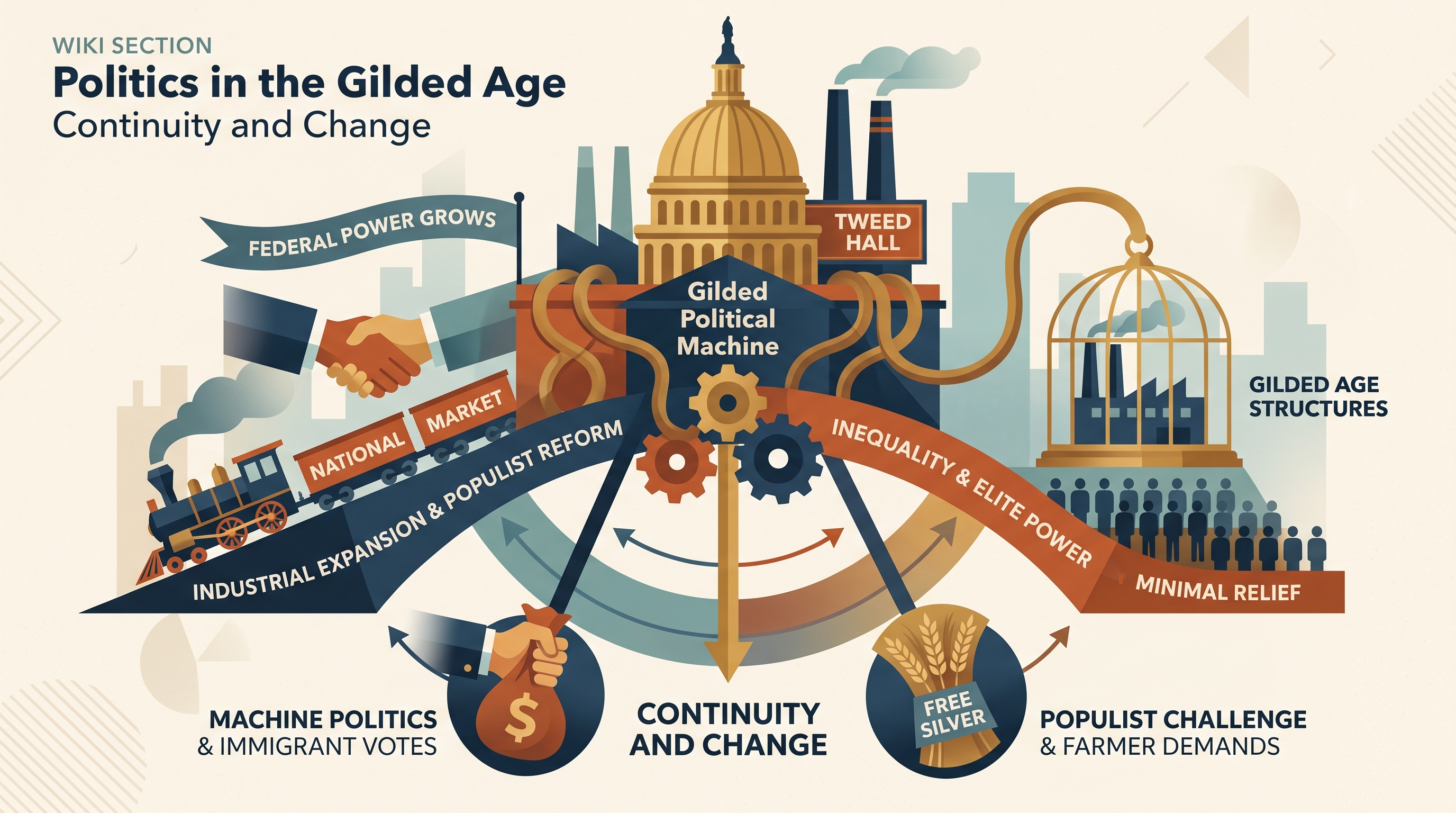
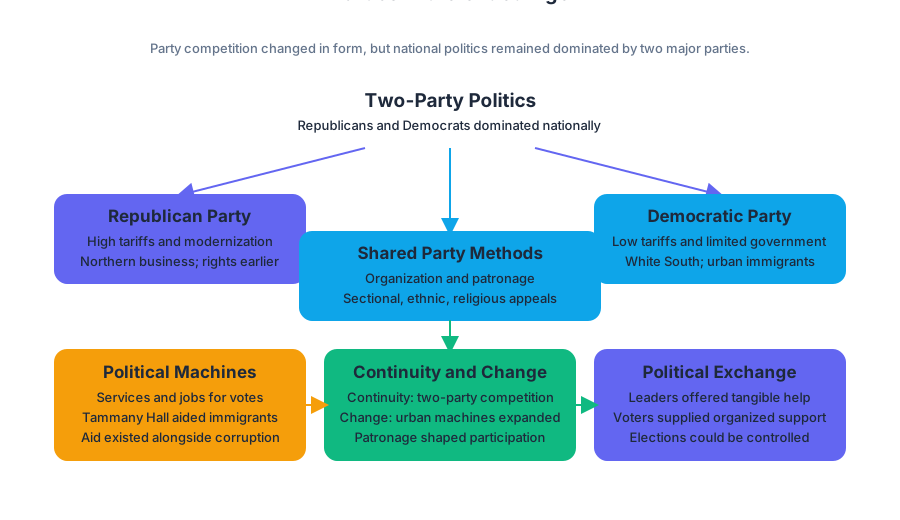
6.13.A focuses on how political parties changed and remained the same during the Gilded Age. Republicans and Democrats continued to dominate national politics, but both parties relied heavily on organization, patronage, and appeals to sectional, religious, ethnic, and economic interests.
A political machine was an organized party network that exchanged services or jobs for political support. In cities such as New York, Tammany Hall connected immigrants to food, employment, housing assistance, and legal help; in return, machine leaders expected votes. This system could provide real assistance to poor residents, but it also encouraged corruption, bribery, and control over elections.
| Political force | What it sought | Typical supporters or examples |
|---|---|---|
| Republican Party | High tariffs, economic modernization, and federal protection of African American rights, especially earlier in the period | Northern business interests, many African Americans, Union veterans |
| Democratic Party | Limited federal government, lower tariffs, and local control | White southerners, urban immigrants, conservative business interests |
| Populist Party | Monetary reform, railroad regulation, and greater political power for farmers and workers | Farmers facing debt, falling crop prices, and railroad costs |
The major parties often competed intensely without offering radically different solutions to industrial capitalism. Elections were close, but party loyalty was unusually strong. Campaigns used parades, newspapers, rallies, ethnic appeals, and patronage to turn social identities into votes.
Patronage, corruption, and contested elections
Patronage means awarding government jobs or contracts in exchange for political loyalty. The “spoils system” made party victory materially valuable, but it also encouraged unqualified appointments and corruption. The assassination of President James A. Garfield by a disappointed office seeker in 1881 strengthened support for civil-service reform; the Pendleton Civil Service Reform Act created competitive examinations for some federal positions.
The election of 1876 revealed how fragile the political system remained after Reconstruction. Democrat Samuel J. Tilden won more popular votes, but disputed electoral returns in several southern states prevented a clear Electoral College victory. The informal Compromise of 1877 placed Republican Rutherford B. Hayes in the presidency and contributed to the withdrawal of federal troops from the South, helping end Reconstruction.
Misconception check: The Compromise of 1877 was not a formal constitutional amendment or a single public law. It was an informal political settlement whose consequences included the end of sustained federal enforcement of Reconstruction governments.
The Populist challenge
Farmers organized through the Grange, Farmers’ Alliances, and finally the People’s Party, commonly called the Populists. They demanded policies such as the free coinage of silver, a graduated income tax, government control or regulation of railroads, and reforms intended to make government more responsive to ordinary producers.
The 1896 election demonstrated both the appeal and limitation of Populism. Democrat William Jennings Bryan adopted the Populist free-silver position, but Republican William McKinley won by defending the gold standard and presenting himself as the candidate of economic stability. Populist ideas later influenced Progressive reforms, even though the party itself declined.
6.14 Continuity and Change in Period 6
6.14.A requires analysis of continuity and change across Period 6, not a list of events. Period 6 transformed the scale of the economy and the federal government, but older structures of racial inequality, gender inequality, class conflict, and territorial expansion persisted.
| Area | Significant change, 1865–1898 | Important continuity |
|---|---|---|
| Economy | Railroads, factories, corporations, and national markets expanded rapidly | Wealth and decision-making remained concentrated among powerful elites |
| Government | Federal agencies and courts increasingly addressed national economic questions | Government frequently protected property and corporate interests |
| West | Railroads, mining, ranching, and settlement linked the West to national markets | Indigenous peoples faced dispossession, warfare, and forced assimilation |
| Labor | Industrial workers formed unions and organized strikes | Employers retained major power, and labor conflict remained severe |
| Immigration and cities | Urban populations and immigrant communities grew | Nativism and ethnic discrimination continued |
| African Americans | The Fourteenth and Fifteenth Amendments established formal citizenship and voting rights | Segregation, disfranchisement, racial violence, and sharecropping restricted freedom |
| Politics | Mass parties, machines, and new reform movements mobilized voters | Two-party competition and patronage remained central |
A strong continuity-and-change argument must explain why both patterns existed. Industrialization produced new corporations, urban classes, and national conflicts, but older assumptions about racial hierarchy, property, and social control shaped how institutions responded to those changes.
Worked argument: building a complex claim
Consider the claim: “Period 6 greatly expanded federal power.” The claim is partly valid. Congress supported railroad construction, regulated interstate commerce through the Interstate Commerce Act, and used federal troops and courts during labor conflicts and Reconstruction. Yet federal power was uneven: courts often limited regulation, federal officials withdrew from protecting Black voting rights, and government frequently acted on behalf of corporations.
This reasoning demonstrates Skill 6: Continuity and Change Over Time, especially 6.D, which asks students to corroborate, qualify, or modify an argument using diverse evidence to develop a complex argument. It also uses Skill 3: Analyzing Historical Evidence, specifically 3.D, “Explain how claims or evidence support, modify, or refute a source’s argument.”
Exam-ready distinction: “Change” identifies what became different; “continuity” identifies what persisted; “complexity” explains how the two interacted. Saying that industrialization “changed everything” is not analysis because it erases the persistence of racial, class, and gender hierarchies.
Retrieval check
- Why did political machines attract immigrant support despite corruption?
- How did the Populists challenge both major parties?
- Give one major change and one major continuity in Period 6.
- Qualify the statement: “The federal government became more powerful after the Civil War.”
A complete response should connect machines to material assistance and votes; Populism to farmer demands such as free silver and railroad regulation; change to industrialization or national markets; continuity to racial inequality or elite economic power; and federal expansion to its uneven enforcement and frequent support for property interests.
Source Materials
- AP U.S. History Course and Exam Description
- AP U.S. History Course and Exam Description Clarifications and Corrections
- AP U.S. History Course Overview
- AP U.S. History Course at a Glance
- AP United States History Course at a Glance Poster
- AP United States History
- AP United States History
- AP United States History Sample Syllabus 1