From the free course AP United States History on Lykke
Course Framework, Skills and Reasoning Processes
Key concepts: AP U.S. History course framework and curriculum design · College- and university-level expectations · Historical thinking skills · Analysis of primary and secondary sources · Evaluation of diverse historical evidence and perspectives · Constructing historical arguments in writing · Founding documents and their influence on American history · Use of individuals, events, and documents to trace ideas and themes · Student prerequisites and academic readiness · Optional unit sequencing and teacher-designed curricula
AP U.S. History is an introductory college-level course spanning approximately $1491$ to the present, but it has no formal prerequisites: students should be able to read a college-level textbook and write grammatically correct, complete sentences.
Course Framework, Skills and Reasoning Processes
AP U.S. History is an introductory college-level course spanning approximately $1491$ to the present, but it has no formal prerequisites: students should be able to read a college-level textbook and write grammatically correct, complete sentences.
What “college-level” means in practice
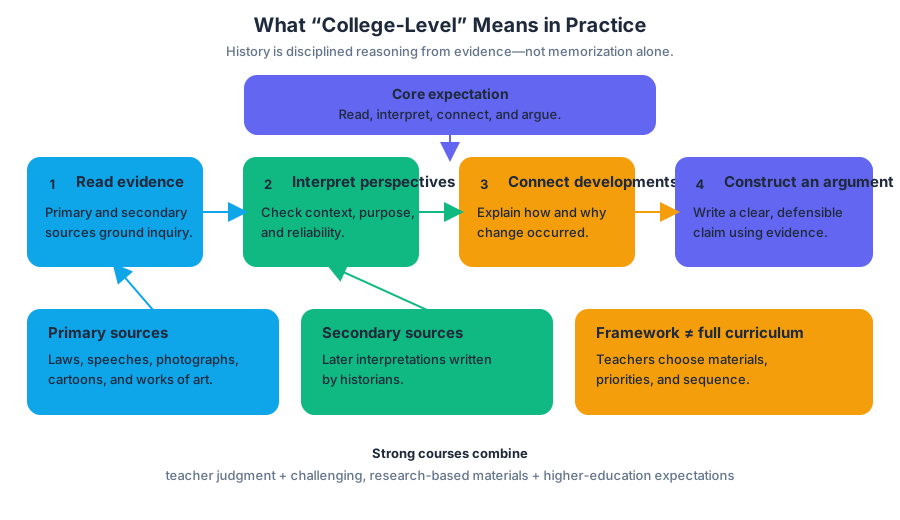
College-level history is not the memorization of an endless list of names and dates. It is the disciplined use of evidence to explain how and why historical developments occurred. Students read primary sources created during the period—such as laws, speeches, photographs, political cartoons, and works of art—and secondary sources written later by historians, then evaluate perspective, context, purpose, and reliability.
Core expectation: Read evidence, interpret perspectives, connect developments, and construct a defensible historical argument in writing.
Teachers select the specific textbooks, individuals, events, and documents used in instruction. The Course Framework establishes required content and historical thinking expectations, but it is not a complete curriculum, and its chronological unit sequence is optional. A strong curriculum therefore combines teacher judgment and local priorities with challenging, research-based materials aligned to higher-education expectations.
The framework’s organizing architecture
The framework is grounded in themes: cross-cutting concepts that build understanding and reappear across different periods. Themes prevent history from becoming a series of isolated episodes. For example, WXT: Work, Exchange, and Technology can connect colonial labor systems, industrial capitalism, and the post-1945 economy; MIG: Migration and Settlement can connect Indigenous societies, westward expansion, immigration, and modern migration.
The eight recurring themes are NAT: American and National Identity, PCE: Politics and Power, WXT: Work, Exchange, and Technology, WOR: America in the World, GEO: Geography and the Environment, MIG: Migration and Settlement, ARC: American and Regional Culture, and SOC: Social Structures. A single event usually belongs to several themes at once: the Mexican–American War, for instance, involves national identity, territorial expansion, diplomacy, geography, and slavery-related sectional conflict.
| Historical thinking skill | What the historian does |
|---|---|
| Skill 1: Developments and Processes | Identifies and explains significant historical developments and processes |
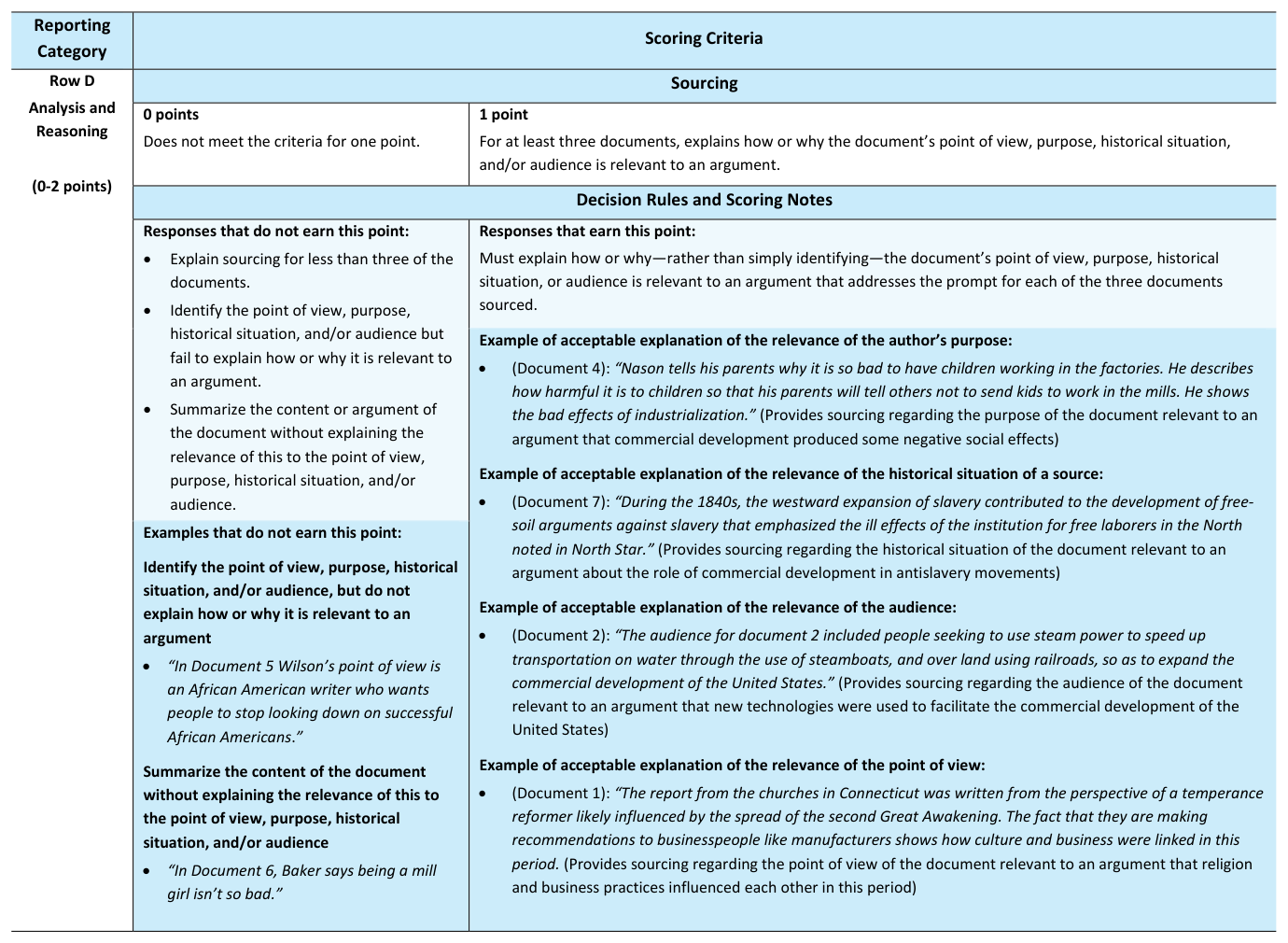
| Skill 2: Sourcing and Situation | Analyzes a source’s point of view, purpose, historical situation, and/or audience |
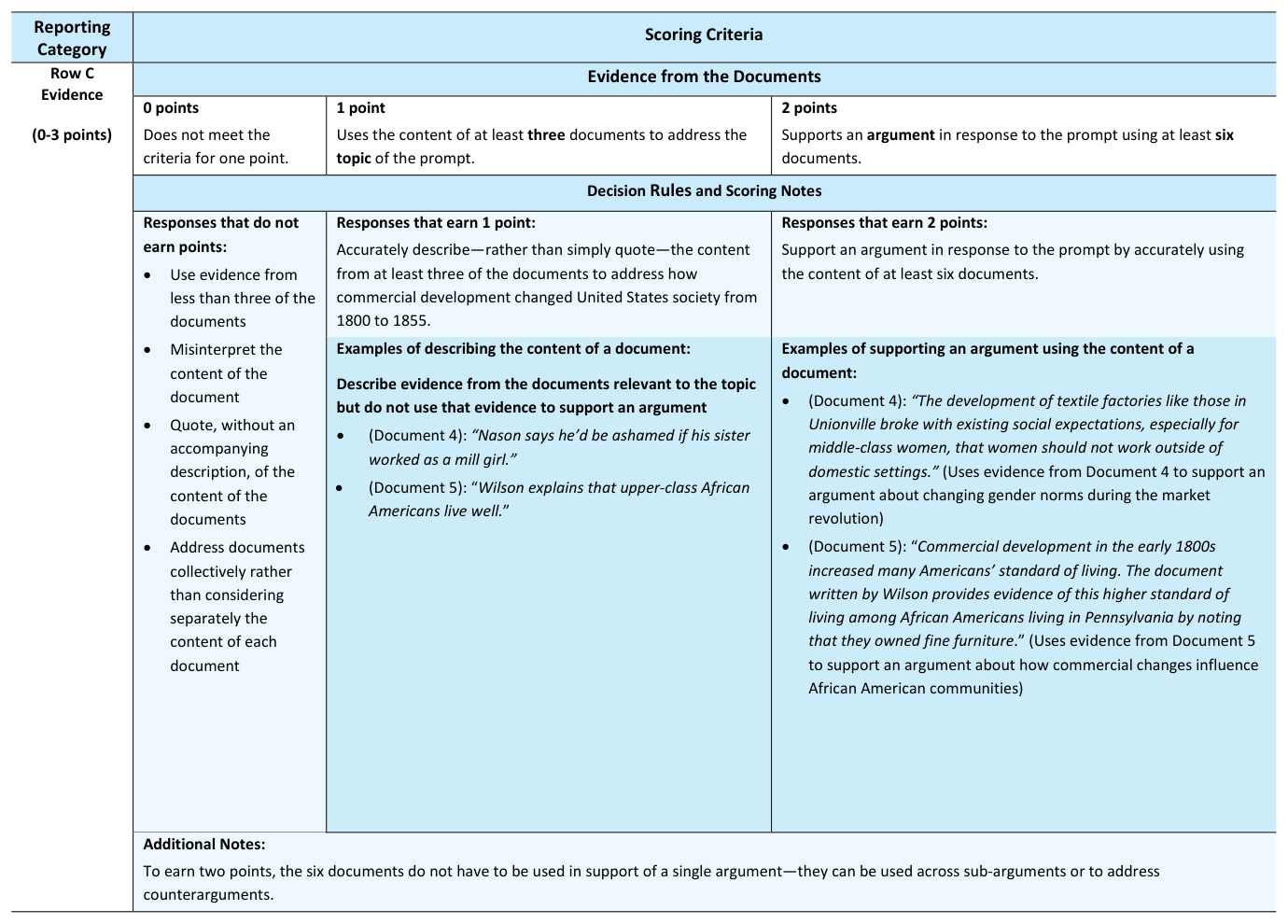
| Skill 3: Claims and Evidence in Sources | Evaluates claims and uses evidence from sources |
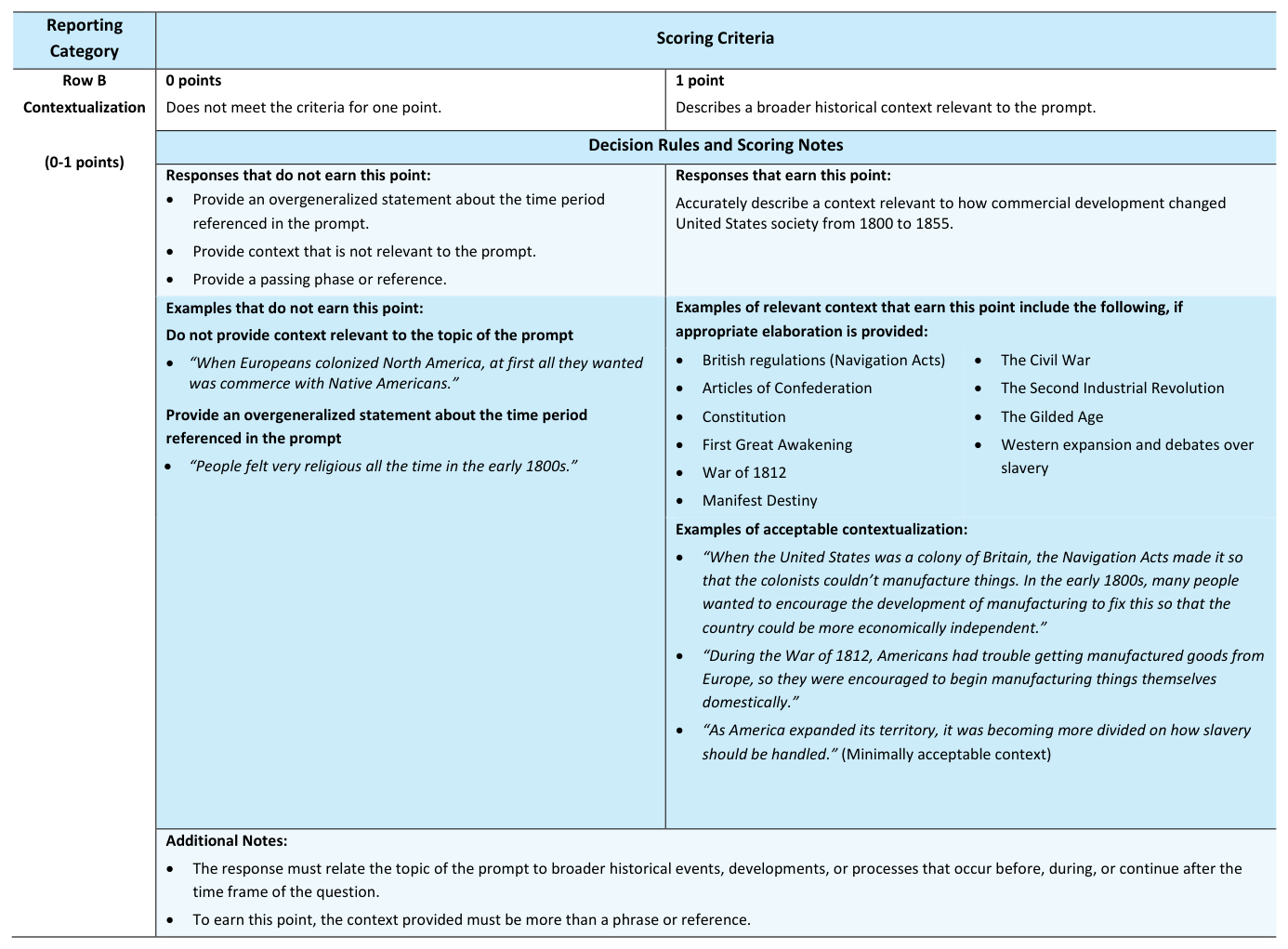
| Skill 4: Contextualization | Connects a development to broader regional, national, or global circumstances |
| Skill 5: Making Connections | Explains relationships among historical developments |
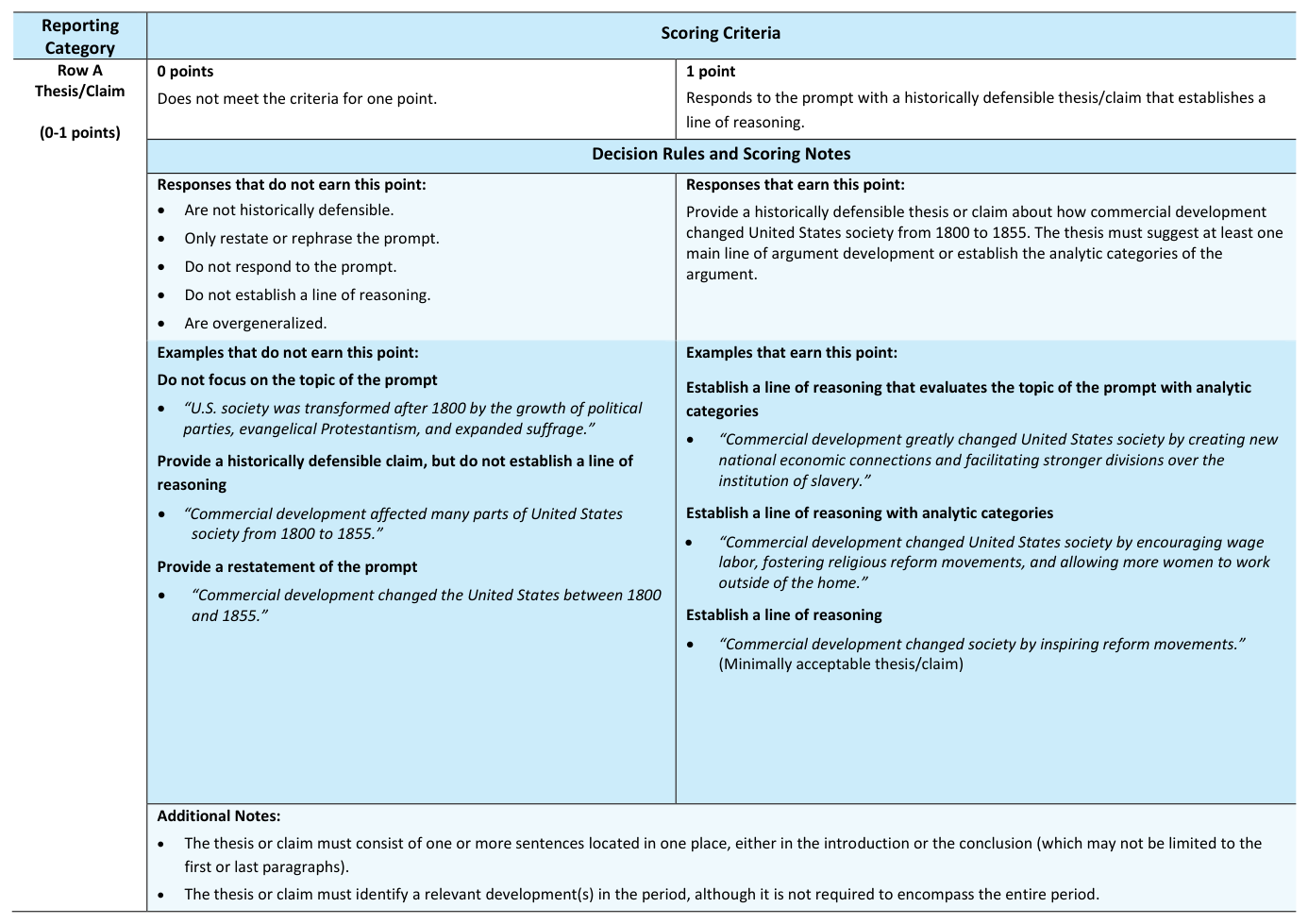
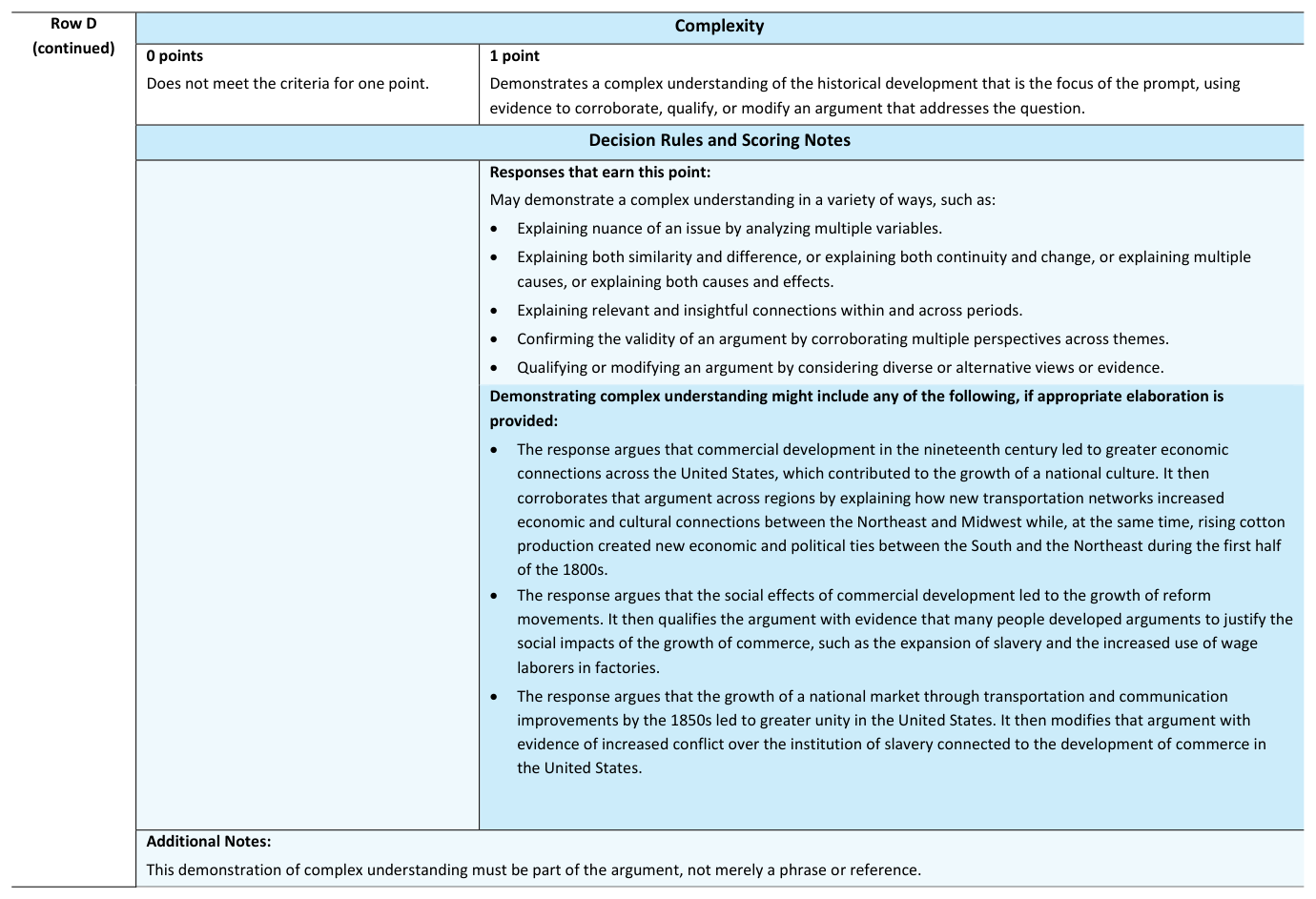
| Skill 6: Argumentation | Constructs a historically defensible argument using evidence and reasoning |
How historical thinking works
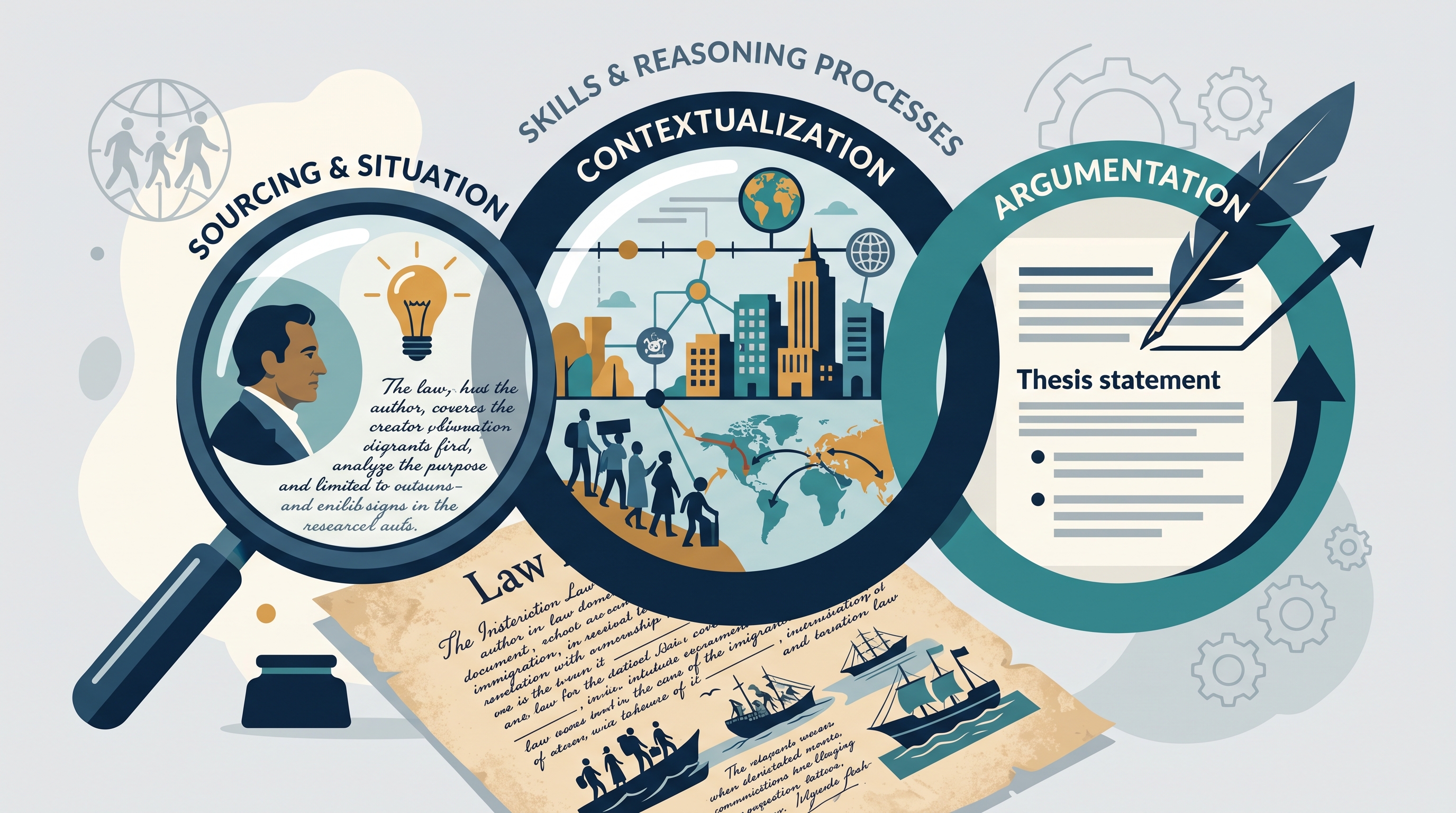
These skills operate as a chain rather than as separate tricks. Suppose a student reads a colonial law regulating labor. Skill 2: Sourcing and Situation asks who issued it, when, for what purpose, and for which audience. Skill 3: Claims and Evidence in Sources asks what the law reveals—and what it cannot reveal—about labor conditions. Skill 4: Contextualization places the law within imperial expansion, Indigenous dispossession, and labor demand. Skill 5: Making Connections links it to later racial and economic hierarchies. Skill 6: Argumentation turns those observations into a claim supported by precise evidence.
Worked example: A student examining the Declaration of Independence should not merely identify its date, $1776$. The student can explain how Enlightenment ideas and imperial disputes provide context; analyze the document’s purpose in justifying separation; identify its language about equality as evidence of revolutionary ideals; and connect those ideals to later debates over slavery, women’s rights, and civil rights. The argument becomes stronger when it distinguishes the document’s universal language from the unequal society in which it was written.
Founding documents as historical evidence
The Declaration of Independence, Constitution, Bill of Rights, and Federalist Papers deserve sustained attention because their ideas and debates influenced pivotal moments throughout American history. “Command” of these documents means more than recalling their provisions: students should recognize arguments, identify tensions, and trace how later Americans invoked, contested, or reinterpreted them.
A common misconception is that founding documents express a single, settled national meaning. In reality, they contain competing principles and emerged from conflict. The Constitution, for example, created a stronger national government while leaving major questions—including the status of slavery and the balance between federal and state authority—to ongoing political struggle.
Misconception check: A founding document is not automatically a neutral description of society. It is also an argument produced by particular people, for particular purposes, in a particular historical situation.
Evidence, perspectives, and written argument
Students are expected to analyze a wide array of historical evidence and perspectives, including voices that differ by region, race, gender, class, political position, and relationship to power. Diverse evidence makes historical reasoning more accurate: a government report may reveal official policy, while a personal letter, protest song, oral testimony, image, or newspaper may expose experiences and criticisms that policy documents omit.
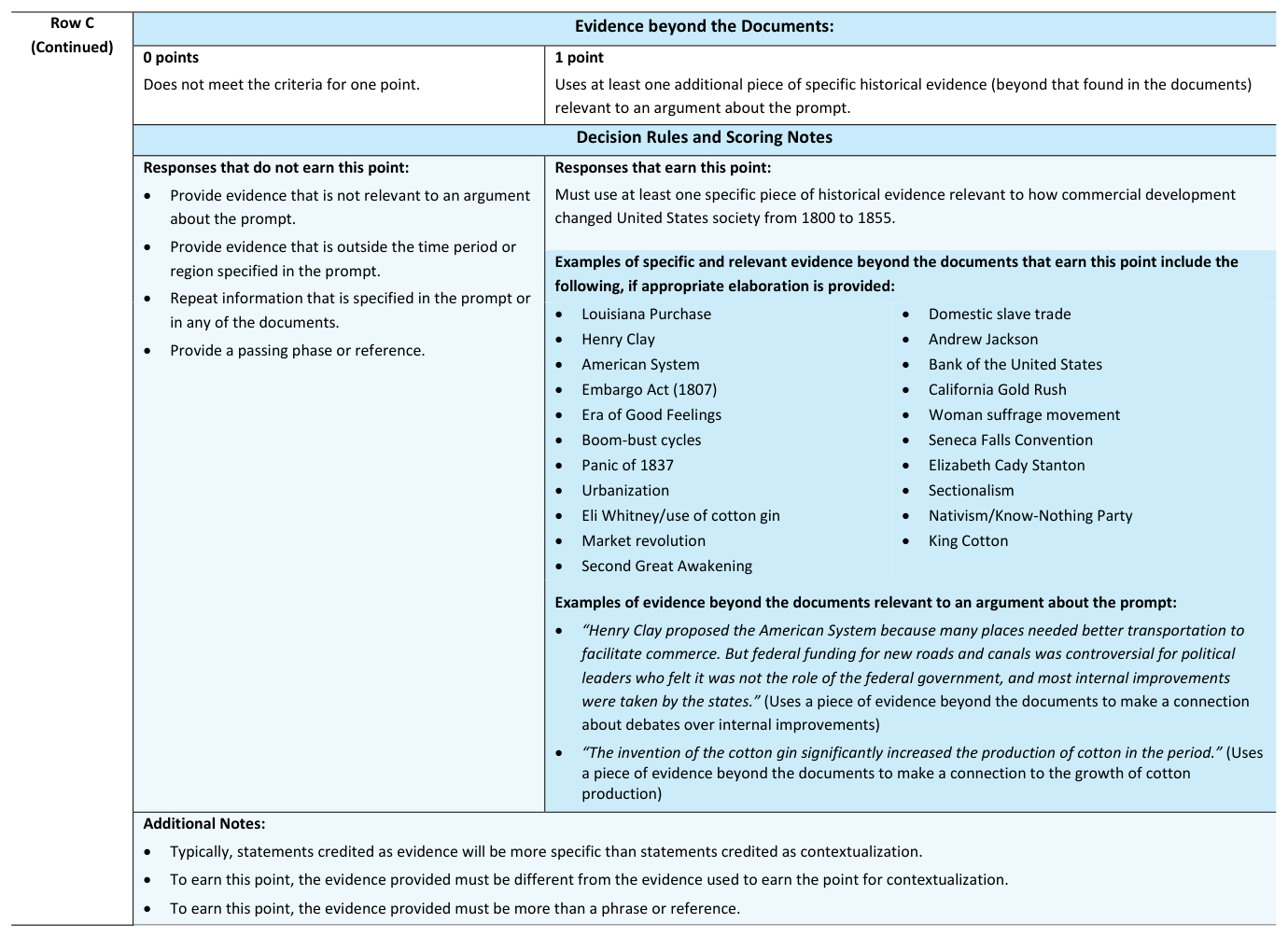
On the AP U.S. History Exam, students read and analyze primary and secondary sources, draw evidence from them, and connect that evidence to their own historical knowledge. The skills therefore appear across multiple task types: selected-response questions test interpretation and connections; short-answer questions require concise evidence-based reasoning; and extended writing asks students to contextualize, use evidence, and construct an argument.
Retrieval check
A law is passed during a period of intense immigration. Name the skill that asks you to examine the law’s author and purpose, the skill that places it in broader circumstances, and the skill that turns your interpretation into a defensible written claim. Answer: Skill 2: Sourcing and Situation, Skill 4: Contextualization, and Skill 6: Argumentation.
Source Materials
- AP U.S. History Course and Exam Description
- AP U.S. History Course and Exam Description Clarifications and Corrections
- AP U.S. History Course Overview
- AP U.S. History Course at a Glance
- AP United States History Course at a Glance Poster
- AP United States History
- AP United States History
- AP United States History Sample Syllabus 1
- © 2023 College Board
- © 2023 College Board
- © 2023 College Board
- © 2023 College Board