From the free course AP United States History on Lykke
5.3 The Mexican–American War · 5.4 The Compromise of 1850
Key concepts: Mexican–American War · Compromise of 1850 · Tallmadge amendment · Slavery in the territories · Regional differences over slavery · Federal government intervention in slavery disputes · Indigenous peoples and Mexican Americans in newly acquired lands · Arguments for and against compromise · Immigration and opportunities and hardships for recent immigrants · Connections between the Mexican–American War and the Civil War
The Mexican–American War did more than redraw the map: it forced the United States to answer an explosive question—when the nation acquires new territory, who decides whether slavery may enter it?
5.3 The Mexican–American War · 5.4 The Compromise of 1850
The Mexican–American War did more than redraw the map: it forced the United States to answer an explosive question—when the nation acquires new territory, who decides whether slavery may enter it? Victory over Mexico created the Mexican Cession, a vast region that included present-day California, Nevada, Utah, and parts of several other western states. Expansion enlarged the nation while making sectional conflict harder to contain.
Unit 5: Learning Objective C: Explain the causes and effects of the Mexican–American War.
Unit 5: Learning Objective D: Explain the similarities and differences in how regional attitudes affected federal policy in the period after the Mexican–American War.
Expansion creates a political crisis
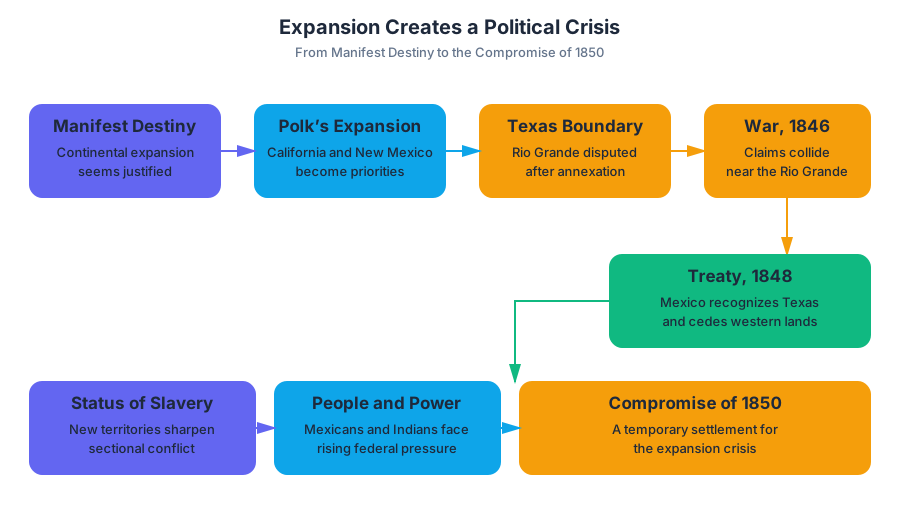
The war grew from the expansionist vision often called Manifest Destiny—the belief that the United States should extend across the continent. President James K. Polk supported acquiring California and New Mexico, while disputes over the Texas–Mexico boundary intensified after Texas joined the Union. Fighting began in 1846 after U.S. and Mexican claims collided near the Rio Grande.
The Treaty of Guadalupe Hidalgo ended the war in 1848. Mexico recognized the Rio Grande as the boundary of Texas and ceded a large western territory to the United States. Under KC-5.1.I.C, this expansion raised questions about the status of slavery, American Indians, and Mexicans in lands newly controlled by the United States. Under KC-5.1.II.C, federal interaction and conflict with Mexican Americans and American Indians increased, threatening established economic practices, political authority, and cultural independence.
The Wilmot Proviso and the Tallmadge amendment
The central dispute was whether Congress could prohibit slavery in the territories gained from Mexico. Representative David Wilmot proposed the Wilmot Proviso, which sought to ban slavery in any territory acquired from Mexico. It passed the House of Representatives but failed in the Senate, where southern senators had greater ability to block it.
The earlier Tallmadge amendment provides an important comparison. In 1819, Representative James Tallmadge proposed limiting slavery in Missouri by prohibiting the further introduction of enslaved people and requiring gradual emancipation for children born there. Southern opposition defeated the proposal, but the debate helped produce the Missouri Compromise. Both the Tallmadge amendment and the Wilmot Proviso show Congress becoming the battlefield for disputes over slavery’s expansion.
Misconception check: The Wilmot Proviso did not end slavery in the South. It concerned slavery’s expansion into territory acquired from Mexico. The distinction between existing slavery and slavery in the territories is essential.
Regional positions: three different answers
Northern opinion was not completely uniform, but many northerners opposed the expansion of slavery because they feared the political power of slaveholders and competition from enslaved labor. The Free Soil position emphasized keeping western territories available for free white labor, even when it did not demand immediate abolition in the states where slavery already existed.
Southern leaders generally argued that enslaved people were property protected by the Constitution and that Congress should not discriminate against slaveholders who carried that property into the territories. Some demanded federal protection for slavery; others defended the principle that territorial settlers should decide the issue themselves.
A third position favored popular sovereignty, meaning that residents of a territory—not Congress—would determine whether slavery was legal. Senator Lewis Cass promoted this approach, which appeared democratic but postponed rather than solved the conflict. The question remained: Who counts as the legitimate political community, and whose freedom or property receives federal protection?
The Compromise of 1850
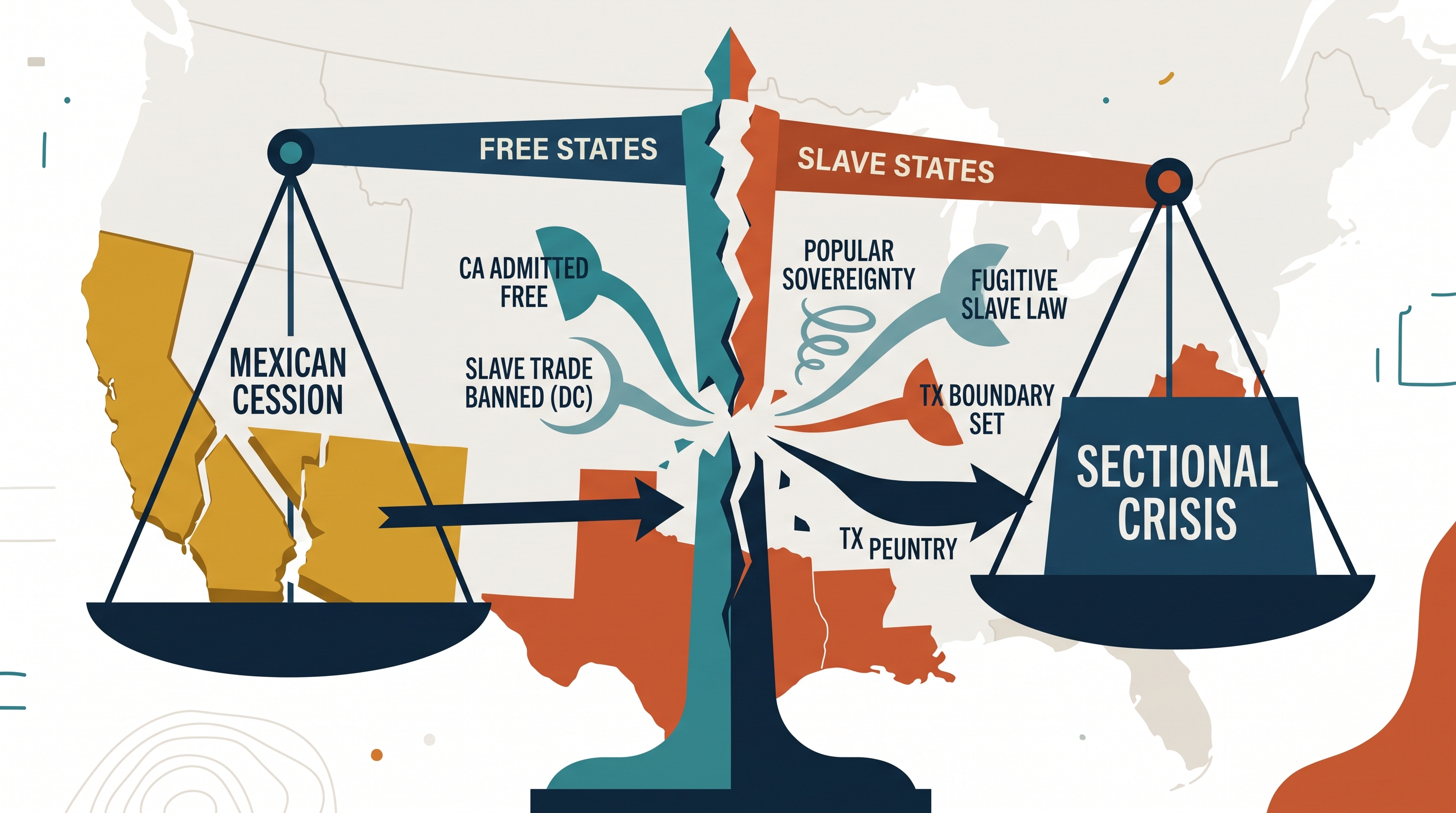
The discovery of gold accelerated California’s population growth, and California requested admission as a free state. This threatened the previous sectional balance in the Senate. Senator Henry Clay proposed a package of measures, later shaped through the work of Stephen Douglas, that became the Compromise of 1850.
| Provision | Immediate effect |
|---|---|
| California entered as a free state | Increased the number of free states |
| Utah and New Mexico territories used popular sovereignty | Territorial residents would decide slavery |
| Texas surrendered disputed western land | The federal government assumed Texas’s debts |
| The slave trade ended in Washington, D.C. | Buying and selling enslaved people ended in the capital, although slavery remained |
| Fugitive Slave Act strengthened | Federal enforcement required the return of alleged escapees |
The compromise temporarily reduced congressional conflict, but it satisfied neither section completely. Northerners objected to the Fugitive Slave Act, while many southerners believed popular sovereignty offered insufficient protection. Under KC-5.2.II.A, the Mexican Cession produced heated controversy over slavery in the territories. Under KC-5.2.II.B.i, the Compromise represents one of several attempts by courts and national leaders to resolve that controversy through federal policy.
Worked comparison: explaining causation
Suppose an argument claims: The Mexican–American War intensified sectional conflict because territorial expansion made slavery an immediate national issue. Build the reasoning in three steps:
- Development: The war produced the Mexican Cession.
- Political problem: Americans disagreed over whether slavery could enter the new territories.
- Policy response: Congress debated the Wilmot Proviso and eventually adopted the Compromise of 1850.
The argument is stronger when it includes both similarity and difference: the Tallmadge amendment and Wilmot Proviso each used congressional power to restrict slavery’s expansion, whereas popular sovereignty attempted to transfer the decision to territorial settlers.
AP historical thinking skills
This topic most directly develops Skill 4.A: Identify and describe a historical context for a specific historical development or process and Skill 4.B: Explain how a specific historical development or process is situated within a broader historical context. The Mexican–American War must be placed within Manifest Destiny, Texas annexation, and sectional arguments over slavery.
It also develops Skill 5.A: Identify patterns or trends in historical development and Skill 5.B: Explain how a historical development relates to another historical development. The pattern is repeated federal intervention—Tallmadge amendment, Missouri Compromise, Wilmot Proviso, and Compromise of 1850—as national leaders repeatedly tried to manage the territorial expansion of slavery. For comparison, use Skill 5.C: Explain how a historical development relates to another historical development, distinguishing what each policy attempted and why each left unresolved tensions.
Retrieval check
Answer without looking back: Why did the Mexican Cession create a more serious sectional crisis than earlier western expansion? Then identify one provision of the Compromise of 1850 that favored northern interests, one that favored southern interests, and one that attempted to avoid choosing between them. A complete answer should connect territorial expansion to the federal government’s growing role in slavery disputes.
Source Materials
- AP U.S. History Course and Exam Description
- AP U.S. History Course and Exam Description Clarifications and Corrections
- AP U.S. History Course Overview
- AP U.S. History Course at a Glance
- AP United States History Course at a Glance Poster
- AP United States History
- AP United States History
- AP United States History Sample Syllabus 1