From the free course AP United States History on Lykke
7.9 The Great Depression · 7.10 The New Deal
Key concepts: Great Depression · Franklin Delano Roosevelt’s New Deal · Relief, recovery, and reform · Federal financial regulation · Glass–Steagall Act · Limited welfare state · Political realignment toward the Democratic Party · Civilian Conservation Corps and youth employment · Mary McLeod Bethune and the National Youth Administration · Political conflict over the scope of the New Deal
How much power should the federal government use when private markets fail? The Great Depression transformed that question from a constitutional argument into an urgent human crisis, and Franklin Delano Roosevelt’s New Deal answered it with three linked goals: relief for suffering people, recovery for the collapsed…
7.9 The Great Depression · 7.10 The New Deal
How much power should the federal government use when private markets fail? The Great Depression transformed that question from a constitutional argument into an urgent human crisis, and Franklin Delano Roosevelt’s New Deal answered it with three linked goals: relief for suffering people, recovery for the collapsed economy, and reform to prevent another breakdown.
KC-7.1.III.A: Franklin Roosevelt’s New Deal attempted to end the Great Depression by using government power to provide relief to the poor, stimulate recovery, and reform the American economy.
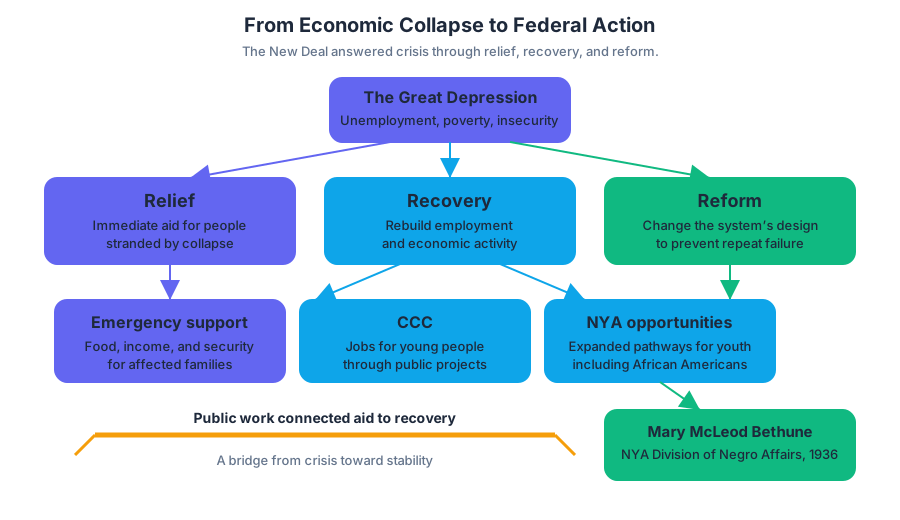
From economic collapse to federal action
The Depression created mass unemployment, poverty, and insecurity. A useful way to distinguish the New Deal’s purposes is to imagine a damaged bridge: relief gives immediate aid to people stranded by the collapse; recovery tries to rebuild traffic and employment; reform changes the bridge’s design so the same failure is less likely to happen again.
The Civilian Conservation Corps (CCC) illustrated relief and recovery together by providing employment and public-service opportunities for young people. Workers received jobs connected to environmental and infrastructure projects rather than simply receiving private charity. The National Youth Administration similarly sought to expand opportunities for youth, including African Americans; Mary McLeod Bethune’s appointment in 1936 as director of its Division of Negro Affairs demonstrated that Black leadership could operate within New Deal institutions.
Reform and financial regulation
The Glass–Steagall Act, formally part of the Banking Act of 1933, represented the reform side of the New Deal. Passed after the stock-market crash that helped bring on the Great Depression, it strengthened federal regulation of banking and sought to reduce dangerous financial practices. Its significance was not merely technical: it showed the federal government accepting responsibility for supervising a financial system that many Americans no longer trusted to regulate itself.
The New Deal therefore created a limited welfare state—a political system in which the federal government accepts continuing responsibility for aspects of citizens’ economic and social well-being. “Limited” matters: the United States did not become a fully government-managed economy, and New Deal programs did not eliminate poverty or guarantee equal benefits to every group. They did, however, permanently expand expectations about what Washington should do during economic emergencies.
Pressure from the left and resistance from the right
Roosevelt did not act in a political vacuum. Radical, union, and populist movements pushed him toward more extensive efforts to change the economic system. Their pressure helped make labor rights, social welfare, and stronger economic regulation politically unavoidable.
KC-7.1.III.B: Radical, union, and populist movements pushed Roosevelt toward more extensive efforts to change the American economic system, while conservatives in Congress and the Supreme Court sought to limit the New Deal’s scope.
Conservatives in Congress and the Supreme Court resisted this expansion of federal power. In Schechter Poultry Corp. v. United States in 1935, the Supreme Court found portions of the National Industrial Recovery Act unconstitutional, limiting the administration’s ability to regulate the economy through broad national codes. Conservative opposition, expressed in congressional debates and documents such as the 1937 Conservative Manifesto, argued that the New Deal threatened private enterprise, constitutional limits, and individual liberty.
Political realignment and the New Deal coalition
The New Deal also changed party politics. A political realignment is a durable shift in the groups that identify with and support a political party. As federal programs offered jobs, assistance, labor protections, and a greater voice in national policy, many working-class communities, ethnic groups, and African American voters increasingly identified with the Democratic Party.
This shift did not mean that every New Deal program treated African Americans equally, nor that all Black voters immediately abandoned the Republicans, the party historically associated with emancipation. It meant that practical experience with federal action increasingly altered political loyalties. Bethune’s role in the National Youth Administration illustrates this change: African Americans were not simply recipients of policy but also participants in shaping its administration. The resulting New Deal coalition became a major Democratic alliance of workers, urban voters, ethnic communities, and many African Americans.
KC-7.1.III.C: Although the New Deal did not end the Depression, it left a legacy of reforms and regulatory agencies and fostered a long-term political realignment in which many ethnic groups, African Americans, and working-class communities identified with the Democratic Party.
The crucial evaluation: reform is not the same as recovery
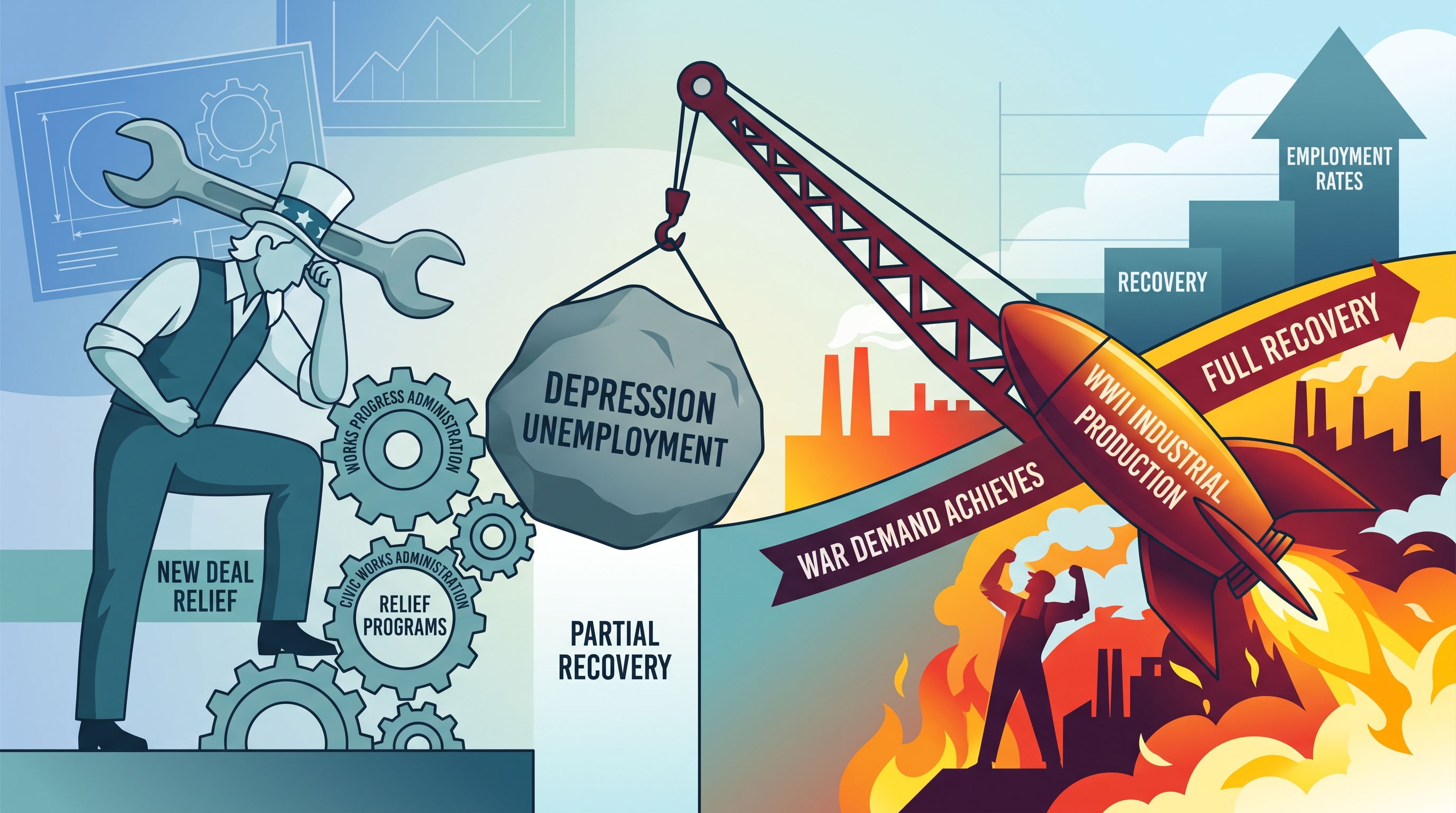
A common misconception is that the New Deal ended the Great Depression. The more precise conclusion is that it provided substantial relief, expanded federal responsibility, and produced lasting reforms, but it did not fully restore the economy. The economic recovery associated with the end of the Depression is a distinct historical development tied to the increased demand for war production and labor during World War II.
This distinction is an example of Skill 5.B: Making Connections—explaining how one historical development or process relates to another. New Deal programs changed the relationship between citizens and the federal government; wartime production later transformed employment and industrial demand. The first development helped reshape American government, while the second supplied the economic force that finally ended Depression-era mass unemployment.
Retrieval check: Classify each development as primarily relief, recovery, reform, political realignment, or a connection to wartime recovery: the CCC, the Glass–Steagall Act, Bethune’s NYA appointment, the Democratic shift among many African American voters, and wartime labor demand. Then explain in one sentence why “the New Deal ended the Depression” is an incomplete claim.
Source Materials
- AP U.S. History Course and Exam Description
- AP U.S. History Course and Exam Description Clarifications and Corrections
- AP U.S. History Course Overview
- AP U.S. History Course at a Glance
- AP United States History Course at a Glance Poster
- AP United States History
- AP United States History
- AP United States History Sample Syllabus 1
- Figure — Free-Response Questions - Set 1 (p. 9)
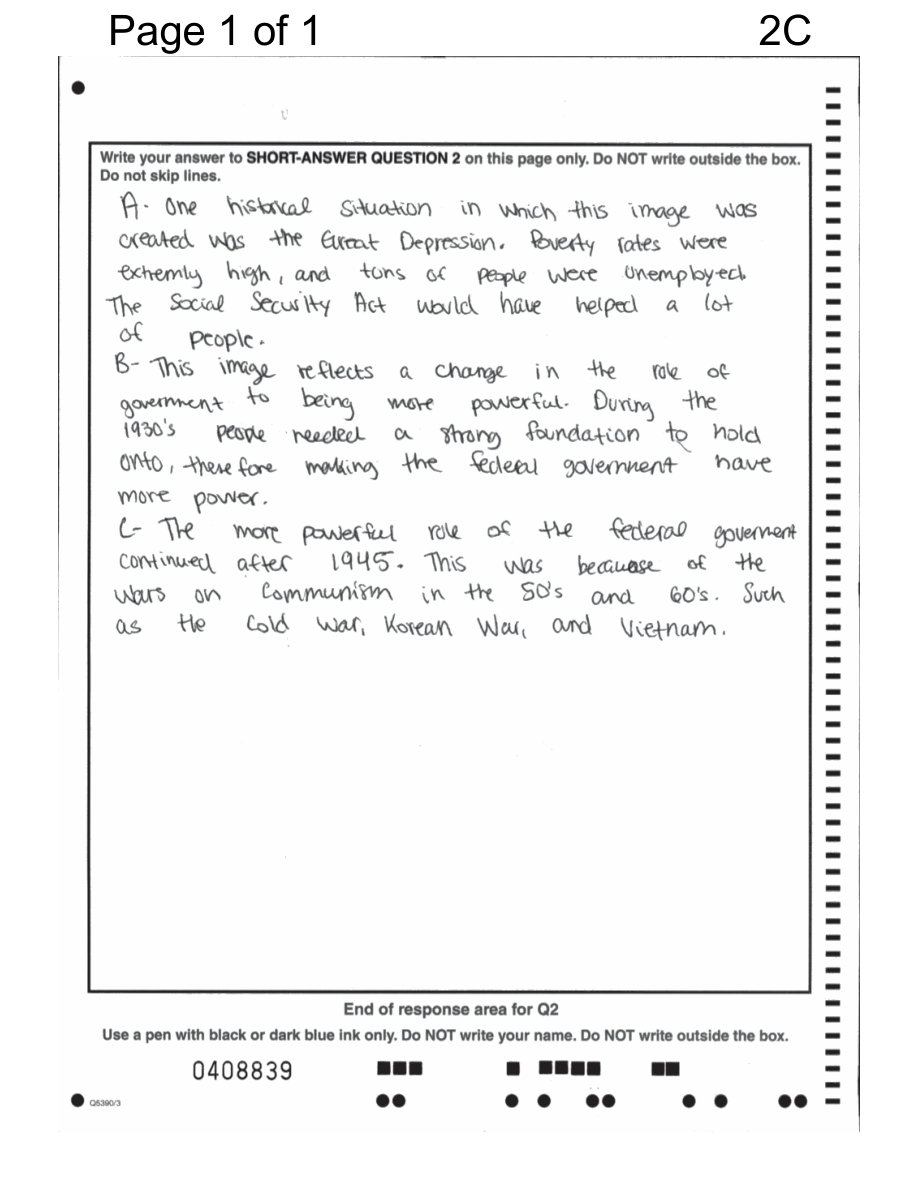
- Figure — Sample Responses - SAQ 2 - Set 1 (p. 4)
- Figure — Sample Responses - SAQ 2 - Set 1 (p. 5)
- Figure — Sample Responses - SAQ 2 - Set 1 (p. 6)