From the free course AP United States History on Lykke
7.5 World War I: Military and Diplomacy · 7.6 World War I: Home Front
World War I transformed the United States from a powerful nation watching Europe’s crisis from across the Atlantic into a combatant claiming a responsibility to reshape world politics.
7.5 World War I: Military and Diplomacy · 7.6 World War I: Home Front
World War I transformed the United States from a powerful nation watching Europe’s crisis from across the Atlantic into a combatant claiming a responsibility to reshape world politics. The central tension was immediate: could the United States defend democratic and humanitarian principles abroad without abandoning its long-standing tradition of avoiding European power struggles at home?
7.5 World War I: Military and Diplomacy
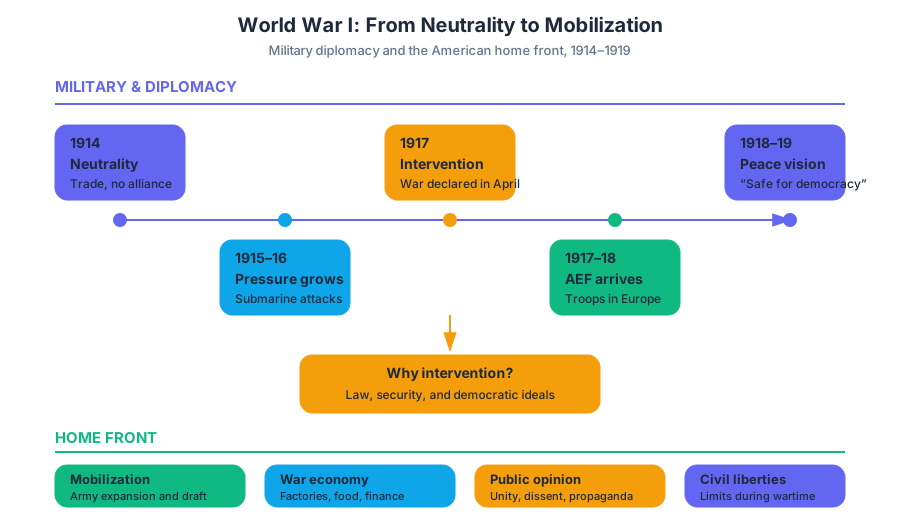
When war began in Europe in 1914, President Woodrow Wilson declared American neutrality. Neutrality meant more than refusing to send troops: the United States attempted to trade with countries on both sides while avoiding formal commitment to either alliance. This policy reflected the older tradition of noninvolvement in European affairs, even though American commerce and public opinion increasingly connected the nation to the conflict.
KC-7.3.II.A: After initial neutrality in World War I, the nation entered the conflict in response to Woodrow Wilson’s call for the defense of humanitarian and democratic principles.
The position became increasingly difficult to sustain. Germany’s unrestricted submarine warfare threatened neutral shipping and civilian lives, while the Zimmermann Telegram revealed a German proposal for an alliance with Mexico against the United States. In April 1917, Wilson asked Congress for a declaration of war. His justification emphasized defending international law, democracy, and a world order “safe for democracy,” rather than acquiring territory.
Worked contextual example — from neutrality to intervention: A historian comparing 1914 and 1917 should identify both continuity and change. Continuity lay in the desire to avoid traditional European balance-of-power politics. Change lay in the growing belief that submarine attacks, economic ties, and democratic ideals made European events directly relevant to American security and moral responsibility. The best causal explanation connects German actions to Wilson’s broader diplomatic vision rather than treating the declaration of war as a single-cause reaction.
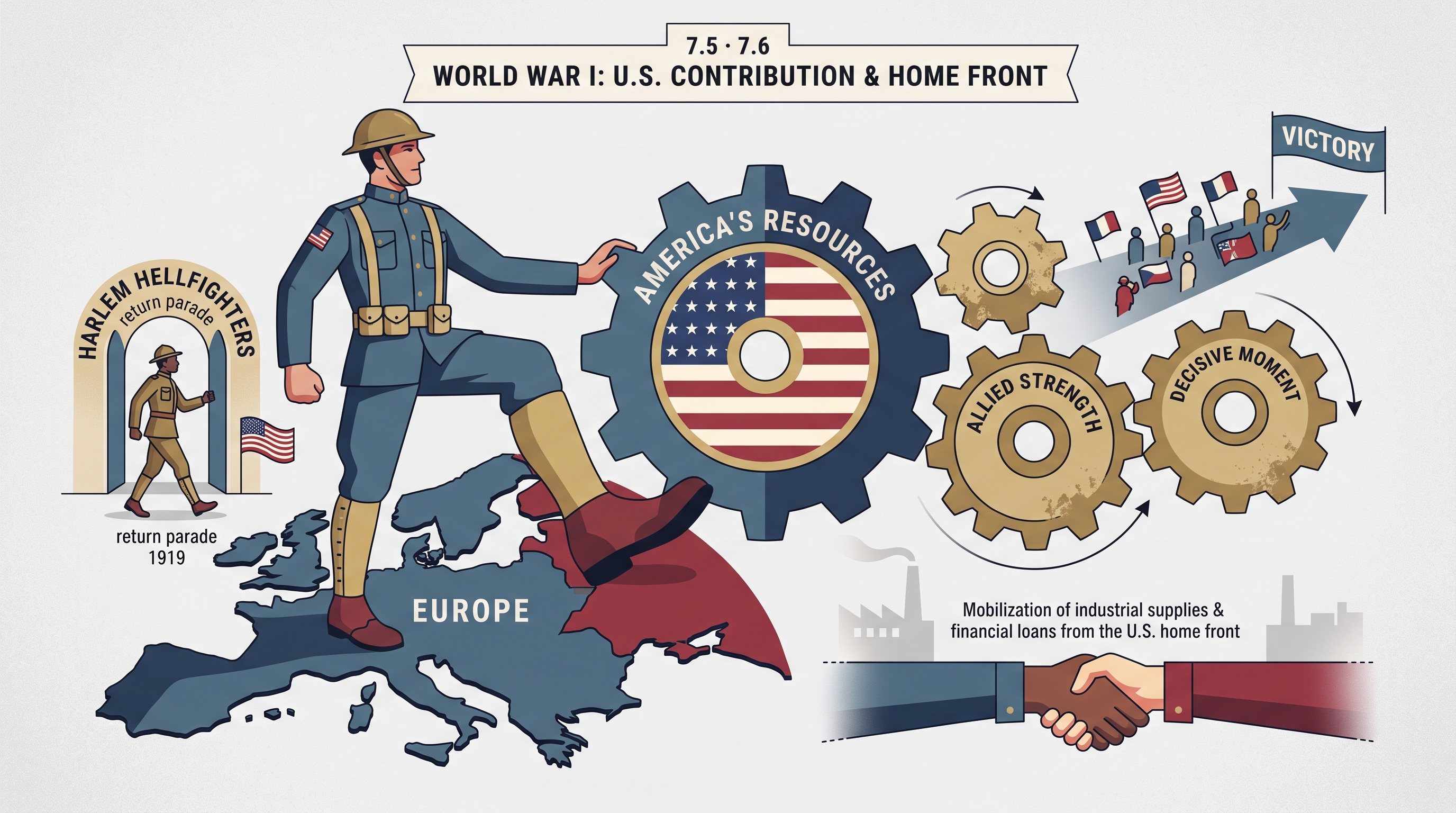
The American Expeditionary Forces, or AEF, were the U.S. military forces sent to Europe under General John J. Pershing. American participation was relatively brief compared with the years of fighting endured by European armies, and the AEF did not single-handedly win the war. Nevertheless, fresh American troops, industrial supplies, loans, and transportation strengthened the exhausted Allies at a decisive moment.
KC-7.3.II.B: Although the American Expeditionary Forces played a relatively limited role in combat, American troops and resources affected the outcome of the war.
The Meuse-Argonne Offensive demonstrates the scale of that contribution. Fought from September 26 to November 11, 1918, it became the final major Allied offensive and the largest AEF operation. Nearly one million American soldiers participated. African American soldiers also served, including the 369th Infantry Regiment, later known as the Harlem Hellfighters, whose wartime service and 1919 return parade exposed the contradiction between fighting for democracy overseas and facing racial inequality in the United States.
7.6 World War I: Home Front
War required mobilization: the government coordinated factories, transportation, food production, military recruitment, and public opinion. Agencies such as the War Industries Board encouraged industrial production, while the Food Administration promoted conservation. Liberty Bond campaigns asked civilians to finance the war, and posters, films, and speeches presented military participation as a patriotic duty.
Mobilization expanded some opportunities but restricted civil liberties. The government used the Espionage Act of 1917 and Sedition Act of 1918 to punish interference with the war effort and harsh criticism of government policy. Socialist and labor activist Emma Goldman became a prominent target; her opposition to conscription contributed to her arrest and eventual deportation to Russia.
KC-7.2.I.C: Wartime repression of radicalism helped produce the postwar Red Scare.
The home front also accelerated migration. Wartime industrial labor shortages encouraged African Americans to leave the South for jobs in northern and western cities, beginning the Great Migration. The Chicago Defender helped publicize these opportunities, while migrant letters reveal both the attraction of factory employment and the continuing danger of racial discrimination.
KC-7.2.II.B.i: Economic opportunities in urban areas encouraged migration to cities such as Chicago and Los Angeles.
KC-7.2.II.C: African Americans found new opportunities in the North and West, although migration did not eliminate racism or segregation.
Skill 5.A — Making Connections: Identify patterns among or connections between historical developments and processes. The most important connection in these topics is that foreign policy and domestic change moved together. The war increased federal power, stimulated industrial production, encouraged the Great Migration, and intensified debates over free speech. A strong AP response does not list these developments separately; it explains how wartime demands produced them.
Misconception check
Misconception: “The United States entered World War I only because Germany attacked it.” German submarine warfare was crucial, but the decision also involved economic ties, the Zimmermann Telegram, Wilson’s interpretation of democratic responsibility, and the collapse of neutrality as a workable policy. A second misconception is that the war immediately created racial equality: African American military service and migration produced claims for citizenship and opportunity, but discrimination remained deeply entrenched.
Retrieval check
- Why did Wilson present intervention as a defense of democracy rather than an effort to gain territory?
- How did the AEF contribute despite its relatively limited combat role?
- Explain one connection between wartime mobilization and the Great Migration.
- Why did World War I produce both expanded opportunity and reduced civil liberties?
Source Materials
- AP U.S. History Course and Exam Description
- AP U.S. History Course and Exam Description Clarifications and Corrections
- AP U.S. History Course Overview
- AP U.S. History Course at a Glance
- AP United States History Course at a Glance Poster
- AP United States History
- AP United States History
- AP United States History Sample Syllabus 1