From the free course AP United States History on Lykke
1.5 Labor, Slavery, and Caste in the Spanish Colonial System · 1.6 Cultural Interactions Between Europeans, Native Americans, and Africans
Explain and apply 1.5 Labor, Slavery, and Caste in the Spanish Colonial System · 1.6 Cultural Interactions Between Europeans, Native Americans, and Africans.
1.5 Labor, Slavery, and Caste in the Spanish Colonial System · 1.6 Cultural Interactions Between Europeans, Native Americans, and Africans
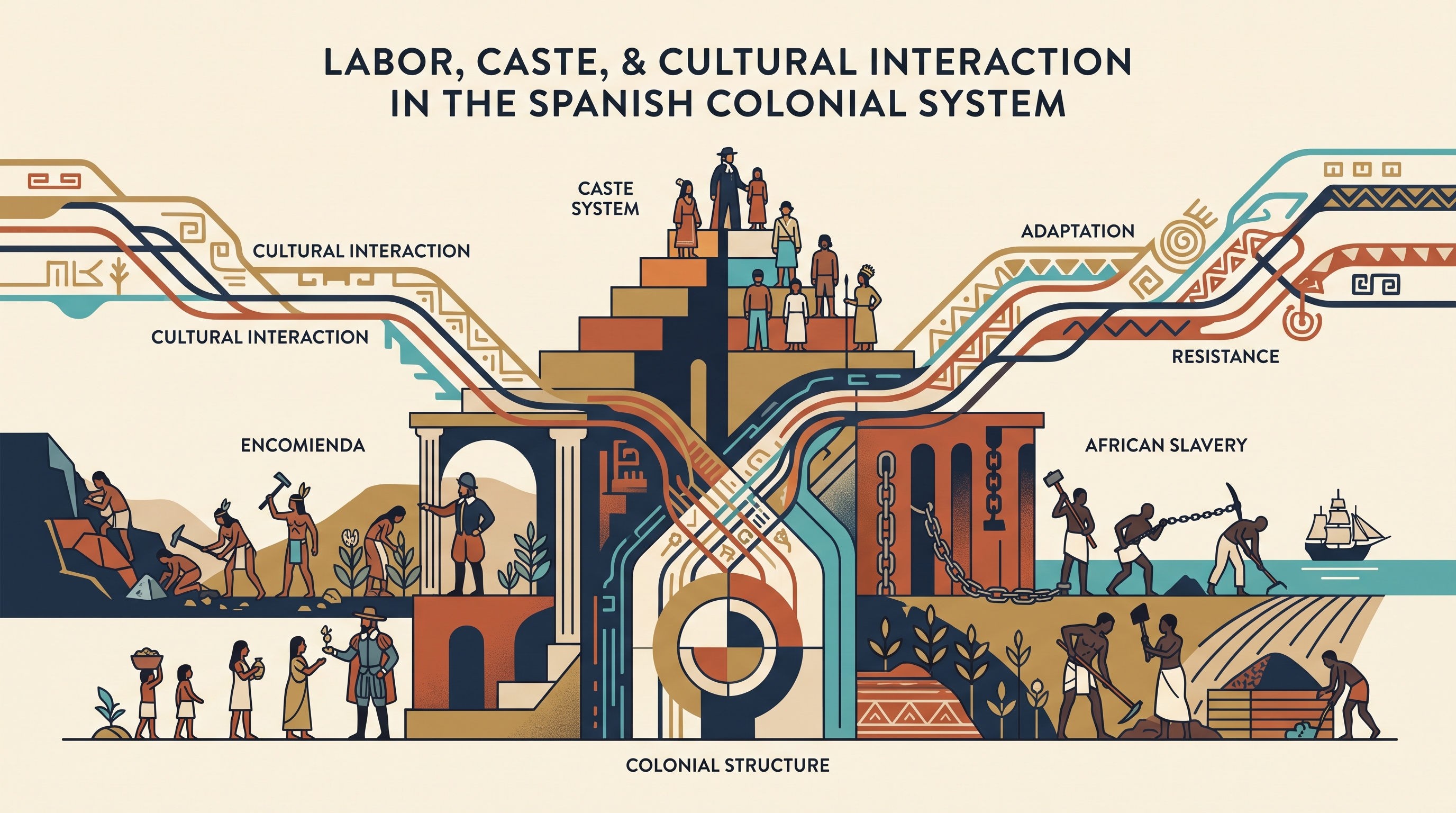
Spanish colonial society rested on a deliberate chain: labor extraction created wealth, wealth sustained empire, and racial classification organized the people forced to produce it. The result was not a simple Spanish-versus-Native American society, but a layered colonial world involving Europeans, Native Americans, and Africans.
The labor system: encomienda and exploitation
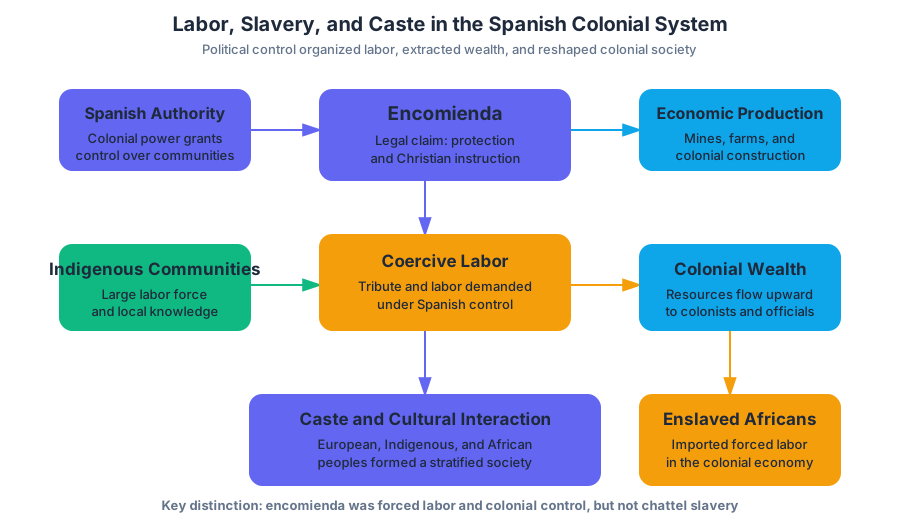
The encomienda system granted Spanish colonists authority over specified Native American communities. In theory, the encomendero—the holder of the grant—was supposed to protect Indigenous people and provide Christian instruction. In practice, the system frequently demanded tribute and labor in agriculture, mining, and construction under coercive conditions.
Key idea: The encomienda system was not the same as chattel slavery, but it subjected Native Americans to forced labor and placed them under Spanish colonial control.
The system connected political power to economic production. Spanish authorities and colonists needed workers for mines and plantations; Indigenous communities possessed local knowledge and represented a large labor force; colonial officials therefore organized Native labor into a structure that claimed legal justification while extracting wealth.
Essential Knowledge KC-1.2.II.C identifies the Spanish colonial society’s use of forced labor, including the encomienda system, and the importation of enslaved Africans. This distinction matters: Spanish expansion depended not only on conquest, but also on institutions that converted conquered populations into laborers.
African slavery and Atlantic labor
As Indigenous populations declined because of epidemic disease, warfare, and harsh labor conditions, Spanish colonists increasingly imported enslaved Africans. Spanish involvement also intersected with West African groups that practiced slavery and with the wider Atlantic trade that forcibly transported Africans to the Americas.
Enslaved Africans were used in plantation agriculture, mining, domestic service, and other forms of labor. Their presence was therefore structural rather than incidental: African labor helped sustain the imperial economy alongside Indigenous labor.
Worked example: Imagine a silver-mining region in Spanish America. The mine requires a large, disciplined workforce. Spanish authorities first compel nearby Native communities to provide labor or tribute through systems related to the encomienda. If the Indigenous workforce becomes smaller or harder to control, colonists purchase or transport enslaved Africans. The mine’s production thus reflects a sequence of conquest, forced labor, demographic crisis, and racialized Atlantic slavery.
Misconception check — “Spanish colonial slavery was only Indigenous.” This is incorrect. Spanish colonization exploited Native American labor and also expanded African slavery. The two systems could operate simultaneously, although their legal categories and social meanings differed.
The caste system: hierarchy made visible
The Spanish developed a caste system, a racialized hierarchy that classified people according to ancestry and place of origin. Europeans occupied the highest positions in colonial society, while Native Americans and Africans faced systematic subordination. People of mixed ancestry occupied intermediate categories whose status could vary according to racial classification, wealth, occupation, and local circumstances.
Essential Knowledge KC-1.2.II.D: The Spanish developed a caste system that incorporated, and carefully defined the status of, the diverse population of Europeans, Africans, and Native Americans in their empire.
The caste system did more than describe difference; it helped distribute privilege. Access to political office, legal treatment, social honor, land, and economic opportunity was shaped by racial identity. In this way, labor exploitation and social hierarchy reinforced one another: those assigned lower status were more vulnerable to coercion, while those at the top benefited from colonial institutions.
Cultural interactions and cultural change
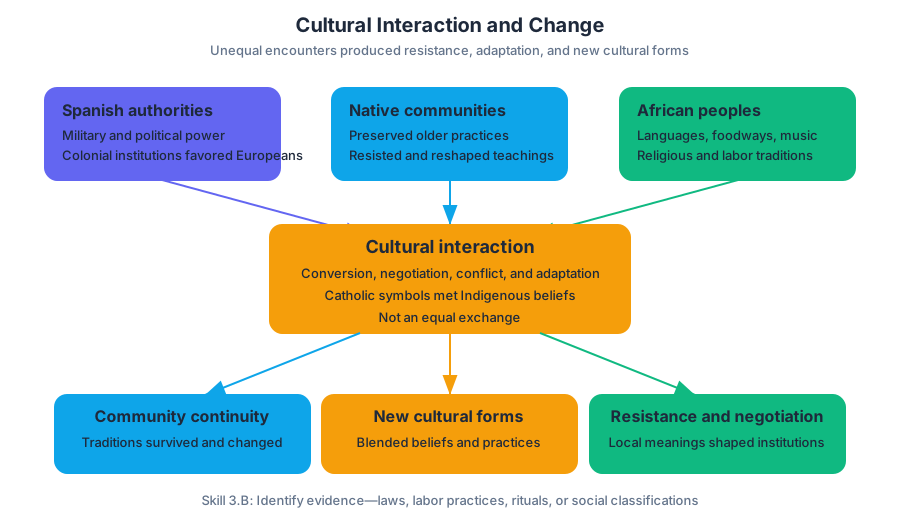
Cultural interaction produced conflict, adaptation, and new cultural forms. Spanish missionaries attempted to convert Native Americans to Catholicism, while Native communities preserved older practices, reshaped Christian teachings, or combined Catholic symbols with Indigenous beliefs. Africans also contributed languages, religious practices, foodways, music, and labor traditions to the societies being formed in the Americas.
These interactions were not equal exchanges. Spanish authorities possessed greater military and political power, and colonial institutions favored Europeans. Yet Native Americans and Africans were not passive recipients of European culture. They resisted coercion, negotiated with colonial authorities, maintained community traditions, and transformed imported institutions into practices with local meanings.
Skill 3.B — Identify the evidence used in a source to support an argument. When analyzing a source about Spanish America, locate the specific evidence the author uses: a law, labor practice, religious ritual, social classification, or testimony. Then explain how that evidence supports an argument about cultural interaction. For example, a source describing Catholic worship alongside Indigenous symbols may support the claim that conversion involved both Spanish pressure and Native adaptation.
Skill 5.A — Identify patterns among or connections between historical developments and processes. A strong connection links labor, demography, and culture: forced Indigenous labor contributed to population decline; population decline encouraged the importation of enslaved Africans; the presence of multiple peoples produced new cultural interactions; and the caste system attempted to control the resulting diversity.
Retrieval check
- How did the encomienda system extract Indigenous labor?
- Why did Spanish colonists import enslaved Africans?
- How did the caste system connect racial identity to power?
- Give one example showing that cultural interaction involved both coercion and adaptation.
A complete answer should connect encomienda, African slavery, and the caste system as parts of one colonial structure, while explaining that Native Americans and Africans shaped colonial culture even under unequal conditions.
Source Materials
- AP U.S. History Course and Exam Description
- AP U.S. History Course and Exam Description Clarifications and Corrections
- AP U.S. History Course Overview
- AP U.S. History Course at a Glance
- AP United States History Course at a Glance Poster
- AP United States History
- AP United States History
- AP United States History Sample Syllabus 1