From the free course AP United States History on Lykke
9.5 Migration and Immigration in the 1990s and 2000s · 9.6 Challenges of the 21st Century
Key concepts: Migration and immigration in the 1990s and 2000s · Challenges of the 21st century · International and domestic challenges after 1980 · Push and pull factors shaping society · Population shifts · The war on terrorism · Civil liberties and human rights · Conflicts in the Middle East · Climate change · U.S. dependence on fossil fuels and environmental impacts of economic consumption
After 1980, migration reshaped the American population while terrorism, energy dependence, climate change, and debates over civil liberties challenged the nation’s understanding of security and freedom.
9.5 Migration and Immigration in the 1990s and 2000s · 9.6 Challenges of the 21st Century
After 1980, migration reshaped the American population while terrorism, energy dependence, climate change, and debates over civil liberties challenged the nation’s understanding of security and freedom. The central question is not simply who moved and why, but how population movement and international crises changed American society and government.
Learning Objective 9.5.A: Explain the causes and effects of domestic and international migration over time.
Essential Knowledge KC-9.5.I: Economic, political, and social factors contributed to migration within and to the United States.
Migration: push, pull, and population change
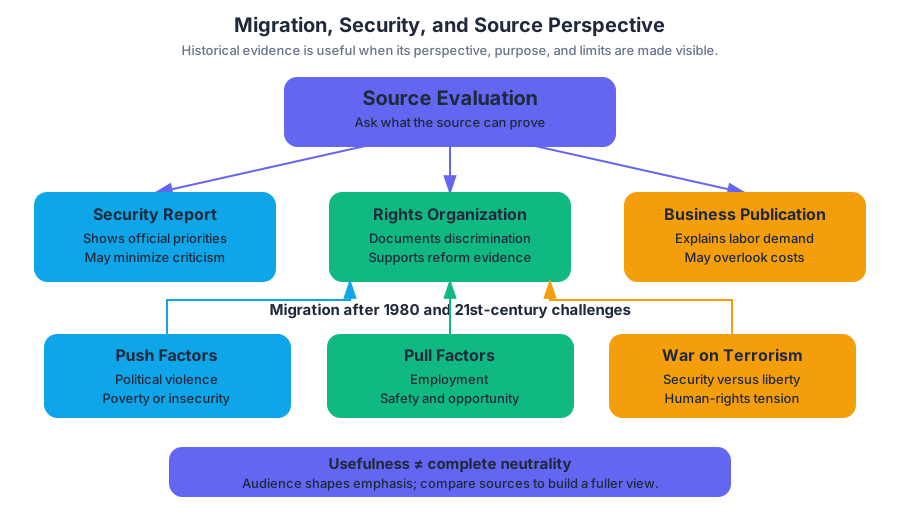
A push factor is a condition that encourages people to leave a place; a pull factor is a condition that attracts people to a new place. In the 1990s and 2000s, migration to the United States reflected both: migrants could be pushed by political instability, violence, poverty, or limited employment and pulled by jobs, education, family reunification, and the expectation of greater security.
The effects were visible in population shifts. Immigration strengthened established communities and expanded new ones, especially in the Southwest, California, Florida, New York, and other metropolitan areas. These changes influenced labor markets, schools, language use, electoral politics, and debates over citizenship and immigration policy.
Worked contextual example: Suppose a manufacturing region loses jobs while a rapidly growing city gains construction and service employment. Workers may move domestically toward the city because employment is a pull factor. At the same time, an immigrant family may move internationally because economic opportunity pulls them toward the United States, while political violence pushes them away from their country of origin. A strong historical explanation connects the movement to both the cause and the effect: migration changes not only where people live but also the social and political concerns of receiving communities.
Misconception check — “Immigration is caused only by poverty.” Poverty can be a push factor, but migration usually has multiple causes. Political conditions, family networks, labor demand, education, war, and legal policy can operate together. Likewise, immigrants did not simply “replace” existing Americans; they entered a society whose economy, culture, and politics were already changing.
The war on terrorism: security versus liberty
The terrorist attacks of September 11, 2001, led the United States to make national security a central domestic and foreign-policy priority. The war on terrorism sought to reduce the danger of terrorist attacks through military action abroad, intelligence gathering, airport and border security, and expanded cooperation among government agencies.
These policies produced a lasting tension. Supporters argued that extraordinary threats required stronger surveillance, detention powers, and preventive measures. Critics warned that such policies could weaken constitutional protections, privacy, due process, and human rights—especially when government action treated broad groups as suspicious rather than focusing on individual evidence.
The historical issue is therefore a conflict between two goals rather than a simple choice between “security” and “freedom.” A policy may improve security in one dimension while creating civil-liberties costs in another. This distinction is essential when evaluating government responses after 2001.
Learning Objective 9.6.A: Explain the causes and effects of the domestic and international challenges the United States has faced in the 21st century.
Essential Knowledge KC-9.6.I: The United States faced international and domestic challenges after 1980.
Energy, climate, and consumption
Conflicts in the Middle East contributed to continuing debates about U.S. dependence on fossil fuels. Because oil was economically important and heavily connected to international politics, instability abroad could raise concerns about energy prices, national security, and the limits of American foreign policy.
At the same time, concerns about climate change focused attention on the environmental effects of economic consumption. Americans debated whether economic growth should depend on high levels of fossil-fuel use and whether the federal government should regulate emissions, promote alternative energy, or leave decisions primarily to markets and individuals.
These debates connected domestic policy to international conditions: energy consumption affected the environment, while foreign conflicts affected the perceived security of energy supplies. The resulting arguments continued older disputes about the proper role of the federal government, but applied them to distinctly twenty-first-century problems.
Source analysis: evidence has limits
Historical Thinking Skill 2.A — Identify a source’s point of view, purpose, historical situation, and/or audience. When analyzing a source about immigration, terrorism, energy, or climate, ask four questions: Who created it? Why? What events shaped it? Who was expected to read or hear it?
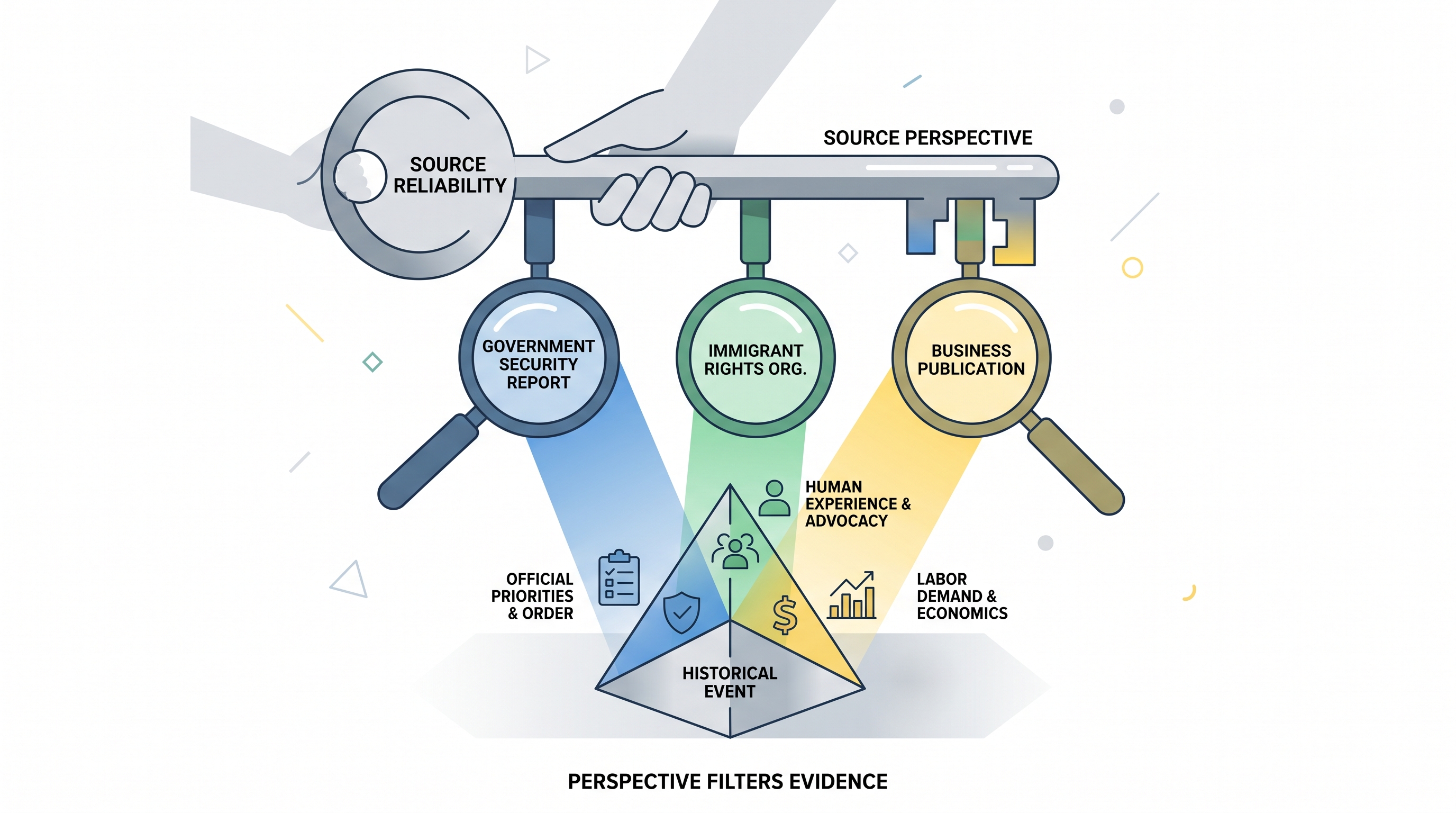
Historical Thinking Skill 2.B — Explain how a source’s point of view, purpose, historical situation, and/or audience may affect the reliability of that source. A government security report may reveal official priorities but minimize criticism. An immigrant-rights organization may document discrimination effectively but emphasize evidence supporting reform. A business publication may explain labor demand while giving less attention to environmental costs.
The key distinction is between usefulness and complete neutrality. A source’s perspective does not automatically make it false; it helps determine what the source can and cannot prove.
Retrieval check: Name one push factor and one pull factor affecting migration after 1980. Then explain one tension created by the war on terrorism. Finally, identify why a source’s audience might limit its usefulness as evidence.
Answer: A push factor could be political violence; a pull factor could be employment. The war on terrorism created tension between improving security and protecting civil liberties and human rights. A source’s audience may shape what its creator emphasizes, so the source may be strong evidence for one perspective but insufficient evidence for the entire historical issue.
Source Materials
- AP U.S. History Course and Exam Description
- AP U.S. History Course and Exam Description Clarifications and Corrections
- AP U.S. History Course Overview
- AP U.S. History Course at a Glance
- AP United States History Course at a Glance Poster
- AP United States History
- AP United States History
- AP United States History Sample Syllabus 1